Google Rep: "You said in the post that quotes don't give exact matches. They really do. Honest.
Me: Google for "quotes don't give": Top result, does not contain the given phrase Second result, does not contain that phrase This is literally the first thing I tried and I did a view source to be sure. They are lying to us and/or themselves. Looking at the result, I would say 1/2 the results don't include that phrase including results for products on Amazon. Clearly Search does not work they way this Google Rep believes it to work.
The difference might be due to Google A/B testing their algorithm. That is, giving users different results for the same query trying to infer which results were preferred based on whatever happens next (user keeps searching, or user goes and stays on some site).
Ignoring full page replacements ('Showing results for "eggzactly that", to see results for "eggzackly that"...) I think this is all just punctuation related.
For instances, on the ["quotes don't give"] example, the first result I get is https://www.goodreads.com/quotes/tag/never-give-up If I do a find-in-page for "quotes don't give", I get zero results. Oh no! Perfidy! ... but, if you look more closely, you'll find this string waaaaay down at the bottom: > tags: don-t-give-up, don-t-give-up-on-your-dreams, don-t-give-up-on-yourself, don-t-give-up-quotes, don-t-give-up-the-fight, encouragement, ... Thanks to the wonders of tokenization, that "don-t-give-up-quotes, don-t-give-up-the-fight" gives you the string of tokens, "don t give up quotes don t give up the fight", which contains the exact phrase "quotes don t give", which is the tokenization of the phrase "quotes don't give".
I may start using another search engine just because of this. I can't tell you how many times I've searched for something in quotes, but the results almost always lack a word or two. They just want to show you some results; they don't care if that's exactly what you wanted.
What's interesting to me is that if I search for "You said in the post that quotes" the first result is the Twitter thread, with that quoted phrase bolded. the second result is some other site which is mirroring this thread itself. There are no more results, I only get those two.
However, if I search like you did for "quotes don't give" then I get the behavior you describe. So the quoting works sometimes, not others. Maybe based on length or something else, I'm not sure.
I'm the Google Rep, and there were two more parts to my reply which explain this:
Here's why people often think quoting with Google doesn't work when it really does (I've looked a huge number of these reports).
1) We match ALT text
2) We match text not readily visible, such as in a menu or small text
3) Page has changed since we indexed it
4) Punctuation... Punctuation comes into play if you did a quoted search like "dog cat" and there's text that says "dog, cat" then we'll see that without the punctuation. That doesn't seem a major issue but we're looking at if we could improve there. And...as noted in another reply below, in the first result, if you look at the cached page that shows the ENTIRE page that we indexed (rather than the paginated version you land on), there's this text: quotes, don-t-give-up-the-fight with when you remove the punctation, is the match: quotes dont give And I get that this can be frustrating, that we don't consider punctation in a quoted search. That's not a new change, however. It's been that way for ages. But as I also said, it's something we might revisit.
Does not contain:
"quotes don't give"
"quotes dont give" Nor does the cached version: http://webcache.googleusercontent.com/search?q=cache:https:/... Yes, as someone pointed out, there are tokenized versions down at the bottom, but that exact string does not exist. So first of all it's just not true. Second of all, if your consumers are all complaining the results do not match what they are searching, it might make more sense to listen. Adding quotations marks like that to find an exact string should be a huge red flag that the user is only interested in that string – why then would "it's in an offscreen meta tag of a cached version of the actual site" be anything other than a bad result?
Regarding point #2 - why would you ever match text that cannot be CTFL+F'd?
I can understand why you would match it generally, but why would you ever serve those types of results to users in a browser? Why would users ever want this as a feature?
Put in a search term. E.g. "fat wallet" "About 22,100,000 results" it says. Click through to the last page. "Page 6 of about 198 results (1.03 seconds)" So out of 22 million results, I can really only see 198?? That can't be right. Wait, it says, "In order to show you the most relevant results, we have omitted some entries very similar to the 198 already displayed.
If you like, you can repeat the search with the omitted results included." Yeah, that's what I'd like, I want to see all the results. CLICK. OK, it takes me back to "About 22,100,000 results," so far, so good. Click through again to the last one. "Page 10 of about 22,100,000 results" Ok ok. Let's keep going. CLICK. "Page 11 of about 415 results." That's it. No more results shown. What happened to the other 22,099,585 results????
I always figured this was a performance issue related to sharding in distributed systems. Deep pagination is an expensive operation so most search clusters limit the number of visible results by default. That, in addition to an assumption that results beyond a certain number are unlikely to be useful - how many times have you found something on page 10 vs just reformulated your search query? - means that most applications just leave the default limit in place.
Returning a count of results, however (especially if it doesn't need to be precise), is a lot less expensive. Hence why Google is happy to give you the 22,000,000 number.
Yup, deep paging is a huge problem for distributed search systems. It's not just a Google thing, its every search engine. Here is a section from ElasticSearch's documentation[0]:
"Avoid using from and size to page too deeply or request too many results at once. Search requests usually span multiple shards. Each shard must load its requested hits and the hits for any previous pages into memory. For deep pages or large sets of results, these operations can significantly increase memory and CPU usage, resulting in degraded performance or node failures." [0] https://www.elastic.co/guide/en/elasticsearch/reference/curr...
It's not just a Google thing, its every search engine.
OK, I see now. I tried it on Bing and got similar results with two small caveats. First, Bing gave me 861 accessible results, which is a base 2 order of magnitude greater than Google's. Second, Bing's total number isn't nearly as astronomical, it claims only 191K total results, not Google's 22M. Could it be that Google has just indexed 100x more terms compared with Bing? Maybe, but my anecdotal use of both of them doesn't really seem to indicate that Bing is so deficient. For example, I tried using a phrase that would come up with just a few results. "bioavailable turmeric extract formulation" (in quotes) yielded 24 results on Google, (plus 4 ad results on top). On Bing I got 33 results, plus 2 ads on top. In fact, Bing looks more like "old Google" than new Google looks like old Google.
I've noticed that I have started doing that recently - appending reddit to my queries.
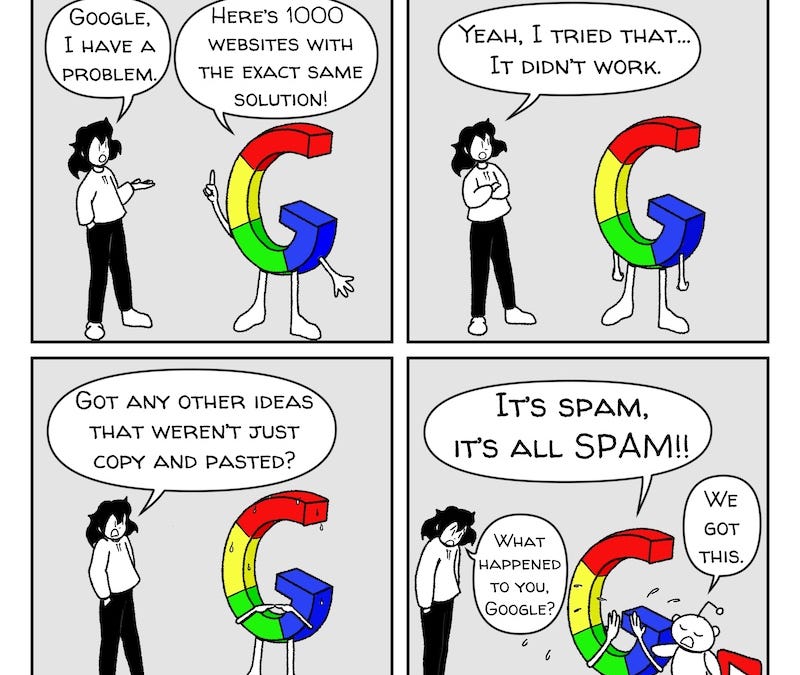
There just seems to be a load of imitation sites now, like 6 different wrapper sites for GitHub, 8 for StackOverflow, a couple for GitLab, something aggregating a load of forums - so the first couple of pages are the exact same content - just from 15 different sites that copy the originals. At least going with a community site there tends to be actual discussion and or useful links to the relevant content
I have found that installing uBlacklist (a browser extension) and blocking these sites from search results as I encounter them helps noticeably. There are only so many of these "clone" sites that rank highly on Google, so I found it pretty easy to keep up with them for the things I usually search for. There are even shared uBlacklist lists for things like SO clones, but I haven't even bothered to use them.
It’s sad but I also noticed I have to add « wiki » more and more because Wikipedia is increasingly not the first result for searches where it should be the first result. Instead there’s often the stupid Google widget obviously copying Wikipedia’s content without a direct link to the actual page.
Those are infuriating. I hate to see ACTUAL content creators having their livelihoods stolen this way. Why wouldn't Google filter out the worst offenders? It takes literally one minute to get a nice list of a dozen imitation sites that nobody would miss. Maybe Google feels a little inhibited from 'choosing the winners' for all but the largest cases?
One FTE at Google could probably filter out like 99% of the SEO spam sites in technical english querries.
It would be a winning battle, since it is less work to blacklist than to make a high scoring site. I guess Google Search internally is a mess. Maybe they have no clue what they are doing or have some really bad directors and lower managers messing stuff up. Maybe there are so much blackbox ML called from 1000s of Perl files that the engineers don't understand what is happening.
I often wonder how much modern IT infrastructure is simply this mess of 'we have no idea how it really works' blackboxes strung together with API calls.
I suspect you're right about how much of a true understanding they (at google) still have of the behaviour of their search engine.
I'm not sure about these days, but historically the engineers on Google search wanted to fix these problems algorithmically, rather than delisting specific sites by hand
> If you can do this, so can Google. This just shows they refuse to.
If they immediately blocked these sites then Google would get a lot of flack for censoring the web. I don't like these sites as much as anyone. A while back I even tweeted about[0] having a dream where I wrote a browser extension to intercept and redirect these copycat sites to the real site. In my mind this falls into the same category as phone spam. The phone networks could block these but how would you feel if you knew your phone company was auto-filtering incoming calls without you having any control over that? It's a very thin line. Hopefully one days algorithms will be smart enough to auto de-rank copycat sites or blatant plagiarism so they don't show up on the first page. [0]: https://twitter.com/nickjanetakis/status/1473671136928018434
There HAS to be a way for google to detect a site is a copy and de-rank it. I refuse to believe their army of PhDs can't figure this out. Google's incentives are wrong. They make more money from SEO spam with ads than from the original sites.
Still in shock that they killed reverse image search and replaced it with some useless AI tech demo.
It used to use the actual image and be able to provide context from where that image was found elsewhere. Now it seems to throw the image at AI and the AI will go "Oh that's a street" then they will just show you streets with similar colors as the image you put in. Completely useless for trying to locate what movie a screenshot is from, or even similar images because the category searching is too general. Yandex image search completely blows it out of the water by being nothing more than a modern version of 2010 era Google Image Search.
Comments (1,561) 373 threads
Earlier commentsMe: Google for "quotes don't give":
Top result, does not contain the given phrase
Second result, does not contain that phrase
This is literally the first thing I tried and I did a view source to be sure. They are lying to us and/or themselves.
Looking at the result, I would say 1/2 the results don't include that phrase including results for products on Amazon.
Clearly Search does not work they way this Google Rep believes it to work.
Shameless how they think anyone would be gaslit.
For instances, on the ["quotes don't give"] example, the first result I get is
https://www.goodreads.com/quotes/tag/never-give-up
If I do a find-in-page for "quotes don't give", I get zero results. Oh no! Perfidy!
... but, if you look more closely, you'll find this string waaaaay down at the bottom:
> tags: don-t-give-up, don-t-give-up-on-your-dreams, don-t-give-up-on-yourself, don-t-give-up-quotes, don-t-give-up-the-fight, encouragement, ...
Thanks to the wonders of tokenization, that "don-t-give-up-quotes, don-t-give-up-the-fight" gives you the string of tokens, "don t give up quotes don t give up the fight", which contains the exact phrase "quotes don t give", which is the tokenization of the phrase "quotes don't give".
Continue this thread — 3 replies
However, if I search like you did for "quotes don't give" then I get the behavior you describe. So the quoting works sometimes, not others. Maybe based on length or something else, I'm not sure.
Here's why people often think quoting with Google doesn't work when it really does (I've looked a huge number of these reports). 1) We match ALT text 2) We match text not readily visible, such as in a menu or small text 3) Page has changed since we indexed it 4) Punctuation...
Punctuation comes into play if you did a quoted search like "dog cat" and there's text that says "dog, cat" then we'll see that without the punctuation. That doesn't seem a major issue but we're looking at if we could improve there.
And...as noted in another reply below, in the first result, if you look at the cached page that shows the ENTIRE page that we indexed (rather than the paginated version you land on), there's this text:
quotes, don-t-give-up-the-fight
with when you remove the punctation, is the match:
quotes dont give
And I get that this can be frustrating, that we don't consider punctation in a quoted search. That's not a new change, however. It's been that way for ages. But as I also said, it's something we might revisit.
Does not contain: "quotes don't give" "quotes dont give"
Nor does the cached version: http://webcache.googleusercontent.com/search?q=cache:https:/...
Yes, as someone pointed out, there are tokenized versions down at the bottom, but that exact string does not exist.
So first of all it's just not true.
Second of all, if your consumers are all complaining the results do not match what they are searching, it might make more sense to listen. Adding quotations marks like that to find an exact string should be a huge red flag that the user is only interested in that string – why then would "it's in an offscreen meta tag of a cached version of the actual site" be anything other than a bad result?
I can understand why you would match it generally, but why would you ever serve those types of results to users in a browser? Why would users ever want this as a feature?
Put in a search term.
E.g. "fat wallet"
"About 22,100,000 results" it says.
Click through to the last page.
"Page 6 of about 198 results (1.03 seconds)"
So out of 22 million results, I can really only see 198?? That can't be right. Wait, it says, "In order to show you the most relevant results, we have omitted some entries very similar to the 198 already displayed. If you like, you can repeat the search with the omitted results included."
Yeah, that's what I'd like, I want to see all the results. CLICK.
OK, it takes me back to "About 22,100,000 results," so far, so good.
Click through again to the last one.
"Page 10 of about 22,100,000 results"
Ok ok. Let's keep going. CLICK.
"Page 11 of about 415 results."
That's it.
No more results shown.
What happened to the other 22,099,585 results????
Returning a count of results, however (especially if it doesn't need to be precise), is a lot less expensive. Hence why Google is happy to give you the 22,000,000 number.
"Avoid using from and size to page too deeply or request too many results at once. Search requests usually span multiple shards. Each shard must load its requested hits and the hits for any previous pages into memory. For deep pages or large sets of results, these operations can significantly increase memory and CPU usage, resulting in degraded performance or node failures."
[0] https://www.elastic.co/guide/en/elasticsearch/reference/curr...
OK, I see now. I tried it on Bing and got similar results with two small caveats. First, Bing gave me 861 accessible results, which is a base 2 order of magnitude greater than Google's. Second, Bing's total number isn't nearly as astronomical, it claims only 191K total results, not Google's 22M.
Could it be that Google has just indexed 100x more terms compared with Bing? Maybe, but my anecdotal use of both of them doesn't really seem to indicate that Bing is so deficient. For example, I tried using a phrase that would come up with just a few results. "bioavailable turmeric extract formulation" (in quotes) yielded 24 results on Google, (plus 4 ad results on top). On Bing I got 33 results, plus 2 ads on top. In fact, Bing looks more like "old Google" than new Google looks like old Google.
Continue this thread — 1 reply
The other 22,099,585 results were identical copies of the 415 pages you did see. SEO farms are huge.
There just seems to be a load of imitation sites now, like 6 different wrapper sites for GitHub, 8 for StackOverflow, a couple for GitLab, something aggregating a load of forums - so the first couple of pages are the exact same content - just from 15 different sites that copy the originals.
At least going with a community site there tends to be actual discussion and or useful links to the relevant content
I makes me wonder how Google can mess this up.
It would be a winning battle, since it is less work to blacklist than to make a high scoring site.
I guess Google Search internally is a mess. Maybe they have no clue what they are doing or have some really bad directors and lower managers messing stuff up.
Maybe there are so much blackbox ML called from 1000s of Perl files that the engineers don't understand what is happening.
I suspect you're right about how much of a true understanding they (at google) still have of the behaviour of their search engine.
There are no Google adverts on GitHub, Stack Overflow, etc but there are on many of the copycat sites.
It blocks copycats and hide them from multiple search engines. You may also use the list with uBlacklist.
If they immediately blocked these sites then Google would get a lot of flack for censoring the web.
I don't like these sites as much as anyone. A while back I even tweeted about[0] having a dream where I wrote a browser extension to intercept and redirect these copycat sites to the real site.
In my mind this falls into the same category as phone spam. The phone networks could block these but how would you feel if you knew your phone company was auto-filtering incoming calls without you having any control over that? It's a very thin line.
Hopefully one days algorithms will be smart enough to auto de-rank copycat sites or blatant plagiarism so they don't show up on the first page.
[0]: https://twitter.com/nickjanetakis/status/1473671136928018434
Continue this thread — 3 replies
It used to use the actual image and be able to provide context from where that image was found elsewhere. Now it seems to throw the image at AI and the AI will go "Oh that's a street" then they will just show you streets with similar colors as the image you put in.
Completely useless for trying to locate what movie a screenshot is from, or even similar images because the category searching is too general. Yandex image search completely blows it out of the water by being nothing more than a modern version of 2010 era Google Image Search.
How is this shocking? Google has a very strong track record in killing useful services.
Ruining the tech came years later.
Continue this thread — 1 reply
Continue this thread — 6 more replies
All comments shown.
Couldn't load more comments. Check your connection and try again.