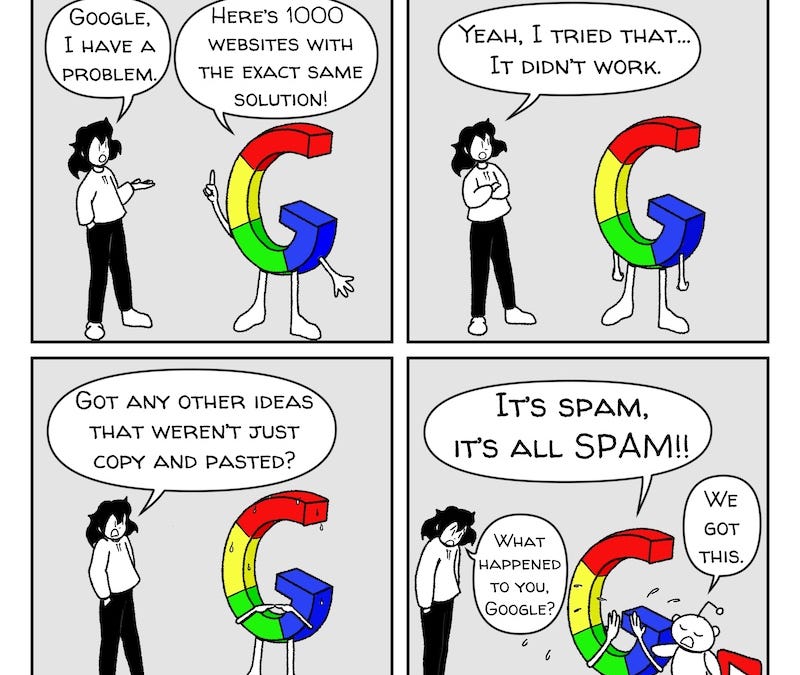
Google used to be really, really good at finding exactly what I told it to find. Nowadays, it's turned into the yellow pages; sponsored content from businesses trying to sell me goods and services.
Can people suggest good alternatives or search patterns for certain categories of information or search types? Some of the search patterns I currently I use: * Youtube for product reviews and demos, entertainment, music and educational material. * Google with site:reddit.com at the start for questions best answered by other humans; crowd-sourced answers, authentic replies from mostly real people. * Google with site:news.ycombinator.com if I want to find "forum-like" discussion on topics I'm interested in. * Google Image search with site:amazon.co.uk when looking for niche products I need to buy, because Amazon's search is so incredibly broken and game-ified. What I'm having a heck of a time finding is technical content; long-form programming tutorials, deep dives into academic concepts (I do a lot of signal/audio processing and search for blog posts related to these topics), circuit schematics, electronic engineering content. These used to exist on enthusiast forums 10-15 years ago, but Google often no longer surfaces hits from these forums, both because the content is old and the forum model is dying. Reddit is the "replacement" but it plagued with low-effort "look at my thing" posts that help nobody.
I've had some luck inserting "forum" into search terms to find real human content. Mostly when trying to find technical info about cars, but may apply to other fields.
I've been on the Kagi beta test for a few weeks now and, for the kind of searches I mostly do, it seems to be a massive improvement on Google. Strongly recommended. https://kagi.com/
Same. Over the years I've trialed most search engines out there, but always find my way going back there after at most 2 days of trying them, because I end up adding "@google" before every query anyways because the results are bad.
With Kagi most of the results are what I'm looking for. If they are not, I'll still try "@google", but so far with very few queries Google's results were actually better. The biggest drawback is worse "smart cards" results, but I hope they keep those optional/unobtrusive anyway. The strange thing is that the feeling Kagi gives me, isn't even unknown. It just feels like Google circa 2010.
I've also been using Kagi for ~1 month and god can I testify for how fantastic it's been. You have to TRY to find blogspam and the allowance of blacklisting domains plus some other handy search customization features make it an absolute joy to use.
It may lack "instant answer" widgets or other fancy search engine features but it gets the actual "search" part of the equation so right that I find it astonishing how I ever used DDG/Google in the past.
I love this search engine, it gives me the same feeling that Google did when it became a thing. Their business model after beta will be that users pay to use it, and it has no ads. This is a very encouraging sign, and personally I'll be willing to pay for quality search without ads. I hope enough other people feel the same to make Kagi profitable and functioning for years to come.
I've signed up for the beta, but it's hard to shake the feeling that signing in to a search engine is a mistake. "We respect your privacy", "we'll never sell your data", I've heard these claims before and they've almost always been lies. They can tell me that they don't maintain an eternal history of all my queries, but how can I ever verify that?
Umm... Google and Bing track the hell out of you whether you sign in or not. DuckDuckGo claims not to but the sites you hit through it certainly employ tons of fingerprinting.
Kagi ultimately will be a paid service. As I've noted in the context of other services (email), by providing revenue in the form of paid services (and only paid, no freemium tier) the service doesn't have to implement ads at all, and thus can skip the pressure to deliver more and more data in exhange for better rates.
Write and ask them. GDPR requires that users can retrieve all stored information associated to their profile/person. Most large internet companies have this functionality.
Presumably because, as they move out of beta, they want people to start paying to use their search engine. Thats the only way they can afford to be ad-free.
In the FAQ they mention potentially charging around $10/month. Not sure if I'm being entitled or anything, but I was expecting something more like the original WhatsApp model of a few dollars a year. Perhaps I'm under-estimating how computationally heavy search is.
Kagi has a "consumption" section where they show how much your searches cost to perform.
I've done 20 searches this month (I haven't switched it to default) and it says I have incurred $0.25 (between $0.01 and $0.02 per search) so it would seem that it's very expensive for them to provide results at the moment. It would absolutely be unsustainable at a few dollars a year given these consumption numbers.
> Perhaps I'm under-estimating how computationally heavy search is.
It's because they aren't rolling their own search, they pay Google and Bing to do the search for them (via the Google and Bing Search API's which are charged), mix in a few results from their own crawler, and then reorder the results. So they will always have a higher cost base than both Bing and Google, because they are paying for 3 different search indexes (including their own), plus Bing and Google's margins on the API, plus their own infra costs. (Now if this is a sustainable model or not is another question...)
Looks interesting, but am I crazy for thinking that $10/month is an insane price to pay for a general purpose search engine? Surely Google wouldn't making anywhere near $10/month off of me even if I disabled adblock.
Those two sentences have no connection. You can gain a huge amount of consumer surplus, even as the seller reaps almost none of it. Google's gain from ads bears little relation to your gain from Google. (This is why people are so much better off in markets: it's actually very hard for a business to get more than a small fraction of consumer surplus.) As it happens, when people try to estimate your gains from a general purpose search engine, it usually comes in at like $100+/month (search 'willingness to pay search engine' and think about how long it would've taken you to find that in a physical library, and how you wouldn't've bothered in the first place because such a search would be impossibly expensive). So, $10/month would be a steal compared to not using a search engine at $0/month.
The price is crazy only because you're used to not seeing the price you're paying (ads). I spend $10 on things way less valuable very often. A good search engine is at least as much value as intellij to me, and my company pays 5 times more than that per month for intellij.
The problem is that ads price discriminate. Google may not get much money off of you, but there are other users that are very valuable (think of a manager in a billion dollar enterprise searching for a subscription product to buy). Would you be okay with it costing 0.05% of your income?
Of course it will be hard to compete with ads as business model if the alternative doesn't allow for price discrimination.
Comments (1,561) 373 threads
Show all comments
Showing thread 3 of 373
Can people suggest good alternatives or search patterns for certain categories of information or search types?
Some of the search patterns I currently I use:
* Youtube for product reviews and demos, entertainment, music and educational material.
* Google with site:reddit.com at the start for questions best answered by other humans; crowd-sourced answers, authentic replies from mostly real people.
* Google with site:news.ycombinator.com if I want to find "forum-like" discussion on topics I'm interested in.
* Google Image search with site:amazon.co.uk when looking for niche products I need to buy, because Amazon's search is so incredibly broken and game-ified.
What I'm having a heck of a time finding is technical content; long-form programming tutorials, deep dives into academic concepts (I do a lot of signal/audio processing and search for blog posts related to these topics), circuit schematics, electronic engineering content. These used to exist on enthusiast forums 10-15 years ago, but Google often no longer surfaces hits from these forums, both because the content is old and the forum model is dying. Reddit is the "replacement" but it plagued with low-effort "look at my thing" posts that help nobody.
I've been on the Kagi beta test for a few weeks now and, for the kind of searches I mostly do, it seems to be a massive improvement on Google. Strongly recommended.
https://kagi.com/
With Kagi most of the results are what I'm looking for. If they are not, I'll still try "@google", but so far with very few queries Google's results were actually better. The biggest drawback is worse "smart cards" results, but I hope they keep those optional/unobtrusive anyway.
The strange thing is that the feeling Kagi gives me, isn't even unknown. It just feels like Google circa 2010.
Continue this thread — 2 replies
It may lack "instant answer" widgets or other fancy search engine features but it gets the actual "search" part of the equation so right that I find it astonishing how I ever used DDG/Google in the past.
Continue this thread — 1 reply
Continue this thread — 3 replies
Write and ask them. GDPR requires that users can retrieve all stored information associated to their profile/person. Most large internet companies have this functionality.
Continue this thread — 10 replies
https://kagi.com/privacy
In the FAQ they mention potentially charging around $10/month.
Not sure if I'm being entitled or anything, but I was expecting something more like the original WhatsApp model of a few dollars a year.
Perhaps I'm under-estimating how computationally heavy search is.
I've done 20 searches this month (I haven't switched it to default) and it says I have incurred $0.25 (between $0.01 and $0.02 per search) so it would seem that it's very expensive for them to provide results at the moment. It would absolutely be unsustainable at a few dollars a year given these consumption numbers.
Continue this thread — 5 replies
It's because they aren't rolling their own search, they pay Google and Bing to do the search for them (via the Google and Bing Search API's which are charged), mix in a few results from their own crawler, and then reorder the results.
So they will always have a higher cost base than both Bing and Google, because they are paying for 3 different search indexes (including their own), plus Bing and Google's margins on the API, plus their own infra costs.
(Now if this is a sustainable model or not is another question...)
Continue this thread — 4 replies
Of course it will be hard to compete with ads as business model if the alternative doesn't allow for price discrimination.
At $10 a month you have to pay per search if you search over 20 times per day or something.
Continue this thread — 1 more reply
Continue this thread — 15 more replies