Some really good thoughts here. I'll summarize the ones that hit me:
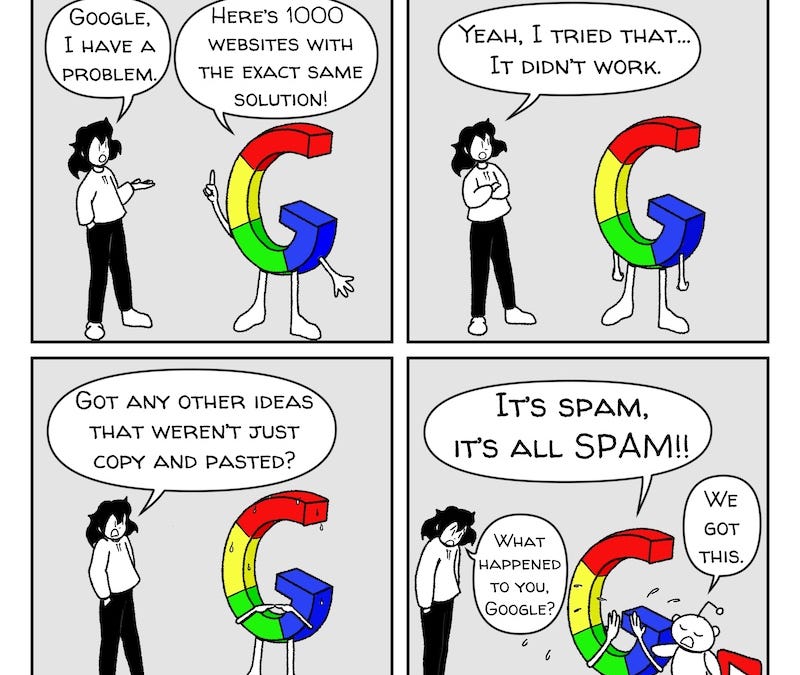
- "Why are people searching Reddit specifically? The short answer is that Google search results are clearly dying. The long answer is that most of the web has become too inauthentic to trust." This is it for me exactly. I search for the following kinds of things on Reddit exactly because results on other sites aren't trustworthy: Reviews are secretly paid ads. The "best" recipe for pancakes is only what's trending on instagram right now. The latest conditions on mountain bike and hiking trails are being shared inside communities like Reddit but not on the web. The same for trending programmer tools. - "It is obvious that serving ads creates misaligned incentives for search engines..." What I'm shocked by is that Google somehow maintained a balance on this for so long. Well, at least a good enough balance that people still use it primarily. - "Google increasingly does not give you the results for what you typed in. It tries to be “smart” and figure out what you “really meant" ..." This is the most annoying behavior because I really mean what I write. - "There’s a fun conspiracy theory that popped up recently called the Dead Internet Theory..." I hadn't heard of this. Now that's some sci-fi level of conspiracy but in today's world it seems totally plausible.
> This is the most annoying behavior because I really mean what I write.
Tons of people don't, though. They type whatever unprocessed half-second thought they have into Google and expect Google to lead them to the water, even if they're tugging and trying to go in the completely wrong direction. Google has optimized for working 'most of the time' for 'the most people', and that means striving for fixing the complete word soup of search results people type in.
This is very helpful if I search for a name I didn't quite pick up or don't know how to spell, or if I only remember fragments of a quote or topic, then I just blurt out my stream of consciousness and Google will mostly point me in the right direction. That being said, I wish I could explicitly tell Google to treat my query more literally. Ideally you would be able specify the search query in some kind of grammar. They have these kinds of prompt mechanics for GPT3, so I doesn't seem too unrealistic, even if it's all ML nowadays.
I work for Google Search. We have several ways for you to do this. The easies is to put quotes around a word or a phrase that you absolutely, positively want to be present in content retrieved. And yes -- it still works. It really really does, but if you or anyone finds an example where you believe it doesn't, please let me know. We'll debug it. The reasons people sometimes think it's not working is because the text appears in ALT text, or it appears in text that's not readily visible on a page (maybe in a menu bar or small text), or there's punctuation ("dog cat" will match "dog, cat") or sometimes a page has changed after we've indexed it (so view the cached copy, if available). You can also use verbatim mode from the toolbar so that we search for only the exact words you provide.
Do they? I see this stated all the time, with no references. They type whatever unprocessed half-second thought they have into Google and expect Google to lead them to the water Perhaps if Google didn't try to fix things for people, they would be more thoughtful with their searches. Take away the junk food, and people will resort to real food. The same way some cities limit parking at big events so that people have to take mass transit. It's for their own good, but they have to be shown the way. Google has optimized for working 'most of the time' for 'the most people This may be Google's goal, but it hasn't happened yet. I don't have very many friends or acquaintances in the tech bubble, so I base my observations around real people in the real world. More and more they're giving up on Google entirely. Their primary search engines these days seem to be Instagram, Pinterest, Etsy, Amazon, and other non-Google sources. When I ask someone why they're searching Amazon reviews for tech support information, they tell me because it's not on the web. That's Google's failure.
> Their primary search engines these days seem to be Instagram, Pinterest...
Why would someone want to search Pinterest? Every time I've gotten a search result to Pinterest it's been some scraped image completely and frustratingly devoid of the context I was originally searching for. Pinterest is one of the worst offenders on the web.
> Take away the junk food, and people will resort to real food.
Many people already resort to real food, even with plenty of junk food around. “Problem” is unfortunately, that it comes at a price, that many are simply not ready or able to pay. Who should step in is a good question, and probably governments should make access to information a right and have high quality public service available (in this case a public web search engine). Public libraries used to fulfill this role for centuries.
That's like speaking to little children, that are learning to talk, reproducing their errors. Some adults believe that it's cute, but it's idiotic, confuses the babies and make their progress more difficult and slow.
I don’t think this means anything for the point you wanted to make about search results, but please note you’re exactly wrong about baby talk! It’s not a good analogy.
Baby talk (or CDS, child-directed speech) helps engage their attention and provides valuable feedback. Kids who experience less CDS develop language more slowly. See https://en.wikipedia.org/wiki/Baby_talk (I heard about this research a number of years ago. Although I must admit, now I wonder if it’s affected by the science reproducibility crisis!)
Fathers descend to "baby talk" when the child is learning and slowly bring them up to par instead of trying to just force perfect talk from the start. They do this instinctively. There's some great comments on this from salman khan, I think. He recorded the first years of his kid's life at home and documented this phenomenon
A single mediocre experience optimized to work ‘most of the time’ for ‘most people’ is quite contrary to the narrative that has made Google such tremendous amounts of money (“let us surveil you so that you can have a more personalized experience”) though, isn’t it?
Given all of the data collected about Google users, ought not one of the applications of that data be some way to give users specifically what they are searching for if their past behavior suggests that they mean what they type? Couldn’t the “search only for “ option be a very good data point on making that determination automatically, or enabling a user setting for “give me exact results based on what I actually typed by default”? It seems possible to me that this behavior has more to do with the value of ads for “big” keywords than with (poorly) inferring user intent.
I have a sense that this is the dirty little secret of the spyware advertising industry, personalization just isn't that great. Yeah, putting you into a male or female bucket, parent or child, homeowner or renter, that's worth a little bit. But, to find out your name and address and search history and how long your last bowel movement took, just to deliver an ad that's theoretically hyper-optimized to make you buy something... I just don't believe it.
I don't believe that it's worth anything near what they are charging for it, except perhaps in the case of politics, which has always been an extremely efficient use of money. And even then, it's not worth a tiny fraction of the real cost it has to society.
I agree with you. I highly doubt that our economy has enough (product, message) combinations to justify the need for personalization based on more than a dozen attributes.
Right, people radically overestimate how much a profile is worth. Someone who owns a house in a rich area is somewhat easy to identify, and you target them... along with everyone else who is also trying to reach that rich slice, so you pay more.
The very high quality pieces of information can be things like "wants to buy a life insurance policy this week" or "just had a baby" or "just bought a plane ticket to XYZ," or "is in the frequent flyer program and spends more than $20,000 per year on travel." However the majority of information about people, the overwhelming majority of whom have no significant disposable income, is worthless and not worth tracking for the most part. You reach those people through traditional mass marketing means.
It's a great point you have made. I work technically as a data scientist, but my domain is scientific data. I have quite a few GitHub packages and get recruiter calls for data science jobs almost every week, with pretty generous salary offers.
And from what it seems to me, there is a giant bubble. The vast majority of companies doing "data science" jobs are things that a smart undergrad can do with a month or two of training. And this is because I believe C-suites have completely gulped down the data is oil mantra. There are entirely charlatan companies with unicorn, even decacorn valuations now being built on this mantra - for example, CRED in India. Yet, as you said, and as I believe too, most of the data is worthless.
Right, but unlike oil, most data is worthless most of the time.
For example, I'm about to list my house on the market. The real estate agents who reached out to me last year and the year before that to try to induce me to sell the house had no chance of succeeding. Now is the time if they knew the secret that I'm about the list the house that they should all be competing for my business. The only relevant piece of information is that I'm about to sell the house. That is a valuable lead that many in my region would bid on. My background information is frankly not that relevant to the value of that lead, and isn't something that is readily surfaced by the kind of deep profiling that is supposed to be going on. It can be signaled by me signing up to some kind of list that sells my lead to a zillion people at once, but is never going to be surfaced accurately to the people who can earn the most profits from it by my Youtube habits or whatever. Zillow sells the logged in user data in the market I'm buying in to the real estate agents listing the houses, but that again is not something being modeled by some kind of big data operation, but is merely the same kind of "little data" provided on things like dating websites or LinkedIn when people browse your profile. There's no modeling going on there that requires sophistication.
It's always fun watching an ad system try to figure out nonbinary people. Spotify ads can't decide whether I'm a successful businessman or Spanish-speaking housewife.
Given all of the data collected about Google users, ought not one of the applications of that data be some way to give users specifically what they are searching for...
You're missing what "personalization" has come to really mean. It means knowing enough about the user to give them an experience you can profit from and which they will accept. If there isn't something you can expect profit from, there's no reason to give them anything.
Google has optimized to whatever sequence of behaviors achieves the most profit. The search results are not chosen for utility to the user but as nudges in a cycle of influence intended to drive you to attend to an ad, purchase something, or consume particular content.
They should not be engaged in non-consensual manipulation of social or political behaviors, and the ethics of market manipulation at scale through advertisement are far from clear.
Comments (1,561) 373 threads
Show all comments
Showing thread 1 of 373
- "Why are people searching Reddit specifically? The short answer is that Google search results are clearly dying. The long answer is that most of the web has become too inauthentic to trust."
This is it for me exactly. I search for the following kinds of things on Reddit exactly because results on other sites aren't trustworthy: Reviews are secretly paid ads. The "best" recipe for pancakes is only what's trending on instagram right now. The latest conditions on mountain bike and hiking trails are being shared inside communities like Reddit but not on the web. The same for trending programmer tools.
- "It is obvious that serving ads creates misaligned incentives for search engines..."
What I'm shocked by is that Google somehow maintained a balance on this for so long. Well, at least a good enough balance that people still use it primarily.
- "Google increasingly does not give you the results for what you typed in. It tries to be “smart” and figure out what you “really meant" ..."
This is the most annoying behavior because I really mean what I write.
- "There’s a fun conspiracy theory that popped up recently called the Dead Internet Theory..."
I hadn't heard of this. Now that's some sci-fi level of conspiracy but in today's world it seems totally plausible.
Tons of people don't, though. They type whatever unprocessed half-second thought they have into Google and expect Google to lead them to the water, even if they're tugging and trying to go in the completely wrong direction. Google has optimized for working 'most of the time' for 'the most people', and that means striving for fixing the complete word soup of search results people type in.
Google is optimizing for that.
Continue this thread — 12 replies
The query syntax:
https://support.google.com/websearch/answer/2466433?hl=en
Continue this thread — 13 replies
Do they? I see this stated all the time, with no references.
They type whatever unprocessed half-second thought they have into Google and expect Google to lead them to the water
Perhaps if Google didn't try to fix things for people, they would be more thoughtful with their searches.
Take away the junk food, and people will resort to real food. The same way some cities limit parking at big events so that people have to take mass transit. It's for their own good, but they have to be shown the way.
Google has optimized for working 'most of the time' for 'the most people
This may be Google's goal, but it hasn't happened yet.
I don't have very many friends or acquaintances in the tech bubble, so I base my observations around real people in the real world. More and more they're giving up on Google entirely.
Their primary search engines these days seem to be Instagram, Pinterest, Etsy, Amazon, and other non-Google sources.
When I ask someone why they're searching Amazon reviews for tech support information, they tell me because it's not on the web. That's Google's failure.
As someone who's been a public librarian, I can tell you that is not how people work.
Continue this thread — 2 replies
Why would someone want to search Pinterest? Every time I've gotten a search result to Pinterest it's been some scraped image completely and frustratingly devoid of the context I was originally searching for. Pinterest is one of the worst offenders on the web.
Continue this thread — 1 reply
Many people already resort to real food, even with plenty of junk food around.
“Problem” is unfortunately, that it comes at a price, that many are simply not ready or able to pay.
Who should step in is a good question, and probably governments should make access to information a right and have high quality public service available (in this case a public web search engine). Public libraries used to fulfill this role for centuries.
Continue this thread — 1 reply
https://archive.md/wwMY3
https://www.google.com/search?q=how+old+is+linux&oq=how+old+...
Continue this thread — 1 reply
Continue this thread — 5 replies
Baby talk (or CDS, child-directed speech) helps engage their attention and provides valuable feedback. Kids who experience less CDS develop language more slowly.
See https://en.wikipedia.org/wiki/Baby_talk
(I heard about this research a number of years ago. Although I must admit, now I wonder if it’s affected by the science reproducibility crisis!)
Continue this thread — 12 replies
Fathers descend to "baby talk" when the child is learning and slowly bring them up to par instead of trying to just force perfect talk from the start. They do this instinctively.
There's some great comments on this from salman khan, I think. He recorded the first years of his kid's life at home and documented this phenomenon
Given all of the data collected about Google users, ought not one of the applications of that data be some way to give users specifically what they are searching for if their past behavior suggests that they mean what they type? Couldn’t the “search only for “ option be a very good data point on making that determination automatically, or enabling a user setting for “give me exact results based on what I actually typed by default”?
It seems possible to me that this behavior has more to do with the value of ads for “big” keywords than with (poorly) inferring user intent.
Continue this thread — 2 replies
I don't believe that it's worth anything near what they are charging for it, except perhaps in the case of politics, which has always been an extremely efficient use of money. And even then, it's not worth a tiny fraction of the real cost it has to society.
Continue this thread — 6 replies
The very high quality pieces of information can be things like "wants to buy a life insurance policy this week" or "just had a baby" or "just bought a plane ticket to XYZ," or "is in the frequent flyer program and spends more than $20,000 per year on travel."
However the majority of information about people, the overwhelming majority of whom have no significant disposable income, is worthless and not worth tracking for the most part. You reach those people through traditional mass marketing means.
And from what it seems to me, there is a giant bubble. The vast majority of companies doing "data science" jobs are things that a smart undergrad can do with a month or two of training. And this is because I believe C-suites have completely gulped down the data is oil mantra. There are entirely charlatan companies with unicorn, even decacorn valuations now being built on this mantra - for example, CRED in India.
Yet, as you said, and as I believe too, most of the data is worthless.
For example, I'm about to list my house on the market. The real estate agents who reached out to me last year and the year before that to try to induce me to sell the house had no chance of succeeding. Now is the time if they knew the secret that I'm about the list the house that they should all be competing for my business. The only relevant piece of information is that I'm about to sell the house. That is a valuable lead that many in my region would bid on. My background information is frankly not that relevant to the value of that lead, and isn't something that is readily surfaced by the kind of deep profiling that is supposed to be going on. It can be signaled by me signing up to some kind of list that sells my lead to a zillion people at once, but is never going to be surfaced accurately to the people who can earn the most profits from it by my Youtube habits or whatever.
Zillow sells the logged in user data in the market I'm buying in to the real estate agents listing the houses, but that again is not something being modeled by some kind of big data operation, but is merely the same kind of "little data" provided on things like dating websites or LinkedIn when people browse your profile. There's no modeling going on there that requires sophistication.
Continue this thread — 1 more reply
Continue this thread — 15 replies
Continue this thread — 11 more replies
You're missing what "personalization" has come to really mean. It means knowing enough about the user to give them an experience you can profit from and which they will accept. If there isn't something you can expect profit from, there's no reason to give them anything.
They should not be engaged in non-consensual manipulation of social or political behaviors, and the ethics of market manipulation at scale through advertisement are far from clear.
Continue this thread — 3 replies
Continue this thread — 8 more replies
Continue this thread — 64 more replies