I was curious how he did those visualizations so I looked at the source code. Turns out he codes everything by hand in WebGL [1]. Absolutely impressive stuff. Source code is non-minified so you can have a look and understand everything as well.
He does it "the right way™". Use the platform. Don't use any framework or generic library. Go straight to the point and code what you need, when you need it. Don't minify or bundle anything, and let the people who are learning and courious a straightforward way to connect the dots, without forcing them into a github repository with 90% of the code unrelated to the thing and existing just to glue 1000 pieces written by 10000 people together.
Every essay by Bartosz is so top-notch and a such breath of fresh air! He gives me hope in humanity and I am immensely grateful for what he does.
I mostly agree with you, but I don’t mind minification when appropriate, as it can serve a functional purpose with tangible end-user-friendly benefits (less downloaded over the network = faster response times).
But if you want to be friendly to the tinkerers, you could always host both the *.js and *.min.js versions, and have the webpage just pull the latter - anyone who wants the unminified source can remove the “min” part from the URI, while the majority of end users will still benefit from pulling the minified js.
That's simply not a very well followed (and thus discoverable) standard. Especially for hand crafted code, minifying functions and variable names only obfuscates what is written and minifying whitespace often only has minimal benifits.
In practice this seems to be a lost cause, and links to alternatively hosted source code is more common. Sadly this makes is simple to introduce subtle, harmful differences between the source and what is hosted.
A discoverable version would be to include source maps that link to the original as well. That way a browser console will automatically pull up the original.
People measure minification in byte size (unfortunately I guess you're charged by CDNs by that metric too?). In reality everything text based compresses really well over the wire. In either case, importing tons of libs left and right is going to vastly out-size any minification, yet most fe devs are very liberal with dependencies.
Minification strips comments too though, which may be undesirable in many cases.
minified js is not greatly smaller than gzipped js, I think the whole minification thing is a swing and a miss and now we have to deal with source maps and shit, and build pipelines and etc
    $ ls -la
    -rw-r--r-- 1 jack 197609 330905 May  4 22:56 watch.js
    -rw-r--r-- 1 jack 197609 152172 May  4 22:55 watch.min.js

    $ gzip watch.js
    $ gzip watch.min.js
    $ ls -la
    -rw-r--r-- 1 jack 197609 43690 May  4 22:56 watch.js.gz
    -rw-r--r-- 1 jack 197609 32507 May  4 22:55 watch.min.js.gz
The tradeoff is that there is basically nobody else that has the expertise or time to do the same thing at a similar level of polish. We're not going to see more Ciechanowski-level posts unless new libraries and frameworks make it more accessible.
> He does it "the right way™". Use the platform. Don't use any framework or generic library.
Hard disagree. "Use What's Right For You™". Of course there is value in understanding the platform beneath your framework or generic library, but that's just an extension of "understand what you're using and why".
I strongly disagree that this is "the right way". I think that the platform provides low level primitives that are _designed_ to have abstractions built upon them.
Doing it like this has the potential to be the most performant, but it does so in the same way as writing your programs directly in assembly is potentially performant. I also don't think that the source code is particularly readable for me, and contains lots of magic numbers and very imperative code. I would personally find it a lot more readable if it was written in some sort of declarative way using a library, even if I have to look at a GitHub repo instead of view source.
> but it does so in the same way as writing your programs directly in assembly
> contains lots of magic numbers and very imperative code Well, we really don't know if the code was written in this form by hand, don't we. It could have been compiled into this, to use your words, "assembly with magic numbers and imperative" from much more elegant form. We may see this form only because this is what browsers understand. I am not saying it was compiled, just speculating that seeing pure WebGL does not mean it was pure WebGL to begin with.
When there's physics, graphics and mathematics, there are magic numbers, which are results of formulas which needs to be computed once, or material properties, or nature's constants.
Also, nature and graphics works as an imperative parallel machine. So the code mirrors that. This is not written deliberately this way. Code comes out like that when you strip all the libraries, fluff, and other less-related stuff. I also write a scientific application, and yes, This is the way.
Yeah in this case it doesn't need to; there's no extraneous or unused code or documentation blocks, and gzip (and comparable) compression is good enough, minification doesn't actually reduce the downloaded code size by that much.
If mechanical watches tickle your fancy, there is a ton of watch repair video on YT. I particularly enjoy wristwatch revival (https://www.youtube.com/channel/UCD80T1s2Za4K682CQDGwEKQ). A warning though, if you consider to get into that hobby. I tried, it's really hard, expensive (I spend close to €1k and that is with b-quality stuff. Good stuff is 5-10x more expensive.) and can be rather frustrating. Finding parts to buy can be complicated depending on your locale, loosing parts is very easy and destroying parts, even when gentle and careful is par for the course. I hat to put my repair hobby on halt after running out of practice pieces. All now have broken or missing parts. your milage may vary ofcourse :)
If you wouldn’t mind answering a question, how difficult is it to swap a dial/handset/movement set into a different case?
I saw a custom mod watch that paired the face/movement of a Marathon navigator with an O&W diver case*. Is a combination I find desirable (as the Marathon bezel is too chunky for my use), but the maker won’t respond to emails. Is it possible that the combination could be “ drop in” or is it likely to require significant modification? *https://westcoastime.com/m16typidivbe.html
Depends. The ETA-2824 is a fairly common movement with inexpensive Chinese clones, so dials and hands are reasonably cheap and common. If the target case also uses the same ETA movement then it’s simple: Unscrew the back, remove the crown stem, drop the movement. Assembly is the reverse of removal.
Where it gets tricky is if the target doesn’t use the same movement. In that case, I’d just buy an AliExpress watch with the same dial size and an ETA clone movement. Otherwise you have to ensure your target is the correct size and you’ll probably need to 3D print a movement holder.
That really depends on the sizes, if the face and movement are the same size I expect it should be easy enough. You will need some tools and fine motor skill, but no where near as much as you need when taking apart a movement.
Looking at the two watches you mention, the navigator has a Quartz Harley Ronda 373 movement and the diver has a ETA 2824-2 movement. The 373 I can't find the specs for, but from an ebay auction it seems to be a 11½’’’ diameter. The 2824-2 is the same diameter. However, all 11½’’’ ronda quartz movements I can find are 3mm thick where the 2824 is 4.6mm. So what I'd expect is that it will fit, but you might not be able to secure it properly. It really depends on how the movement is held in place. Perhaps you can fabricate/3d-print a spacer for that. Another consideration is the lug stem, that might not be the right size. To long is solveable, to short means buying a replacement. I am also not sure wether the stems can have a different thickness, to thin and it wont be waterproof, to thick just won't fit. You could probably try without destroying anything (no guarantees ;)), you are not really touching any of the fragile & tiny parts. But you will atleast need tool(s) to open the cases, they might be different, and a tiny screwdriver to release the lug. And I wouldn't count on it remaining waterproof, not sure.
Thank you for the detailed response! It’s the sort of project I find intriguing, so I’ll have to do a little more digging. May end up being beyond me though.
Edit: I see that Marathon does make several watches with the 2824 (which would presumably simplify the process).
> A warning though, if you consider to get into that hobby. I tried, it's really hard, expensive
Wrist watches are pretty hard and expensive. Pocket watches are less so. When I was interested in getting more intimate with watch repair, I went to eBay and bought up a whole bunch of old pocket watch movements. I've got about 150 of them in various condition, most of them Waltham (easy to get, inexpensive, and I happen to have spent the first 25 years of my life spending a lot of time in the old Waltham Watch Co factory building because my father's company leased out space in it). Basic tools aren't too bad, just a nice set of tweezers, screwdrivers, and a good magnifier is enough to do a lot of repairs. But you can fall down the rabbit hole pretty quickly with the desire for increased quality tools and things like a staking set so you can replace balance wheel arbors. I tried to move from the pocket watches into wrist watches, and while the technology is largely the same, the reduced size and increased complexity made it less enjoyable for me. Instead I ended up moving the other direction and now have a nice collection of 18th and 19th century 30-hour and 8-day clocks (more commonly known as "grandfather clocks").
I was able to get into this with a $60 set of screwdrivers, a $20 crappy movement from eBay, and another $20 toolkit of random watch repair stuff that wasn't really necessary. And maybe like $20 of lube. I would never attempt to service something I wear/use, but for the $20 crap movement off eBay there's no harm no foul.
I probably already went overboard a bit when staring out. My cost where mostly in a stereo microscope and the consumables (mobius oils, cleaning liquids). Oh and maybe I didn't need a timegrapher before having a functional movement haha
Also, almost everything I had to import in to the EU. Importing chemicals is expensive for some reason I discovered. UPS charged me like 3 times the usual amount. There is a lot of advice that says 'don't cheap out, just buy good stuff'; which is great if you are going to make this really your hobby for years to come. But I feel starting with some cheap tools on a junk movement is a fine start.
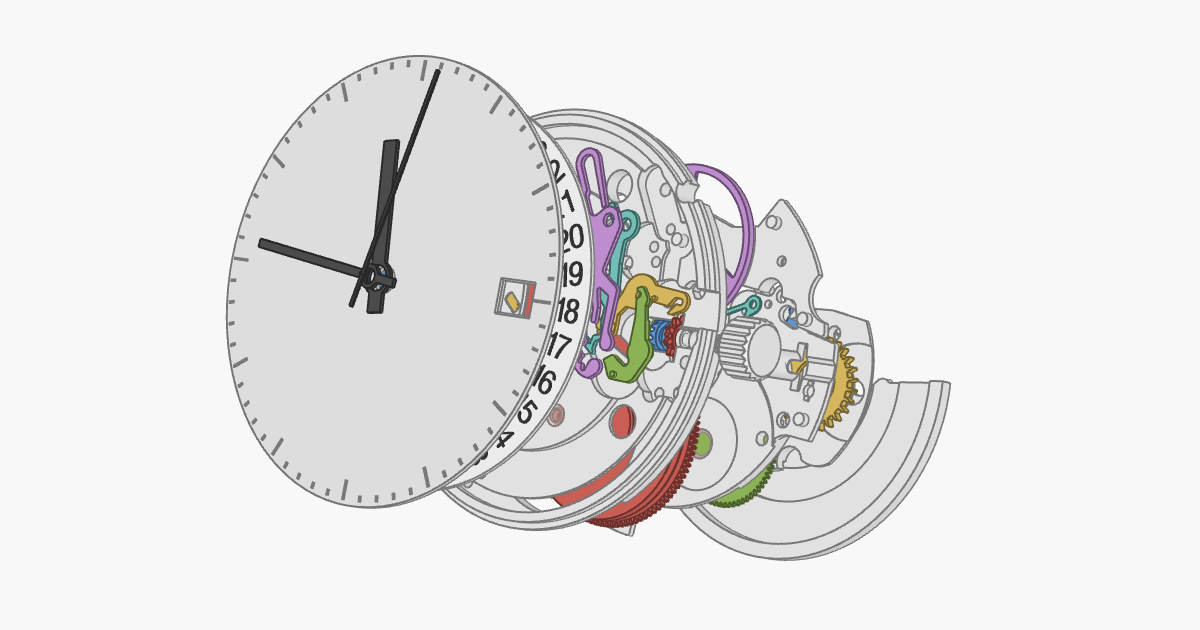
This may not be the most valuable comment, but my goodness, the quality of this writeup and it's interactive descriptions of complex mechanical components AND their interactions is radically impressive. The treatment of complex topics in deeply visual and partially interactive ways, for me at least, is a remarkably helpful way to learn.
Comments (413) 108 threads
[1]: https://ciechanow.ski/js/watch.js
But if you want to be friendly to the tinkerers, you could always host both the *.js and *.min.js versions, and have the webpage just pull the latter - anyone who wants the unminified source can remove the “min” part from the URI, while the majority of end users will still benefit from pulling the minified js.
In practice this seems to be a lost cause, and links to alternatively hosted source code is more common. Sadly this makes is simple to introduce subtle, harmful differences between the source and what is hosted.
Continue this thread — 1 reply
Seems better just to have premassaged source available in a repo somewhere, or called out on the page itself for a downloaded archive.
Minification strips comments too though, which may be undesirable in many cases.
Continue this thread — 7 replies
Continue this thread — 1 reply
Continue this thread — 1 reply
Hard disagree. "Use What's Right For You™".
Of course there is value in understanding the platform beneath your framework or generic library, but that's just an extension of "understand what you're using and why".
Doing it like this has the potential to be the most performant, but it does so in the same way as writing your programs directly in assembly is potentially performant.
I also don't think that the source code is particularly readable for me, and contains lots of magic numbers and very imperative code. I would personally find it a lot more readable if it was written in some sort of declarative way using a library, even if I have to look at a GitHub repo instead of view source.
Continue this thread — 1 reply
Continue this thread — 8 replies
> contains lots of magic numbers and very imperative code
Well, we really don't know if the code was written in this form by hand, don't we.
It could have been compiled into this, to use your words, "assembly with magic numbers and imperative" from much more elegant form. We may see this form only because this is what browsers understand.
I am not saying it was compiled, just speculating that seeing pure WebGL does not mean it was pure WebGL to begin with.
Continue this thread — 2 replies
It also has the potential to evolve in the most efficient way.
Also, nature and graphics works as an imperative parallel machine. So the code mirrors that.
This is not written deliberately this way. Code comes out like that when you strip all the libraries, fluff, and other less-related stuff.
I also write a scientific application, and yes, This is the way.
Yeah in this case it doesn't need to; there's no extraneous or unused code or documentation blocks, and gzip (and comparable) compression is good enough, minification doesn't actually reduce the downloaded code size by that much.
Continue this thread — 1 more reply
Continue this thread — 11 more replies
If mechanical watches tickle your fancy, there is a ton of watch repair video on YT. I particularly enjoy wristwatch revival (https://www.youtube.com/channel/UCD80T1s2Za4K682CQDGwEKQ).
A warning though, if you consider to get into that hobby. I tried, it's really hard, expensive (I spend close to €1k and that is with b-quality stuff. Good stuff is 5-10x more expensive.) and can be rather frustrating. Finding parts to buy can be complicated depending on your locale, loosing parts is very easy and destroying parts, even when gentle and careful is par for the course.
I hat to put my repair hobby on halt after running out of practice pieces. All now have broken or missing parts. your milage may vary ofcourse :)
I saw a custom mod watch that paired the face/movement of a Marathon navigator with an O&W diver case*. Is a combination I find desirable (as the Marathon bezel is too chunky for my use), but the maker won’t respond to emails.
Is it possible that the combination could be “ drop in” or is it likely to require significant modification?
*https://westcoastime.com/m16typidivbe.html
Where it gets tricky is if the target doesn’t use the same movement. In that case, I’d just buy an AliExpress watch with the same dial size and an ETA clone movement. Otherwise you have to ensure your target is the correct size and you’ll probably need to 3D print a movement holder.
Looking at the two watches you mention, the navigator has a Quartz Harley Ronda 373 movement and the diver has a ETA 2824-2 movement. The 373 I can't find the specs for, but from an ebay auction it seems to be a 11½’’’ diameter. The 2824-2 is the same diameter. However, all 11½’’’ ronda quartz movements I can find are 3mm thick where the 2824 is 4.6mm. So what I'd expect is that it will fit, but you might not be able to secure it properly. It really depends on how the movement is held in place. Perhaps you can fabricate/3d-print a spacer for that.
Another consideration is the lug stem, that might not be the right size. To long is solveable, to short means buying a replacement. I am also not sure wether the stems can have a different thickness, to thin and it wont be waterproof, to thick just won't fit.
You could probably try without destroying anything (no guarantees ;)), you are not really touching any of the fragile & tiny parts. But you will atleast need tool(s) to open the cases, they might be different, and a tiny screwdriver to release the lug. And I wouldn't count on it remaining waterproof, not sure.
Edit: I see that Marathon does make several watches with the 2824 (which would presumably simplify the process).
https://www.youtube.com/playlist?list=PLZioPDnFPNsHnyxfygxA0...
Wrist watches are pretty hard and expensive. Pocket watches are less so. When I was interested in getting more intimate with watch repair, I went to eBay and bought up a whole bunch of old pocket watch movements. I've got about 150 of them in various condition, most of them Waltham (easy to get, inexpensive, and I happen to have spent the first 25 years of my life spending a lot of time in the old Waltham Watch Co factory building because my father's company leased out space in it).
Basic tools aren't too bad, just a nice set of tweezers, screwdrivers, and a good magnifier is enough to do a lot of repairs. But you can fall down the rabbit hole pretty quickly with the desire for increased quality tools and things like a staking set so you can replace balance wheel arbors.
I tried to move from the pocket watches into wrist watches, and while the technology is largely the same, the reduced size and increased complexity made it less enjoyable for me. Instead I ended up moving the other direction and now have a nice collection of 18th and 19th century 30-hour and 8-day clocks (more commonly known as "grandfather clocks").
This little site really helped me cement in my mind what’s going on inside of the watch.
Also, almost everything I had to import in to the EU. Importing chemicals is expensive for some reason I discovered. UPS charged me like 3 times the usual amount.
There is a lot of advice that says 'don't cheap out, just buy good stuff'; which is great if you are going to make this really your hobby for years to come. But I feel starting with some cheap tools on a junk movement is a fine start.
Continue this thread — 3 more replies
Continue this thread — 9 replies
Continue this thread — 45 replies
All comments shown.
Couldn't load more comments. Check your connection and try again.