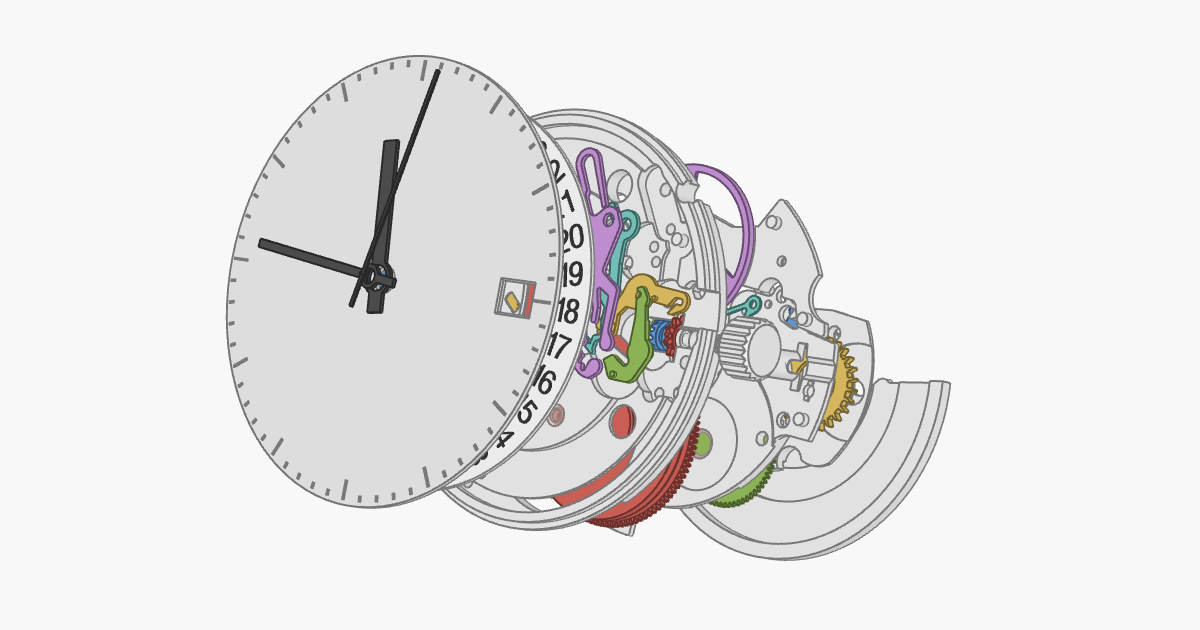
This man is marvelous. Even though I know how top-notch he is at writing interactive blog posts, he surprises me with his quality every time I open his new blog posts. Bartosz is a huge inspiration for me.
I don't make this comparison lightly but I'm reminded of Leonardo DaVinci. How much talent does one need to create something like this? It's not enough to be just 'good' at engineering, design, watchmaking, and writing... you have to be amazing at it ALL of it. AND have motivation to do it.
There's something magical about mechanical watches. Maybe it's just knowing that you have this perpetually winding machine on your hand (in the case of "automatic" mechanical watches).
Also knowing that the thing will last forever, take care of it and it will probably outlive you. Can't say that about an Apple Watch. If you want a good mechanical watch that won't break the bank I suggest picking up a Seiko SKX (though prices have been going up), a Vostok Amphibia (might be hard with the ukraine conflict) or a Timex Marlin.
As an owner of an SKX who doesn’t know much about watch longevity, how long can I expect it to last? Are there other automatics that will outlast a person’s life?
It still blows my mind that you can take the SKX scuba diving, especially when you factor in the price. This may sound cynical but as I get older and see the world becoming more and more digital and connected, I find myself appreciating analog, mechanical things like watches and old cars more and more.
If you are going to take your SKX diving, you probably want to have a watchmaker pressure test it once in a while and make repairs as needed. The seals dry out and water will get in.
I think maintenance requirements are overstated. I wore a relatively cheap (~£120) mechanical watch continuously for about 8 years, and never had a single problem with it. I only stopped wearing it about 2 years ago when I finally bought a smartwatch. It still works fine, I just don't wear it except on special occasions.
If your watch is a sizable investment then maybe you care about maintenance more, but otherwise I wouldn't worry that it's going to stop working in short order.
Mechanical watches can last a lifetime (or more) if properly maintained and periodically serviced, just like old cars.
People all over the world pass down their Rolexes and Omegas, still ticking, to their children and even grandchildren. Patek Philippe is well known for their slogan, "You never actually own a Patek Philippe. You merely look after it for the next generation," showing confidence in the longevity of their watches. Of course those are very expensive brands, but I think part of what makes expensive watches last longer is that their owners take good care of them. Few people bother to get their SKX checked up on a regular schedule, on the other hand, because they're so cheap and easily replaceable by first-world standards.
I have a 7s26A movement out of a late 90s SKX which was unserviceable, and another 7s26C became unusable after 4-5 months of use.
I also have a replacement 7s26C which worked flawlessly [-5,+5] s/d out of the box and a year so far, and another watch with NH35 which still holds [-5,+5] s/d after seven years of daily use. There are stories of SKX:s which hold good time after 20 years. There are much cheaper watches than SKX (at their current prices) that will withstand the depth, see "Beyond on the press" pressure chamber tests, for example https://www.youtube.com/watch?v=Ti-GdfGbj4Y
My father's Seiko from the late 70s still keeps time at around 30 seconds per day. It has never been serviced so I am sure it is bone dry and really should not be run. I regularly wear a 2015 Seiko that used to be 8 seconds per day fast but has fallen to 5 seconds per day slow so it is probably time to service it. My two newest watches are from 2017 and 2021 and they are consistent since break in. So given my limited number of data points, I would say 5-7 years between service but if you just want to wear it until it dies, 10+ years is probably reasonable.
On a side note, I have read about 40 year old Seikos being worn daily without service but that sure feels outside of the norm.
> Are there other automatics that will outlast a person’s life?
Very unlikely. You do hear the occasional story of a mechanical watch running fine for several decades without requiring any servicing, but there's a lot of survivorship bias at play there. It's extremely unlikely to go ~8 decades without needing servicing. Keep in mind there are lubricants at various places in the movement that are essential to proper operation that evaporate/denature over time.
Agree with you so much. It still feels absolutely magical wearing one. The SKX007 was my first automatic watch and I wore it daily for 10 years. Incredible thing.
A mechanical watch needs regular service which is usually just cleaning, lubricating, replacing seals and springs. Eventually it will need replacement parts and that is probably the end of life for the watch.
There are a some brands that will service every watch they've ever made, fabricating new parts as needed. Few of us can afford one of those.
The solar Casio I bought as a teenager stopped holding a usable charge after a few winters. Maybe it was just bad luck. I'll see if the new Citizen Eco-Drive in my collection lives up to the 40 years claim I saw elsewhere. :)
The parts last quite some time if properly maintained. If you're worried about replacement parts availability, stick with the most popular movements such as the ETA2824/SW200 series or Seiko's NH35 series.
A lot of watch fans are happy when they see a watch brand use an in-house movement. I’m exactly the opposite for the reason you say - the popular movements are going to be easily and inexpensively serviced for much longer.
That said, a lot of in-house movements are little more than tweaks and high end finishing applied to existing commodity movements.
For example, the size and fit of Seiko "calibers" are the same going back further than NH35, which means far older watches can accept NH35 as replacements. Even sub-assemblies and parts of NH35 fit straight onto 7s26s from the 90s.
NH35 can be serviced, but makes more sense an assembled replacement part. The same argument can probably made for the entire watch. The appeal of using one watch for 30 years is more in romantic fantasy than practicality.
Parts rarely fail on watches from the 50's on, especially the better made watches that are sealed. Even those that arn't sealed very well, the parts seem to last.
If a part does fail, it's usually the old blue steel mainsprings. They can be replaced with modern White-Alloy springs. (That is just a brand name.) Watches are my thing. I don't know why I like them so much, but do. Servicing does take awhile to learn though. That whole 10,000 hrs probally. Servicing a watch does not take that long to learn. I'm talking about making parts with a Jeweler's lathe. And getting to the point where you know those parts well enough to visualize exactly what's wrong with a timepiece by looking at it. If you did learn to clean/oil your mechanical watch, it's something that will be passed down to loved ones. Oh yea, Service a mechanical watch when it stops keeping good time. That is unless you take it in the water. I know a watchmaker who told his father he needed to Service his gifted wristwatch. His father got it 30 years ago as a present, and just wore it daily. The watchmaker was expecting dried up oil, but to his astonishment, the oil was still there. It was hermetically sealed. Oils do breakdown, but he couldn't find any damage to parts using a 40x stereoscope.
They last longer if you wear them, say, several times a month - i.e. if you have a rotation with several quartz watches and several mechanical ones. They definitely will last decades that way.
As others have noted, if you own a well-known brand like a Seiko you can easily purchase an entirely new movement for $50-$75 and this should take a watchmaker no more than one hour of labor or you can DIY. (Many non-Seiko brands use NH35/36 movements, which are made by Seiko)
Will Seiko provide parts for older watches? I just got stuck with a bricked Swiss Army quartz watch because no one can get parts for it (it's 20 years old). I'm very tempted by some of the more affordable Seiko mechanical/automatic models, but I'd like the watch to last at least a decade or so.
To that point - yes, but it's less expensive than many people think. I got a vintage 1970 Omega Seamaster in very good condition some time ago, paid less than £1000 for it. It kept very good time, no issues with it, but I decided that since it turned 50 recently I'm going to treat it to a full Omega service with an authorized workshop, paid £495 - that included replacement original parts from Omega, which of course they still stock and make for this watch, because well - it's Omega.
I asked them how this works, and they said anything younger than 80 years Omega just sends them parts without any issue, anything older they have to send back to Switzerland for service, and yes, then Omega might have to manufacture the parts required on the spot - and yes, that then turns really expensive.
Normally I would crap (pretty hard) on web tech, because normally, it's only ever used to make websites harder to follow in the name of design, or to create new ways for ads to be served to me.
This site, and the most recent blog entries on this site, are excellent examples of why web technologies are not all bad. People seeking new ways to make money make everything bad, eventually, and thankfully there are bastions of utility without sales still to be found, sprinkled around.
nah, people trying to make enough money don't create Facebook. people trying to have enough to live comfortably don't create Amazon.
monsters create those companies, and monsters grow them. growing larger and more profitable at any cost is called metastasis, and that's what's happening. lives get worse for most while the cancers grow and grow, almost unabated.
What is wrong about trying to find ways to produce a nice stuff and keep being to able to pay the rent and raise kids?
I run a small and nice visual weather app for Apple Watch and iPhone (https://weathergraph.app). Some people in reviews object to price, but if I wasn't able to charge a subscription (because weather data costs money continuously), there would be no app. And if I wasn't able to make (about 50 % there right now) a living, I would work for a corporation like I did before, and I wouldn't be able to dedicate enough time to make it great ¯\_(ツ)_/¯.
I'm not talking about people like you who make apps like yours.
I'm talking about companies that make everything they touch demonstrably worse if it earns them any money at all. there is a very clear line between you and the companies I'm talking about. you provide a service; the companies I talk about are late-stage capitalism monsters who exist solely to provide value to shareholders, and they don't care if they create a dystopia by doing it.
Mechanical watch nerd here. This describe an ETA (swiss) movement, I really prefer the Japanese movement (I know mostly seikos). The mechanism are more simple and more robust.
For instance, on ETA the crown mechanism is really sensitive, a lot of tiny fragile parts with a lot of tension in them, it go wrong easily.
Also, seeing this web page I got frustrated by the fact it doesn't tackle what got me the hardest time: how can the crown move the hands without any clutch mechanism (some have) ?
It's a matter of friction and torque, so it's hard to get while reasoning on a "perfect" mechanism.
It doesn't go into a lot of detail but the article does say:
> Notice that when we turn the minute wheel only the cannon pinion turns. That pinion fits tightly inside its driving gear – it usually turns with that gear. However, when the driving gear can’t rotate because it’s blocked by the rest of the gear train, the cannon pinion can overpower the friction of that tight fit and rotate on its own. This lets us set time without interfering with the gear train, which could break the delicate parts. Personally, I was wondering how one can wind the watch from the crown without engaging the weight of the autowinding mechanism. I'm guessing that winding with the crown causes the ratchet to slip on both pairs of blue/yellow gears.
Comments (413) 108 threads
Earlier commentsI'm just in awe.
Also knowing that the thing will last forever, take care of it and it will probably outlive you. Can't say that about an Apple Watch.
If you want a good mechanical watch that won't break the bank I suggest picking up a Seiko SKX (though prices have been going up), a Vostok Amphibia (might be hard with the ukraine conflict) or a Timex Marlin.
Mechanical watches are still indeed cool though. :)
It still blows my mind that you can take the SKX scuba diving, especially when you factor in the price.
This may sound cynical but as I get older and see the world becoming more and more digital and connected, I find myself appreciating analog, mechanical things like watches and old cars more and more.
If your watch is a sizable investment then maybe you care about maintenance more, but otherwise I wouldn't worry that it's going to stop working in short order.
People all over the world pass down their Rolexes and Omegas, still ticking, to their children and even grandchildren. Patek Philippe is well known for their slogan, "You never actually own a Patek Philippe. You merely look after it for the next generation," showing confidence in the longevity of their watches.
Of course those are very expensive brands, but I think part of what makes expensive watches last longer is that their owners take good care of them. Few people bother to get their SKX checked up on a regular schedule, on the other hand, because they're so cheap and easily replaceable by first-world standards.
Continue this thread — 1 reply
I also have a replacement 7s26C which worked flawlessly [-5,+5] s/d out of the box and a year so far, and another watch with NH35 which still holds [-5,+5] s/d after seven years of daily use.
There are stories of SKX:s which hold good time after 20 years.
There are much cheaper watches than SKX (at their current prices) that will withstand the depth, see "Beyond on the press" pressure chamber tests, for example https://www.youtube.com/watch?v=Ti-GdfGbj4Y
On a side note, I have read about 40 year old Seikos being worn daily without service but that sure feels outside of the norm.
Very unlikely. You do hear the occasional story of a mechanical watch running fine for several decades without requiring any servicing, but there's a lot of survivorship bias at play there. It's extremely unlikely to go ~8 decades without needing servicing. Keep in mind there are lubricants at various places in the movement that are essential to proper operation that evaporate/denature over time.
It's a mechanical device which stores energy in a spring barrel, and consumes it through a set of gears to produce constant velocity motion.
There are a some brands that will service every watch they've ever made, fabricating new parts as needed. Few of us can afford one of those.
Continue this thread — 3 replies
That said, a lot of in-house movements are little more than tweaks and high end finishing applied to existing commodity movements.
Continue this thread — 4 replies
NH35 can be serviced, but makes more sense an assembled replacement part. The same argument can probably made for the entire watch. The appeal of using one watch for 30 years is more in romantic fantasy than practicality.
If a part does fail, it's usually the old blue steel mainsprings.
They can be replaced with modern White-Alloy springs. (That is just a brand name.)
Watches are my thing. I don't know why I like them so much, but do.
Servicing does take awhile to learn though. That whole 10,000 hrs probally. Servicing a watch does not take that long to learn. I'm talking about making parts with a Jeweler's lathe. And getting to the point where you know those parts well enough to visualize exactly what's wrong with a timepiece by looking at it.
If you did learn to clean/oil your mechanical watch, it's something that will be passed down to loved ones.
Oh yea, Service a mechanical watch when it stops keeping good time. That is unless you take it in the water.
I know a watchmaker who told his father he needed to Service his gifted wristwatch. His father got it 30 years ago as a present, and just wore it daily. The watchmaker was expecting dried up oil, but to his astonishment, the oil was still there. It was hermetically sealed. Oils do breakdown, but he couldn't find any damage to parts using a 40x stereoscope.
As others have noted, if you own a well-known brand like a Seiko you can easily purchase an entirely new movement for $50-$75 and this should take a watchmaker no more than one hour of labor or you can DIY. (Many non-Seiko brands use NH35/36 movements, which are made by Seiko)
Continue this thread — 1 reply
I asked them how this works, and they said anything younger than 80 years Omega just sends them parts without any issue, anything older they have to send back to Switzerland for service, and yes, then Omega might have to manufacture the parts required on the spot - and yes, that then turns really expensive.
Continue this thread — 3 replies
Continue this thread — 2 more replies
Continue this thread — 10 more replies
This site, and the most recent blog entries on this site, are excellent examples of why web technologies are not all bad. People seeking new ways to make money make everything bad, eventually, and thankfully there are bastions of utility without sales still to be found, sprinkled around.
The “capitalism bad” trope is a tired one indeed.
monsters create those companies, and monsters grow them.
growing larger and more profitable at any cost is called metastasis, and that's what's happening. lives get worse for most while the cancers grow and grow, almost unabated.
I run a small and nice visual weather app for Apple Watch and iPhone (https://weathergraph.app). Some people in reviews object to price, but if I wasn't able to charge a subscription (because weather data costs money continuously), there would be no app. And if I wasn't able to make (about 50 % there right now) a living, I would work for a corporation like I did before, and I wouldn't be able to dedicate enough time to make it great ¯\_(ツ)_/¯.
I'm talking about companies that make everything they touch demonstrably worse if it earns them any money at all.
there is a very clear line between you and the companies I'm talking about. you provide a service; the companies I talk about are late-stage capitalism monsters who exist solely to provide value to shareholders, and they don't care if they create a dystopia by doing it.
Also, seeing this web page I got frustrated by the fact it doesn't tackle what got me the hardest time: how can the crown move the hands without any clutch mechanism (some have) ? It's a matter of friction and torque, so it's hard to get while reasoning on a "perfect" mechanism.
> Notice that when we turn the minute wheel only the cannon pinion turns. That pinion fits tightly inside its driving gear – it usually turns with that gear. However, when the driving gear can’t rotate because it’s blocked by the rest of the gear train, the cannon pinion can overpower the friction of that tight fit and rotate on its own. This lets us set time without interfering with the gear train, which could break the delicate parts.
Personally, I was wondering how one can wind the watch from the crown without engaging the weight of the autowinding mechanism. I'm guessing that winding with the crown causes the ratchet to slip on both pairs of blue/yellow gears.
Continue this thread — 1 more reply
All comments shown.
Couldn't load more comments. Check your connection and try again.