Show HN: I built an app for when I talk too much in online meetings (opens in a new tab)unblah.me
451 pointsAlexis here, I’m a product manager and software developer in Berlin by way of New York.
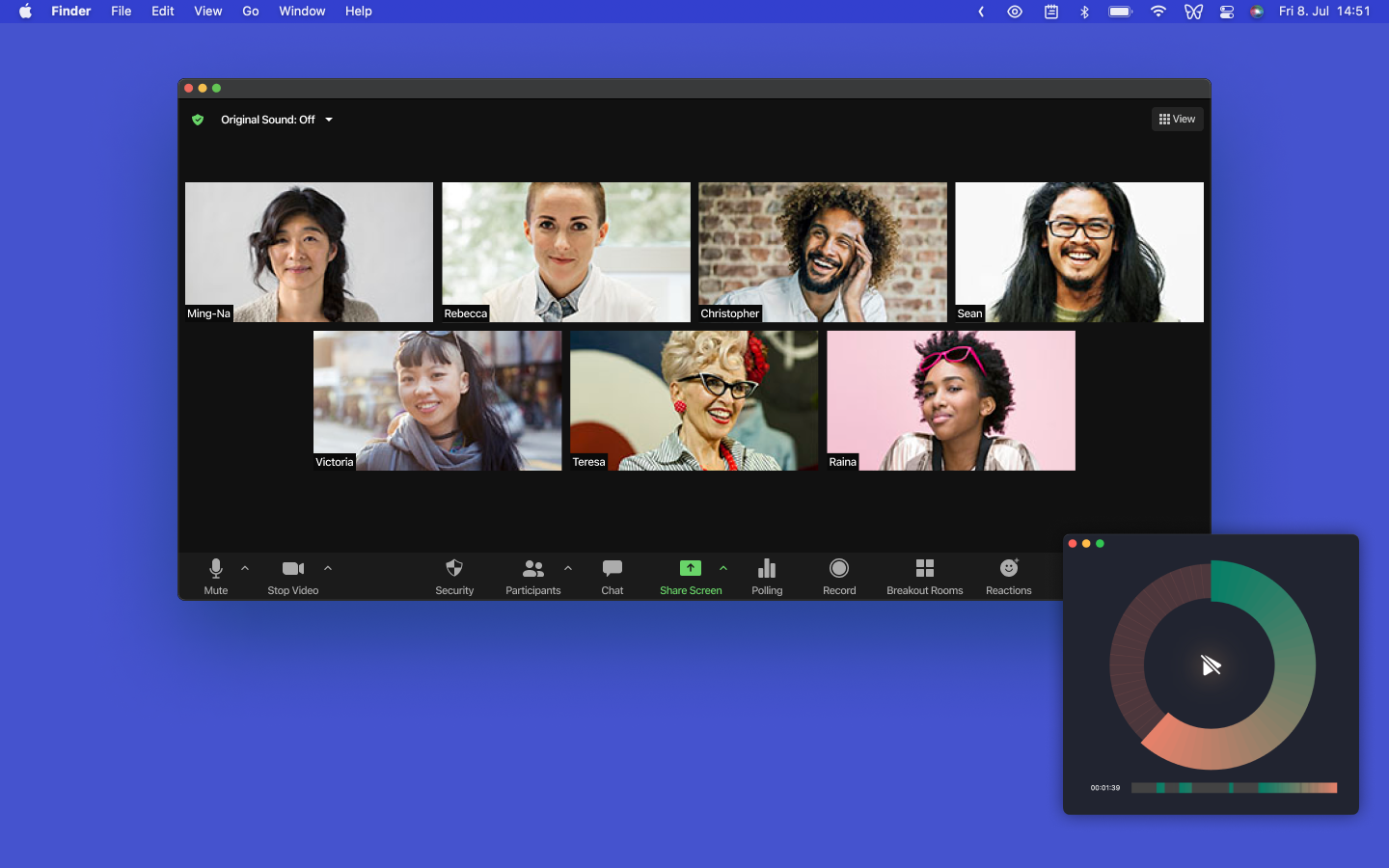
I want to show you this app I made – It’s like a "buddy" for those, like myself, who inadvertedly talk too much in meetings.
The app gives me feedback and a little more in control of what I have influence over by:
* Keeping track of how long I’ve been speaking
* Catching myself before I talk too much
* Developing a better sense of timing
I truly love having conversations with people in real-life.
But online meetings, especially group calls, tend to make me nervous. I can't read body language. The tone of voice, micro-experessions and social cues get lost.
If you, too, accidentally talk too much too often, check it out "Unblah". Watch the quick 2-minute demo and download the macOS app over at https://unblah.me/.
Cheers!
Alexis
PS: There’s a whole FAQ section for common questions you may have – Including if this is yet another "native" Electron app ;)
edit: bullet-list formatting
Comments (189) 56 threads
Earlier commentsFor everyone here who's asking how to get their coworkers using something like this, there's a similar feature in Sesh (web app https://sesh.com/ and zoom app https://marketplace.zoom.us/apps/lmZj36WWSJut8-hAaUJrhQ ) that gives everyone equal opportunities to speak (and plays you off oscars-style when you go too long), and another feature called "talk time" that shows how long each person spent talking at the end of each meeting.
At it's core, it's a really useful meeting agenda app, so sharing it is less "hey you talk too much" and more "let's make our meetings better and more equitable".
I work there & am happy to demo or answer any questions about it :)
Again, really love that you made a version of this that individuals can spin up for their own accountability without the need for whole-team buy in. The design is great too!
https://www.indy100.com/news/victorias-secret-model-lyndsey-...
https://www.fastcompany.com/40456604/these-women-entrepreneu...
https://hbr.org/1995/09/the-power-of-talk-who-gets-heard-and...
https://janicetomich.com/women-speaking-while-female/
https://time.com/3666135/sheryl-sandberg-talking-while-femal...
Hopefully it will raise awareness and those men who support equality in the workplace and more importantly, see the value of women’s ideas - ideas that they perhaps do not hear because they are not giving time for them to speak them- will benefit.
To be more specific, I am also afraid of over-indexing on inclusion. Do I call on female coworkers more often to speak up in areas where I know they are experts because I know they may not do so themselves? Is that fair to them? Does it make them feel inadequate or is it appreciated or does it not even register? If I ask Susan to elaborate on a sprint update but don't ask Frank does that signal that I don't trust Susan? What if I am really just interested in her task?
I know the cliches about confident white men in tech. Talking over people, the white savior, etc. But, as a confident white man in tech I need input from everyone to be better. So, thanks for sharing.
Continue this thread — 2 replies
It was hilarious when he was told by the moderator that no, Jo had used the least time. She’d make a good point, then stop talking. No bloviating like the men.
As a long timer man in tech, being a shy and private person and being uncomfortable speaking in public, I've experienced the same exact things listed in those articles for as long as I can remember, except having to fake a business partner cause I've never participated in a round of funding, but I'd probably hire one if I needed to. Because it would work better than sending myself.
I've learned that those aren't my strongest skills and that's OK, I've become a very good writer instead, because it's something I like and I feel comfortable doing. to the point that people now ask me to help them or plainly ask me if they can pay me to write for them (notice that if you think my writing is mediocre it's because it's true: English is not my native language and foreign languages are another of those "not my strongest skills", I'm much better with programming languages)
Sometimes things are as they are because we are as we are.
I also think there's a cultural aspect to the phenomenon, in some countries, especially in USA, people are pressured to talk in public and express "dominance" or "confidence" by taking the stand.
Fake until you make it they usually say.
In my case it only made me feel more of an impostor, who was faking skills he did not have.
Continue this thread — 2 replies
As someone who'd rather not speak I dislike this. Now I can't just sit back, relax, and let the talkative people run out the clock. There's now a metric to punish my quietness. :P
I can only speak for myself of course: The issue only happens in online meetings and probably only with specific teams. So, I would have "slipped through", if your interview process is in-person.
It starts with the awareness in my opinion. There are people who talk a lot and enjoy dominating the conversation. I wrote an extensive FAQ on why Unblah is not for them.
Those who (like me) talk a lot but are painfully aware – I think aren't extremely damaging. I hope.
I've been trying not to speak at all during meetings, instead following up in chat. As a bonus, this means there's a searchable record of the details, and thus is far more valuable than any in person or video meeting could ever be.
Agreed.
> I've been trying not to speak at all during meetings, instead following up in chat.
How does that work? I mean, interpersonally?
Continue this thread — 1 reply
I do not recommend using the app (especially not without context) as a proxy for a difficult conversation that may have to happen.
Since the question came up earlier, here is my full take on this situation: https://news.ycombinator.com/item?id=32097859
“Dave, found the perfect app for you!” is aggressive. “Wow I might start using this app!” Is better.
Yeah I thought about going this way.
GP is supposed to mediate while at work while their colleague is talking in circles?
Continue this thread — 2 replies
Zoom makes this even worse than in person, as the software often won't even let you insert yourself into someone else's stream-of-consciousness word salad to help them course-correct.
Unfortunately a lot of companies treat them like a pop quiz, ask everyone the same 10 questions, which are mapped to 10 selection criteria and evaluate their 10 mostly prepared responses.
Good interviewers will have a bunch of questions as prompts, but generally ask a lot of follow-ups.
I blame the STAR method mostly, the concept that you have instant recall of past experiences in a high pressure situation, indexed by the questions the company is going to ask, is absolutely crazy. I wonder if there’s been any research into “tell me about a conflict and how you resolved it” type behavioural questions and whether they are effective. Even the most dramatic of employee knows how to tone it down, rewrite/make up scenarios to pass these types of questions.
Corporate meetings are traditionally structured to accommodate those who talk too much in meetings, but they could be structured differently. Deliberate facilitation, for example "taking stack"[1]," can help the puzzle pieces of panel of diverse personalities find their place in contributing maximally to the tasks at hand. Heck, sometimes it's as easy as setting expectations or as simple (albeit not necessarily easy) as establishing an environment of psychological safety[2] in which coworkers feel comfortable pushing back on antisocial behavior, eg asking "can you not interrupt me?"
0. https://en.wikipedia.org/wiki/Fundamental_attribution_error
1. https://techresources.shoestringcollective.com/collaborate/t...
2. https://en.wikipedia.org/wiki/Psychological_safety
People who talk at length during hiring interviews are not necessarily "people who talk at length in meetings", they are doing that because that's what hiring interviews are about. You are misattributing cause.
For in-person, maybe just tell your team that you're feeling insecure about this and would love to get their real-time feedback (?)
Just to mirror what I understand: You have experienced that, while talking, you thought "Oh, I've been talking for hours already. I should stop now." but in reality you haven't even scratched the, let's say, 30 second mark?
Absolutely relevant – I hadn't even thought of that possibility. I'm actually thinking, the whole app could stay the same, just swap the green/red colors (?)
I'd actually love a tool like this for interviews -- if had a mac or there was a linux build I'd definitely use this.
Re: Colours -- If I were to use this for this use-case (next time work gives me a mac perhaps) I think the current green -> red arrangement is fine as-is, as it covers both use-cases (if red -> too long; if green -> still have time)
Continue this thread — 1 reply
Continue this thread — 1 more reply
All comments shown.
Couldn't load more comments. Check your connection and try again.