Show HN: I built my own PM tool after trying Trello, Asana, ClickUp, etc. (opens in a new tab)upbase.io
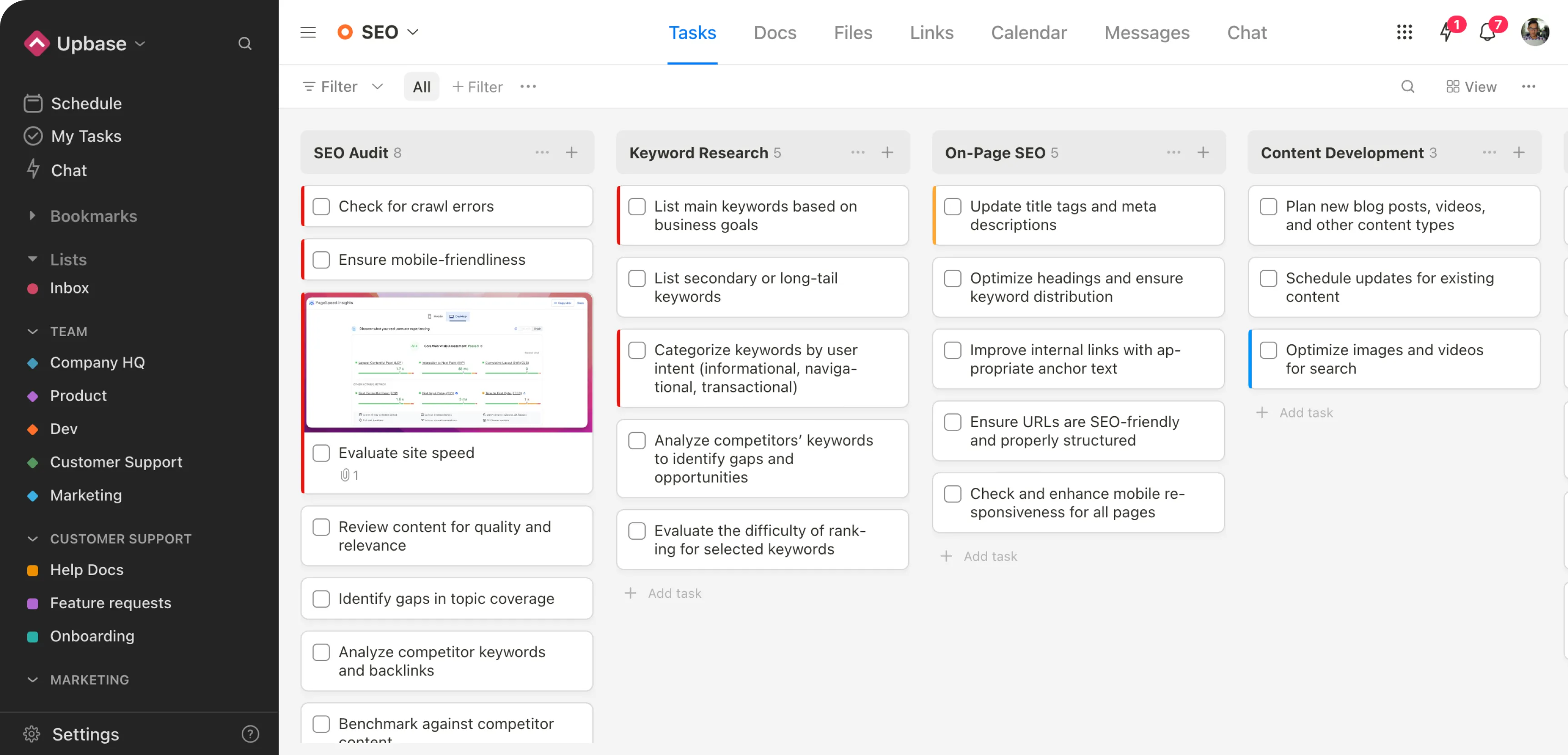
632 pointsOver the past two years, I've been building Upbase, an all-in-one PM tool.
I've tried so many project management tools over the years (Trello, Asana, ClickUp, Teamwork, Wrike, Monday, etc.) but they've all fallen short. Most of them are overly complicated and painful to use. Some others, like Trello, are too limited for my needs.
Most importantly, most of these tools tend to be focused on team collaboration and completely ignore personal productivity.
They are useful for organizing my work, but not great at helping me stay focused to get things done.
That's why I decided to build Upbase.
I try to make it clean and simple, without all the bells and whistles. Apart from team collaboration, I added many personal productivity features, including Weekly/Daily planner, Time blocking, Pomodoro Timer, Daily Journal, etc. so I don't need another to-do list app.
Now I can use Upbase to collaborate with my team AND manage your personal stuff at the same time, without all the bloat.
If these resonate with you, then give Upbase a try. It has a Free Forever plan though.
Let me know if you have any feedback or questions!
Comments (453) 118 threads
You’re marketing this as having “less complexity” which first of all, isn’t going to appeal to people unless they’ve already used the other tools. But, if they had tried Trello, that’s far from complex, as you say it doesn’t have the features you think are needed, so you are more complex than that. It might be that you’re excellent at UX but that needs some comparative examples to see how you have differentiated things.
Instead, it might make sense to go more with all the features you need, nothing you don’t angle. Note that I don’t think this really differentiates too much from clickup which has personal productivity options, and as you get bigger you know customers are going to ask for more and more features, because that’s what they do, and we also know that business accounts are the money makers in this market. It also runs counter to building an “all in one” tool. If you hope to replace chat, docs, collaboration, calendar, and journaling, that’s a big change for people who stepped in just looking for task management.
I did see that your prices are lower so you might try positioning based on lower prices than your competition, if you have carefully chosen those price points.
Positioning yourself as specifically designed for solo and small team project management to me is an underserved market. When I looked at your landing page, I scrolled down quickly thinking "cool another PM tool... just what the world needs". Then when I saw the line 3/4 of the way down that said "Specifically designed for solos, small teams and businesses" that caused me to perk up and go back to the top and look at the page from a different perspective that I was much more interested in.
I see now looking at it again that you mention "personal productivity" which I now understand is your way of saying small and solos. But I just interpreted it as a PM tool that made you productive amongst your team. So it didn't really resonate to me.
Anyway, the product is actually interesting. I'm going to check it out. I've been wanting a PM tool for solos. There are a couple out there, but they all suck. The best solution up to this point for solo project management that I have found is just using a generic solution like Notion or Trello and adapting it to my needs. So this is worth a shot IMHO.
The one thing I'm concerned about regarding the positioning of "a project management suite for solos and small teams" is that people will question: "If my team grows bigger, does the app still work well for us? Or we have to find another solution?"
Continue this thread — 3 replies
Continue this thread — 1 reply
I’d try something a little catchy’r on the home page.
“Personalized project management for the entire team”
Or something of that ilk
Continue this thread — 2 replies
This is the one thing I'm missing the most about Notion, Miro, Google Calendar, and all of this - offline support. In German trains, I'm offline, on flights, I'm often offline; while traveling, I'm often offline. Offline capabilities are often neglected.
I agree, the reason offline support is often not that great is that the customers who are most likely to pay for your product are the least likely to have issues with online connectivity or to care about offline support, OP's edge cases notwithstanding.
I even travel fairly often in the US and it's rare when I'm on a plane that doesn't have wifi.
The storage itself is trivial but for everything else (queries, syncing, conflicts, validation, permissions, schema changes) there's little support and I had to make my own stuff. It works for me, because because I only have 2-3 entities but your app is much more complex, so I wouldn't recommend it even if you started from scratch.
I will say that there's nothing that really stops offline aside from ecosystem support and maturity. All it really takes is a medium-big well maintained project that solves 80-90% of use cases. I think CRDTs are promising for the data layer because it simplifies the API surface (at the expense of complex implementation).
LocalStorage is easy to use but too limited at 50Mb.
WebSQL got deprecated by FireFox because of secuirty issues years ago ( albeit is still somewhat supported in Chrome ).
The FileSystem API looked promising, and then google killed it.
IndexedDb is the only option, it's slow on writes, therefore requiring major hacks like absurd-sql to be performant. It's also old, written before ES6, needs lots of boilerplate, but it does actually work. https://developer.mozilla.org/en-US/docs/Web/API/IndexedDB_A...
Even then however there is a limit of 2GB of persistent storage it can use, which is workable but still:
Some versions of Safari are known to delete IndexedDB after 1 week because of power savings. Chrome does not allow it unless you either accept notifications from that domain and/or pass a certain lighthouse score (these reasons are anectodal and not well-documented).
So yeah it's a mess, and a bit sad considering it will take years to ratify a better standard for this, but not impossible to do. Also annoying to know that internally your browser is actually using sqlite under-the-hood anyway.
Web based game engines (i.e. XREngine) are able to get by with IndexedDB i think, and apps like https://github.com/actualbudget/actual created by the author of absurd-sql are good codebases to follow as example.
WebAssembly based sqlite is coming along nicely too. https://sqlite.org/wasm/doc/tip/about.md.
I am personally working on an offline-capable ML product using pyscript, svelte & indexedDb and it's been a painful ammount of fun so far.
I haven’t tried it yet, but it’s at the top of my list. I want to try and combine it with LiteFS for syncing back up to the server, replication, etc.
Wondering if anyone has tried any of this out yet? There’s the potential for a renaissance of offline-first support for devs.
Edit: I see you mentioned it at the end, my bad
[0] https://news.ycombinator.com/item?id=33374402
Users are downloading apps less and less and relying more on web links from apps they already have. So they mostly tend to end up on their browser anyway, and then workflow is disrupted while commuting and going in and out of signal.
Other less important reasons to consider would be in my opinion:
Electron is a bit too heavy on memory for users with 8GB and less of ram albeit it's gotten better lately.
I can't use ublock-origin on chrome or private-relay on safari while using an electron app (in this case however I still benefit from adding a blocklist like https://someonewhocares.org/hosts/ipv6zero/ to my /private/etc/hosts file on mac)
Continue this thread — 1 reply
2 GB is a lot when you store plain json document data.
> IndexedDb is the only option, it's slow on writes
Only when you need a new transaction per write. Writing many documents in a single tx is not slow [1]
> Safari are known to delete IndexedDB after 1 week
This is not really a problem because if you have not used the app for one week, you can just replicate the data from the server again.
> WebAssembly based sqlite is coming along nicely too
WebAssembly cannot access the IndexedDB API. In my tests, all the wrappers that use webassembly are slower on writes the just using IndexedDB via javascript.
The fastest you can go is by using a Memory-Synced wrapper around IndexedDB, like LokiJS does it or the RxDB memory plugin. [2]
[1] https://rxdb.info/slow-indexeddb.html
[2] https://rxdb.info/rx-storage-memory-synced.html
You can't if you haven't been able to push up the data for a week.
But in that case, you'd just have to remember to 'use it' ever day or so.
Had a use case a few years back for data collection app in remote African villages. There were definitely situations where a week without decent data access were possible, and 'offline' became a requirement.
Continue this thread — 2 replies
Continue this thread — 2 replies
It uses OPS which could in theory be used by other kinds of database besides SQL.
https://web.dev/file-system-access/#accessing-files-optimize...
The File System Access API [0] exists today. Unfortunately it's only Chrome based browsers, and not Firefox supporting this. Mayby you referred to an older "standard".
[0] https://developer.mozilla.org/en-US/docs/Web/API/File_System...
So IMO selling offline support as a feature has to come with a clear description of what it means.
Asking sincerely: to me it seems that 50Mb is quite a bit of storage if you are only persisting simple numbers/strings or small JSON documents?
50MB is plenty for time/project tracking, calendar & similar.
It is until you hit the wall on it and then you end up with a lot of tough tradeoffs.
Continue this thread — 2 more replies
Continue this thread — 7 more replies
Continue this thread — 14 replies
>> Apart from team collaboration, I added many personal productivity features, including Weekly/Daily planner, Time blocking, Pomodoro Timer, Daily Journal, etc.
I'm having a hard time understanding how both statements can be compatible together. Open-minded to an explanation.
Continue this thread — 1 reply
All comments shown.
Couldn't load more comments. Check your connection and try again.