Show HN: I built my own PM tool after trying Trello, Asana, ClickUp, etc. (opens in a new tab)upbase.io
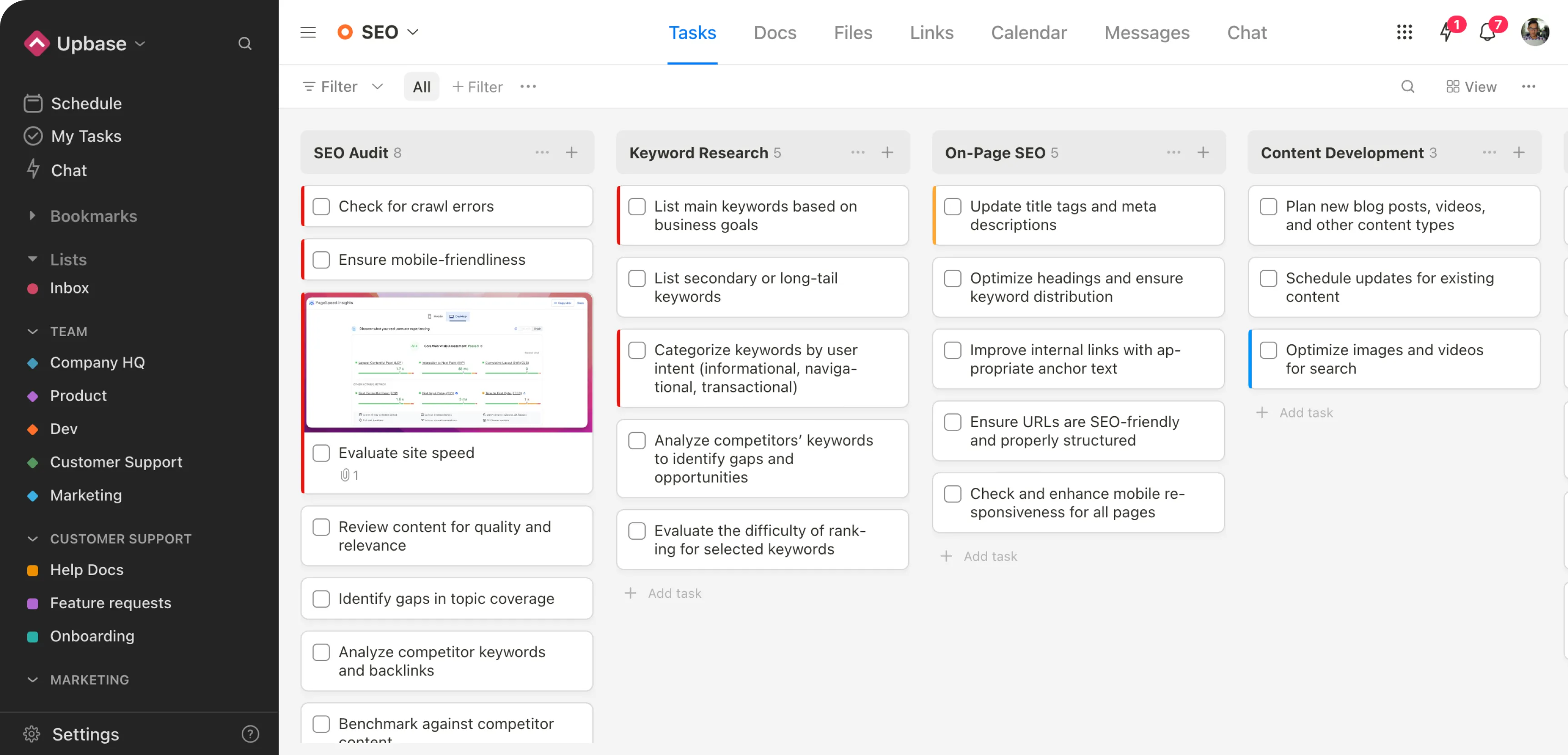
632 pointsOver the past two years, I've been building Upbase, an all-in-one PM tool.
I've tried so many project management tools over the years (Trello, Asana, ClickUp, Teamwork, Wrike, Monday, etc.) but they've all fallen short. Most of them are overly complicated and painful to use. Some others, like Trello, are too limited for my needs.
Most importantly, most of these tools tend to be focused on team collaboration and completely ignore personal productivity.
They are useful for organizing my work, but not great at helping me stay focused to get things done.
That's why I decided to build Upbase.
I try to make it clean and simple, without all the bells and whistles. Apart from team collaboration, I added many personal productivity features, including Weekly/Daily planner, Time blocking, Pomodoro Timer, Daily Journal, etc. so I don't need another to-do list app.
Now I can use Upbase to collaborate with my team AND manage your personal stuff at the same time, without all the bloat.
If these resonate with you, then give Upbase a try. It has a Free Forever plan though.
Let me know if you have any feedback or questions!
Comments (453) 118 threads
Show all comments
Showing thread 2 of 118
This is the one thing I'm missing the most about Notion, Miro, Google Calendar, and all of this - offline support. In German trains, I'm offline, on flights, I'm often offline; while traveling, I'm often offline. Offline capabilities are often neglected.
I agree, the reason offline support is often not that great is that the customers who are most likely to pay for your product are the least likely to have issues with online connectivity or to care about offline support, OP's edge cases notwithstanding.
I even travel fairly often in the US and it's rare when I'm on a plane that doesn't have wifi.
The storage itself is trivial but for everything else (queries, syncing, conflicts, validation, permissions, schema changes) there's little support and I had to make my own stuff. It works for me, because because I only have 2-3 entities but your app is much more complex, so I wouldn't recommend it even if you started from scratch.
I will say that there's nothing that really stops offline aside from ecosystem support and maturity. All it really takes is a medium-big well maintained project that solves 80-90% of use cases. I think CRDTs are promising for the data layer because it simplifies the API surface (at the expense of complex implementation).
LocalStorage is easy to use but too limited at 50Mb.
WebSQL got deprecated by FireFox because of secuirty issues years ago ( albeit is still somewhat supported in Chrome ).
The FileSystem API looked promising, and then google killed it.
IndexedDb is the only option, it's slow on writes, therefore requiring major hacks like absurd-sql to be performant. It's also old, written before ES6, needs lots of boilerplate, but it does actually work. https://developer.mozilla.org/en-US/docs/Web/API/IndexedDB_A...
Even then however there is a limit of 2GB of persistent storage it can use, which is workable but still:
Some versions of Safari are known to delete IndexedDB after 1 week because of power savings. Chrome does not allow it unless you either accept notifications from that domain and/or pass a certain lighthouse score (these reasons are anectodal and not well-documented).
So yeah it's a mess, and a bit sad considering it will take years to ratify a better standard for this, but not impossible to do. Also annoying to know that internally your browser is actually using sqlite under-the-hood anyway.
Web based game engines (i.e. XREngine) are able to get by with IndexedDB i think, and apps like https://github.com/actualbudget/actual created by the author of absurd-sql are good codebases to follow as example.
WebAssembly based sqlite is coming along nicely too. https://sqlite.org/wasm/doc/tip/about.md.
I am personally working on an offline-capable ML product using pyscript, svelte & indexedDb and it's been a painful ammount of fun so far.
I haven’t tried it yet, but it’s at the top of my list. I want to try and combine it with LiteFS for syncing back up to the server, replication, etc.
Wondering if anyone has tried any of this out yet? There’s the potential for a renaissance of offline-first support for devs.
Edit: I see you mentioned it at the end, my bad
[0] https://news.ycombinator.com/item?id=33374402
Users are downloading apps less and less and relying more on web links from apps they already have. So they mostly tend to end up on their browser anyway, and then workflow is disrupted while commuting and going in and out of signal.
Other less important reasons to consider would be in my opinion:
Electron is a bit too heavy on memory for users with 8GB and less of ram albeit it's gotten better lately.
I can't use ublock-origin on chrome or private-relay on safari while using an electron app (in this case however I still benefit from adding a blocklist like https://someonewhocares.org/hosts/ipv6zero/ to my /private/etc/hosts file on mac)
Continue this thread — 1 reply
2 GB is a lot when you store plain json document data.
> IndexedDb is the only option, it's slow on writes
Only when you need a new transaction per write. Writing many documents in a single tx is not slow [1]
> Safari are known to delete IndexedDB after 1 week
This is not really a problem because if you have not used the app for one week, you can just replicate the data from the server again.
> WebAssembly based sqlite is coming along nicely too
WebAssembly cannot access the IndexedDB API. In my tests, all the wrappers that use webassembly are slower on writes the just using IndexedDB via javascript.
The fastest you can go is by using a Memory-Synced wrapper around IndexedDB, like LokiJS does it or the RxDB memory plugin. [2]
[1] https://rxdb.info/slow-indexeddb.html
[2] https://rxdb.info/rx-storage-memory-synced.html
You can't if you haven't been able to push up the data for a week.
But in that case, you'd just have to remember to 'use it' ever day or so.
Had a use case a few years back for data collection app in remote African villages. There were definitely situations where a week without decent data access were possible, and 'offline' became a requirement.
Continue this thread — 2 replies
Continue this thread — 2 replies
It uses OPS which could in theory be used by other kinds of database besides SQL.
https://web.dev/file-system-access/#accessing-files-optimize...
The File System Access API [0] exists today. Unfortunately it's only Chrome based browsers, and not Firefox supporting this. Mayby you referred to an older "standard".
[0] https://developer.mozilla.org/en-US/docs/Web/API/File_System...
So IMO selling offline support as a feature has to come with a clear description of what it means.
Asking sincerely: to me it seems that 50Mb is quite a bit of storage if you are only persisting simple numbers/strings or small JSON documents?
50MB is plenty for time/project tracking, calendar & similar.
It is until you hit the wall on it and then you end up with a lot of tough tradeoffs.
Major technical corrections on this:
WebSQL was never implemented by Firefox. It was an experimental thing that Chrome and Safari shipped, but Firefox refused to because it was the wrong direction since it was certain to in the future cause either major compatibility or functionality problems. The Chrome and Safari developers agreed with this assessment, and so the draft was discontinued, and the two implementations deprecated. Safari finally removed its three years ago, and Chrome has begun the process of removing its this year.
There were no security issues whatsoever—it’s just that what had been made was unsuitable for standardisation, and no one was willing to do the work that would be required to make it suitable for standardisation perhaps because there was no consensus that it would still be a good idea in that form. All up, the WebSQL story is pretty much “it seemed like a good idea at the time because people want the result, and we implemented and shipped it because it was really easy, but then we stepped back and thought things through and realised the entire approach was a mistake”.
How do you mean? They're doing blog posts about web access to the filesystem just this month.
Continue this thread — 6 more replies