Show HN: I built my own PM tool after trying Trello, Asana, ClickUp, etc. (opens in a new tab)upbase.io
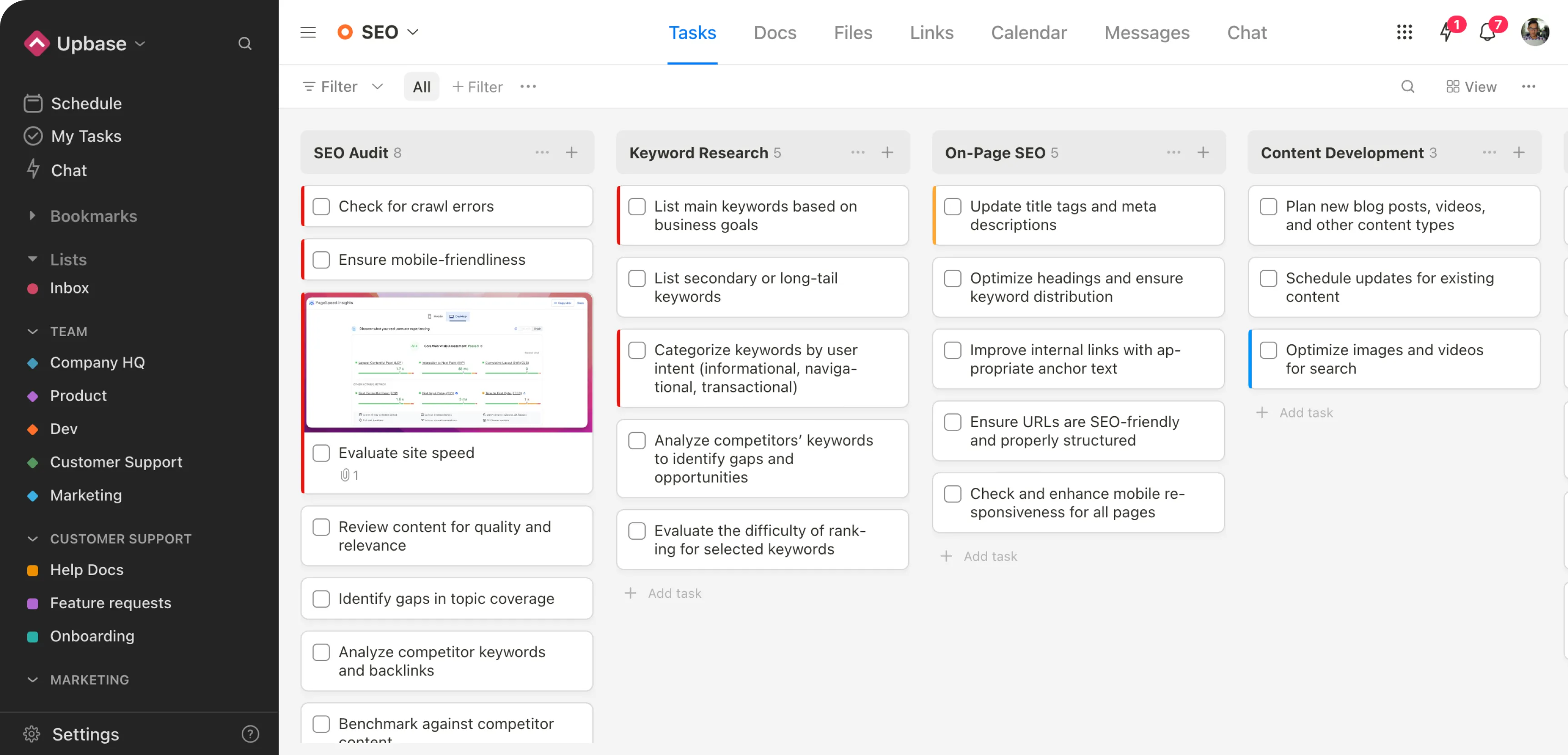
632 pointsOver the past two years, I've been building Upbase, an all-in-one PM tool.
I've tried so many project management tools over the years (Trello, Asana, ClickUp, Teamwork, Wrike, Monday, etc.) but they've all fallen short. Most of them are overly complicated and painful to use. Some others, like Trello, are too limited for my needs.
Most importantly, most of these tools tend to be focused on team collaboration and completely ignore personal productivity.
They are useful for organizing my work, but not great at helping me stay focused to get things done.
That's why I decided to build Upbase.
I try to make it clean and simple, without all the bells and whistles. Apart from team collaboration, I added many personal productivity features, including Weekly/Daily planner, Time blocking, Pomodoro Timer, Daily Journal, etc. so I don't need another to-do list app.
Now I can use Upbase to collaborate with my team AND manage your personal stuff at the same time, without all the bloat.
If these resonate with you, then give Upbase a try. It has a Free Forever plan though.
Let me know if you have any feedback or questions!
Comments (453) 118 threads
Show all comments
Showing thread 6 of 118
My personal opinion as a Product Manager is that there is no all-in-one tool, there never will be an all-in-one tool, and anyone promising an all-in-one tool has some significant blinders on around the job functions they have been exposed to.
Sales will use Salesforce. Engineering will use JIRA. And Product will use some generic roadmap-first tool like Asana, Trello, Miro, Monday, or MS Project. Product will beg everyone to use their tool, but no one will because it's for looking at work, not executing on it.
Product will not understand because we Product Managers don't actually DO things, we talk to people, organize ideas at a coarse level - and we have a simple tool that articulates the vision perfectly! Except it doesn't automatically integrate with the CI/CD pipeline, it doesn't automatically log the last touch with a high-priority prospect, it doesn't pass designs from the designer to the UX engineer. It doesn't actually DO anything. It becomes just another SaaS platform in our Okta stack that only the PMs look at - and it gets out of sync with the actual reality reflected in the other SaaS offerings.
And the reason it doesn't do those things is because the people who built it thought that THEY were the ones who could build the all-in-one project management tool and all those sales people, engineers, designers, lawyers, and marketing writers would log in to theirs. Insert relevant XKCD about standards here. The truth is no PM tool will ever be the system of record for the actual work, but everyone is afraid that the complexity of integrating with others will turn them into JIRA.
So we get these vaguely opinionated ways of moving around and arranging candy-colored cards, and those cards never quite show us the state of the project we are managing, so we have to bug people to "update their status in " before the weekly meeting. Which they don't want to do because it delivers no value to THEM.
Which is all a long-winded way of saying - please think about how a piece of work from each of those functions might be represented in your view, and how that integration would happen automatically.
This is the only way to truly achieve the type of transparency we're all searching for.
Like, how do you translate git commits and tests run to “project Y is now Z% done”?
I think you need to put a lot of work into making the JIRA and Salesforce integrations incredibly clean, not try to get the engineers and biz dev folks to log into a single portal. Look at each of those tools with an editor's eye and figure out what is going to survive into the PM's representation and what is un-necessary complexity.
--------------------------------
Going into specifics of how I tend to run this... Personally, I've found the VMOST[1] (Vision, Mission, Objective, Strategy, Tactic) stack to be the best way of linking vision to roadmap - as lightweight as feasible while providing structure. I rename the pieces to (Vision, Objective, Key Result, Focus Area, Initiative) which tend to be more understandable to most people. This gets bonus points for easily tying into the OKR planning process that many companies run now.
That gives basically a 3-layer strategy pyramid:
* Vision: What we think the best future would look like, where we help someone do something valuable. Maybe 3 years away.
* OKRs: 3ish Objectives that we think will get us much closer to that Vision if we achieve them. For each of those, 3ish Key Results that are objective measures that let us know we have hit our Objectives or are at least going in the right direction at speed.
* Work: 2ish Focus Areas for each Objective that are consensus hypotheses of directionally how we would achieve the Key Results. Then within each Focus Area, 3-5 initiatives.
Put in time order, these Initiatives form the Roadmap. The exact scale of what counts as an Initiative depends on the team and what we're doing, but some examples: A Feature or Epic. Getting a key partnership signed. Launching a marketing campaign. Opening an office.
All of those need to be tracked in one place so that we know overall progress, track inter-function dependencies, and can have serious conversations about what's working and what isn't. It needs to be in one place so that I can ask "Is anyone doing literally anything that is not in this view? Why are you doing that thing?" The answer is usually either "SVP so-and-so said their thing was really important" or "we need to do that operationally so the current product doesn't fall apart." In which case I need to have a conversation with SVP so-and-so, and we need to explicitly decide that we are or are not ok with the current product falling apart, and incorporate support into the stack.
I always do this manually using a Wiki like Confluence, because integrations don't work right and I'm not taking time away from people who actually do things to play bookkeeping games.
[1] https://bad.tools/library/toolkits/vmost/
Learned two interesting things
- if your tool mandates a philosophy or process, you massively shrink your market
- real pms , sponsors and engineer s buffer their risk by selectively disclosing information. They don't want a permanent record of open, granular outcome information unless they are in a very mature company.
I worked on an HR system recently, and "continual feedback" is all the rage. Folks have realized that those annual reviews and PIPs are completely divorced from reality - if we gave people continuous, incremental feedback they could course correct much more regularly. That ought to reduce the emotional shock of a PIP or a bad review, and also the time lost before the employee improves.
So performance review systems have started adding the ability to officially record weekly 1:1 meeting notes, and then getting confused that no one is using this oft-requested feature. Of course any honest feedback is purely verbal, or stored in shared documents kept as far away from HR as possible. The very fact that it's an Official HR Record makes it completely useless for purposes of getting truly honest feedback in there.
You don't, because in most cases, for anything that has the scale of a "project", nobody knows how many commits it will take for it to be done.
How many times have we seen PMs trying to brute-force JIRA (et. al) into a project management tool using weird plugins that don't co-exist peacefully. This always fails, and PMs either retreat to their own trusted platforms (if you're lucky), or in severe cases start asking everybody for "excel summary" or some "one pager" to reveal that holy "project status".
second, if your product management processes deliver no value to your colleagues, then you may need to work on that, perhaps more as an organization than an individual pm. the product management process and tooling should absolutely deliver value to developers, designers, and other individual contributors. most pertinently, tracking velocity is for the team first and foremost, and secondarily for others. it's like keeping score in basketball--it's how the team knows how it's doing.
third, it may be big and "enterprisey", but jira is just fine for product/project management. when folks complain about jira, ~99% of the time, it's a complaint about the process and people involved, but turned toward the tool because it's hard to criticize the offending party directly.
i do agree that product management tooling is secondary to sales, marketing, finance, accounting, etc., and so must interface with those other systems for "truth" rather than being a system of record.
You can either run it out of JIRA and only manage the work of software engineers, or you can run it out of something else and be out of sync. Probably the biggest mental trap PMs of both kinds fall into is running all status checks out of JIRA and ignoring everything about their product/project/career that isn't accomplished by pushing code to prod.
I find the people do get value out of what Product brings to the table, and absolutely buy into the vision (especially if they help define it). That doesn't make them motivated to maintain an additional project tracker for a status meeting. They also don't like flossing, even though they hate cavities.
And that's what we're talking about at the end of the day, because JIRA IS really good at what it does - either everyone gets aboard the JIRA train, or the engineers track all their tickets in something less powerful, or you ask the engineers to use JIRA AND something else.
Most established places go with the first option and then their only muscle is "ship code," many startups go with the second option until they realize they actually need JIRA after all. Then some PM (of one kind or the other) has to make the third option work so that they stop getting blindsided by the compliance work or the marketing campaign.
Not exactly. Most of the time, when people complain about JIRA they are complaining about its complexity, which gets exacerbated by PM's attempts to customize the system to their own liking, turning it into spaghetti. Even when the actual intended process is fine. That, and the slowness, subpar UI and arcane permissions system.
For solos and small teams with simple workflows, I think they'll be able to use some types of "all-in-one" tools to manage their work. For large teams with complex processes, I agree with you that there are no all-in-one tools that could work well for all functions.
I've seen a lot of Monday/Asana/Trello islands in larger orgs, where someone got a foothold for their 3-10 person team but now it can't ever scale. To some extent, using those tools is betting that you'll never actually be successful (if success will require scaling the people/functions that need to be involved). What's the plan for your customers once their thing works and they want to grow?
My vision for the product is to serve solos and small teams, so we'll try to keep everything clean and simple.
Thanks again for joining the conversation here.
I've found the lesser of two evils to be that Product integrate as closely as possible with engineering, which means using either Jira or GitHub issues for high"er" level deliverables. You have to be careful not to use too much of the textbook PM speak--"As a , I can do with the platform"--but if you orient yourself around the logical scoping of engineering work, it's a whole hell of a lot easier for engineers to tie their own work items into the progress (or unfortunate lack thereof) that all of us are inevitably expected to report up to our various business leaders.
That does require some technical acumen. I'm the first to admit that I don't have any of the formal bona fides for said acumen (and I deal with a great deal of imposter syndrome as a result). But when I listen to the engineers, understand their technical blockers, AND colocate our work items, I usually have an easier time.
And yeah, I still gotta copy/paste a bunch of shit into Sheets/Slides for management