Show HN: I built my own PM tool after trying Trello, Asana, ClickUp, etc. (opens in a new tab)upbase.io
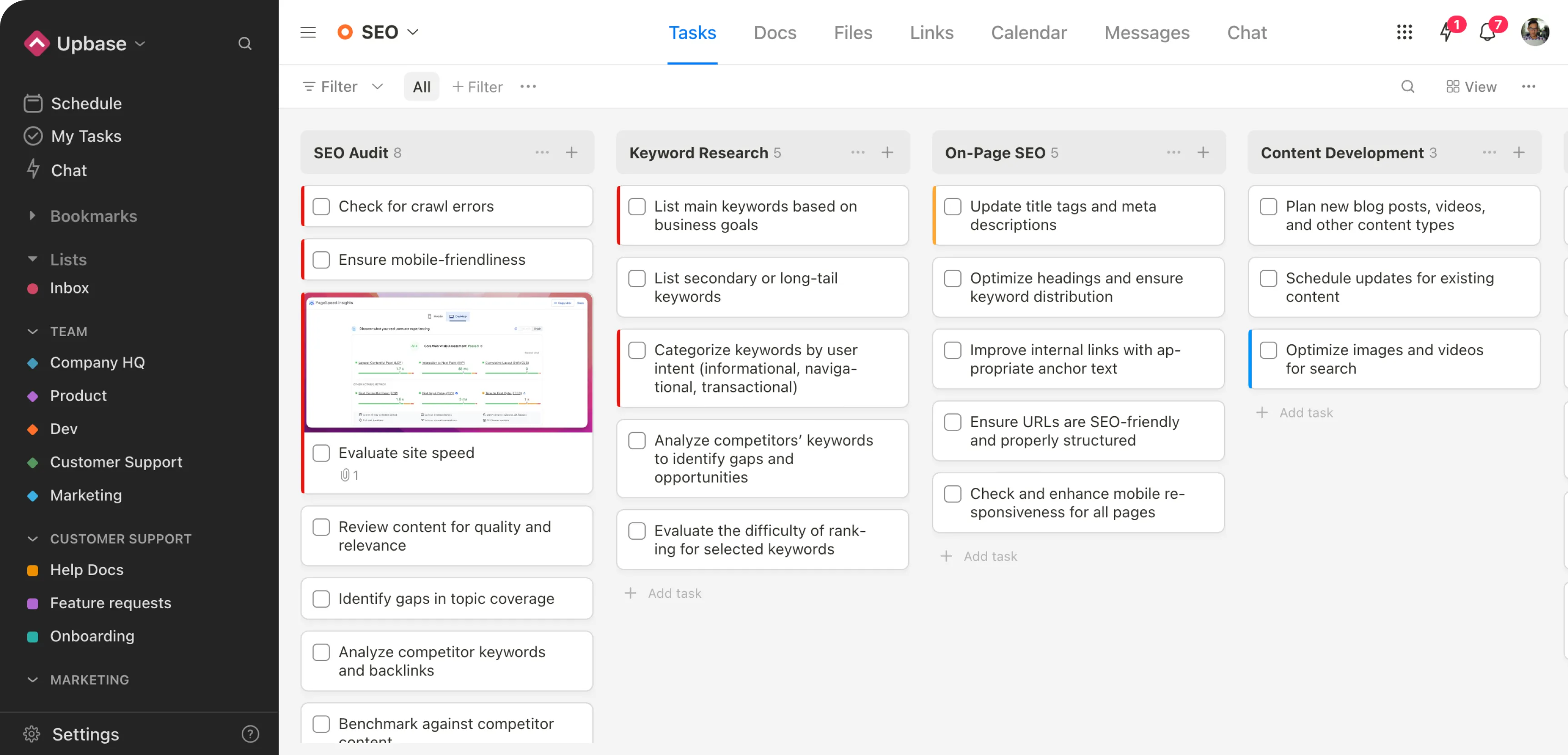
632 pointsOver the past two years, I've been building Upbase, an all-in-one PM tool.
I've tried so many project management tools over the years (Trello, Asana, ClickUp, Teamwork, Wrike, Monday, etc.) but they've all fallen short. Most of them are overly complicated and painful to use. Some others, like Trello, are too limited for my needs.
Most importantly, most of these tools tend to be focused on team collaboration and completely ignore personal productivity.
They are useful for organizing my work, but not great at helping me stay focused to get things done.
That's why I decided to build Upbase.
I try to make it clean and simple, without all the bells and whistles. Apart from team collaboration, I added many personal productivity features, including Weekly/Daily planner, Time blocking, Pomodoro Timer, Daily Journal, etc. so I don't need another to-do list app.
Now I can use Upbase to collaborate with my team AND manage your personal stuff at the same time, without all the bloat.
If these resonate with you, then give Upbase a try. It has a Free Forever plan though.
Let me know if you have any feedback or questions!
Comments (453) 118 threads
Show all comments
Showing thread 9 of 118
The UI would look like a graph and like ms project it could include resource levelling in order to show bottlenecks.
I know this probably sounds complicated but I think it maps to reality fairly well and thus actually simple (fighting reality is hard).
Powerful functionality always comes with the cost of UI/UX. We'll try to make our app simple and easy to use, so we try to avoid any complex features.
Anyway, thanks so much for your feedback and ideas. I appreciate it.
Critical path method > Basic techniques: https://en.wikipedia.org/wiki/Critical_path_method#Basic_tec... :
GitLab EE and Gitea have time tracking on Issues and Pull Requests.> Components: The essential technique for using CPM [8][9] is to construct a model of the project that includes the following:
> (1) A list of all activities required to complete the project (typically categorized within a work breakdown structure), (2) The time (duration) that each activity will take to complete, (3) The dependencies between the activities and, (4) Logical end points such as milestones or deliverable items.
> Using these values, CPM calculates the *longest path* of planned activities to logical end points or to the end of the project, and *the earliest and latest that each activity can start and finish without making the project longer.* This process determines which activities are "critical" (i.e., on the longest path) and which have "total float" (i.e., can be delayed without making the project longer). In project management, a critical path is the sequence of project network activities which add up to the longest overall duration, regardless if that longest duration has float or not. This determines the *shortest time possible to complete the project.\ "*
Re: [Hilbert curve, Pyschedule, CSP,] Scheduling of [OS, Conference Room,] and other Resources https://news.ycombinator.com/item?id=31777451 https://westurner.github.io/hnlog/#comment-31777451
Complexity and/or Time estimates can be stuffed into nonexclusive namespaced label names on GitHub/GitLab/Gitea:
Gitea has untyped Issue dependency edges, but there could probably easily be another column in the is-it-a through table for the many-to-many Issue edges table to support typed edges with URIs i.e. JSONLD RDF.
GitLab Free supports the "relates to" Linked Issue relation; EE also supports "blocks"/"is blocked by".
Planning poker: https://en.wikipedia.org/wiki/Planning_poker
Agile estimation: https://www.google.com/search?q=agile+estimation
"Agile Estimating and Planning" (2005) https://g.co/kgs/kDScM7
When you really need it (like in the case of tens of thousands of people trying to build and ship a single project at lighting speed) PERT is an extremely powerful and effective project management methodology. If, on the other hand, your "project management division" is you, it's a dangerously seductive time sink that will consume huge amounts of your time building and tuning and gathering and updating data and information, for arbitrarily close to zero direct real benefit and huge net negative benefit. The increase in effectiveness you gain from all that modeling is, in software development projects, negligible and the cost of doing all that modeling is much higher than you think it will be if you've never done it (that's why we don't do waterfall planning in software - it's not that no one's thought of it, it's that it's not effective on projects of any real complexity). As with any approach to planning, PERT works best at a particular scale and project type, and it's typically a quite large scale non-software project.
In my personal opinion, from a software development standpoint, the valuable part of building a PERT chart is doing the work and thinking required to draw a dependency map for your tasks. Drawing all those lines to show what has to be done before what is an incredibly effective tool for helping you flesh out and find dependencies (tasks) you hadn't realized needed to be on your list. Use something like MS Project to build that dependency diagram, then force yourself to stop using Project because it's too seductive at making you feel like the data is giving you power when it's really just consuming your brainpower ineffectively. Use dependency mapping to build a waterfall caliber understanding of what you need to build, then set it aside and use more appropriate agile style approaches to actually work through the project in an optimum manner (which often means not building it in exactly the way you mapped out originally).
[0]https://en.m.wikipedia.org/wiki/Program_evaluation_and_revie...
PERT -> see also ->
Time management > Setting priorities and goals > The Eisenhower Method: https://en.wikipedia.org/wiki/Time_management#The_Eisenhower... : From "Ask HN: Any well funded tech companies tackling big, meaningful problems?" https://news.ycombinator.com/item?id=24412493 :"Project network" https://en.wikipedia.org/wiki/Project_network :
> Other techniques:The condition for a valid project network is that it doesn't contain any circular references.*
> Project dependencies can also be depicted by a predecessor table. Although such a form is very inconvenient for human analysis, project management software often offers such a view for data entry.
> An alternative way of showing and analyzing the sequence of project work is the design structure matrix or dependency structure matrix.
design structure matrix or dependency structure matrix: https://en.wikipedia.org/wiki/Design_structure_matrix
READMEs, Issues, Pull Requests, and Project Board Cards may contain Nested Markdown Task Lists with Issue (and actual Pull Request) # references:
> https://en.wikipedia.org/wiki/Strategic_alignment ... "Schema.org: Mission, Project, Goal, Objective, Task" https://news.ycombinator.com/item?id=12525141
And just as a plug, I made https://www.knotend.com which is a keyboard-centric flowchart editor you can use to map dependencies. Im working in adding computation and probability like you say.
[0] https://heteroskedasticblog.wordpress.com/2021/12/04/softwar...
[1] https://erikbern.com/2019/04/15/why-software-projects-take-l...
[2] https://en.wikipedia.org/wiki/Probabilistic_programming
As others have said, PM tools need to become more opinionated rather than recreating what already exists.