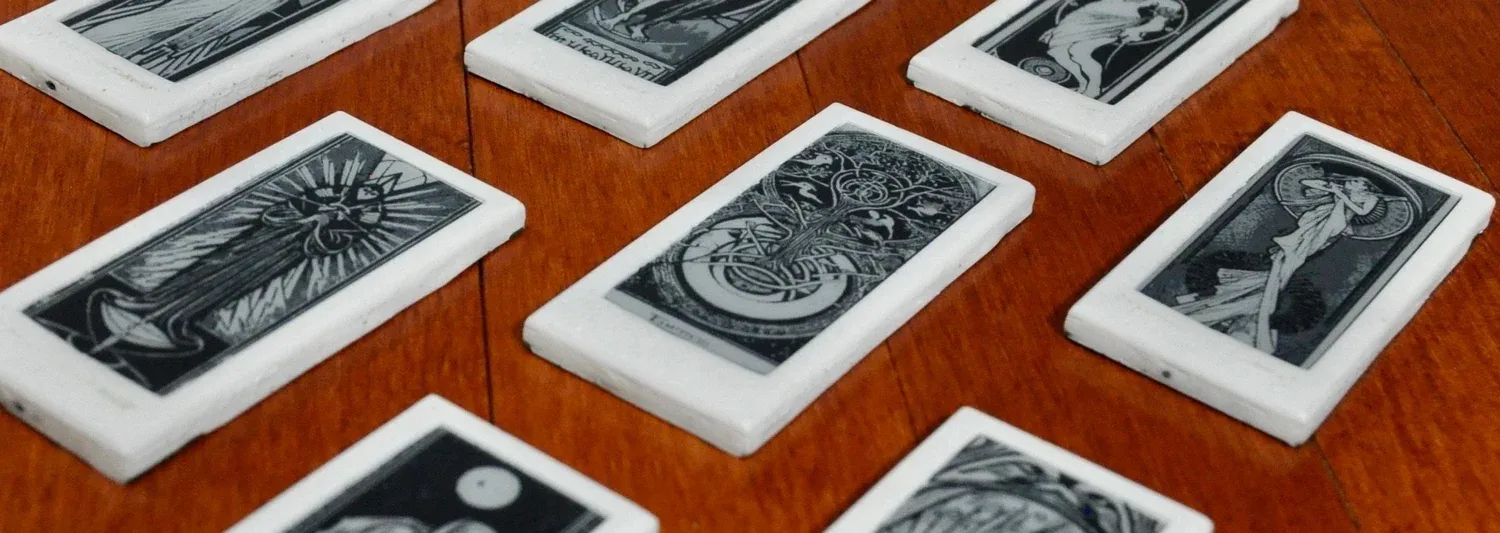
Show HN: Trading cards made with e-ink displays (opens in a new tab)wyldcard.io
1149 pointsI made a thing!
In 2014, I was holding a stack of iPhones and thought to myself:
"Hey, if I had each phone display a playing card, I could click a button and they'd shuffle themselves"
Right now, each card costs me about $20 each, but with only a bit more scale, I think I can get that down to $10.
In doing this project, I learned how to design electronics and circuit boards. I learned Rust and wrote my first driver, I upped my CAD skills, 3D printed, and did my first resin casting. I generated the images on the cards using stable-diffusion.
HN always seems to appreciate new uses for e-ink. Thought I'd share :)
Comments (291) 95 threads
Show all comments
Showing thread 4 of 95
Kind of like the Blinks game system, these little hexes with colored lights in them that each have a separate game in them and can 'teach' the other hexes they connect to.
One of the Blinks Kickstarters: https://www.kickstarter.com/projects/move38/blinks-smart-boa...
Yeah, it's a weird in-between. I don't think a game publisher would take a risk on it, but neither would silicon valley VCs.
Kickstarter would be my bet too. I was going to put this project down for a little while and start a "real" startup though.....
You might still try for the latter. Especially if you can think of ways to make the business bigger.
Can intro me to anyone? email me: jonah@wyldcard.io
I was thinking, very possibly, if I found some angel investors who also love boardgames.....
Continue this thread — 3 replies
By the way, I've been following your posts here for years! I'll trade you cards for candy!
That said, this might be a good "real startup." The problem domain seems modest (e-ink playing cards) but... could be a bridgehead to interesting territory.
These might be designed/used as playing cards, but it's actually a computer with lots of little portable screens. The actual thing is general, a proverbial "computing paradigm."
These are playing cards, but could be concert tickets, conference badges, security doohickeys... They can open a door, clock you in and display your in/out status. If you want to go full "SV Pitch:" these cards are money. Transfer 69 FTX coins onto a card at a secure terminal, and pay by handing it to the hooker. A casino could give you one of these to be your wallet.
Solutions looking for problems sometimes find them. See apple/msft.
Nah. Part of the strip club experience will always be showering the strippers in dollar bills... and why would you do regular payments for hookers with a special token?! Almost all credit and debit cards (=EMV cards) already can do this by NFC and you can also use watches and phones for this, the problem rather is:
- sex workers are pretty much banned from conventional payment methods and networks because sex work is illicit in many countries and even where it's legal, many sex workers prefer hard cash because chargeback fraud aka "post nut clarity" or actually stolen credentials is so common
- whenever you start a new payment scheme - because you are doing precisely this! - you WILL have to follow banking laws and regulations: customer identification, anti-smurfing and other money laundering measures, compliances for data protection, reports to banking authorities... an insane mess to do right. Of course, you can also hope to do a Bitcoin... but given the penalties if you are ever caught by the authorities, it's not worth it.
Continue this thread — 1 reply
What does epaper get you that paper doesn't? A microprocessor and persistent state. RFID cards on a board game might be a good middle state for most cards. Scan them as played. Build gamestate or dynamics to be populated to epaper.
Epaper would be good for storyline branches, timeline progressions, evolving characters. Make them traveling characters being owned by different players. Differentiate them from becoming a static scoreboard that could be represented on a single tablet.
When watching TV shows that have cool card games, like Yu-Gi-Oh, it seems like the game doesn't have rules, but instead the kids reason about the characters by looking at the pictures. Weird unexpected stuff happens all the time, I was thinking about how to implement that in the real world.
For example, imagine a vampire card that has its eyes closed. You try using it, but it doesn't do anything. But, you notice that when you play at night the eyes are open and now it's a powerful vampire!
So you can do time-based mechanics, I could add location-based mechanics. You can also make the cards do different things based on what other cards are in play.
> When watching TV shows that have cool card games, like Yu-Gi-Oh, it seems like the game doesn't have rules, but instead the kids reason about the characters by looking at the pictures.
This is basically how it worked writing-wise in the original Duel Monsters series (though the characters acted like these were mostly all known effects/interactions), after that came GX where they toned down the creativity and mostly used real effects, then in Zexal and afterwards I think they stuck almost entirely to real effects with occasional exceptions.
If you're into this sort of thing, I highly recommend checking out Inscryption, it has some really fun twists on this idea.
Continue this thread — 3 replies
For instance in MTG day/night cycles were featured in the original werewolves (I want to say innistrad), location mechanics can be continuous effects on lands or ETBs, likewise for reaction to other cards in play.
For what it's worth, the actual Yu-Gi-Oh trading card games has rules and the anime uses a very loose interpretation of those rules.
Continue this thread — 3 replies
Continue this thread — 2 replies
When they released the real-world Dueling Monsters card game, they tried to keep the rules consistent with the manga/series, but changed them in places to make a more playable game. Ex.: there is an upper limit to the damage you can do with the Berserker Soul ability.
[1] nsfw https://shop.kingdomdeath.com/collections/in-stock/products/...
If we're talking business models, the one which immediately comes to mind as appropriate is that of a gaming console. Sell the hardware (e-cards, maybe a mat?) at a loss, then sell games for it at no marginal cost. Let other people build games for it because hit games are what sell platforms.
Since this essentially a portable gaming device, consumers may compare it to e.g. a Nintendo Switch - if you undercut the Switch and you have a blockbuster title or two, you could have incredible product on your hands.
Presumably the lucrative economics of trading card games could be applied here as well...!
I think I'd need funding for that though, can't bootstrap a platform without that first blockbuster game.