Maybe I missed it but it's not a net positive output. From the article, the implication it is:
"LLNL’s experiment surpassed the fusion threshold by delivering 2.05 megajoules (MJ) of energy to the target, resulting in 3.15 MJ of fusion energy output" From newscientist, the same info followed by a rider: "generated a power output of 3.15 megajoules from a laser power output of 2.05 megajoules – a gain of around 150 per cent. However, this is far outweighed by the roughly 300 megajoules drawn from the electrical grid to power the lasers in the first place"
This was explained by another commenter yesterday, but this is not an issue. The 3.15:2.05 ratio is the news as it is the part that was difficult to achieve. The 300MJ accounts for significant laser inefficiencies in much the same way that the 3.15MJ of output won't convert to 3.15MJ of electricity as the conversion is not loss less.
In other words: it's a net-positive output for that reaction, not the whole process, there is still a lot of work to be done before you and I exchange comments on a server powered by fusion energy in homes powered by fusion energy.
> in much the same way that the 3.15MJ of output won't convert to 3.15MJ of electricity as the conversion is not loss less ...and very much touche! That's a good point. But I do feel the overall loss should have been made clear and distinct from the gain in one part of the whole. Gross vs net perhaps?
IIRC part of the issue is that NIF's lasers are very old and much less efficient than more modern ones. So the 300 MJ needed to power the lasers is higher than would be expected if this were commercialized.
Even if it doesn’t get smaller (unlikely), we as a society build stadiums all the time. Large construction projects are a small price to pay for abundant clean energy.
Previous Fusion experiments, even though we could get Fusion reactions to occur, required more energy to start and sustain the reaction than was generated from it. For the first time, more was generated from the reaction than put in.
Note that while this is important progress, it's a bit of specific accounting. The entire system still requires more energy input than output, but this isolated piece can now output a little more than input.
> This is indeed a promising and exciting result, but we need to remember that this does not take into account the energy required to run the lasers that confine the reaction and other inefficiencies and losses. https://www.sciencemediacentre.org/expert-reaction-to-fusion... It's still entirely possible that we will not see a fusion reactor in production within our lifetimes.
Since there will necessarily be overhead in any kind of finished design, this "threshold" is an arbitrary one to pass, no more significant that 90% or 125%, or any other round number.
Their goal was to produce a fusion reaction not to improve laser efficiency. That's a bit like complaining they didn't account for the energy used to structure the fuel. I don't think it's 'specific accounting' when (output/input)>1 was their goal from the start
Neither did this one. This is not a net positive. That’s what they told journalists to start the current cycle of hype, but note that announcements direct from DOE don’t use that language.
Is that a different approach than the Tokamak, some piece to make it works, or some other relationship? What does it mean for existing projects such as ITER?
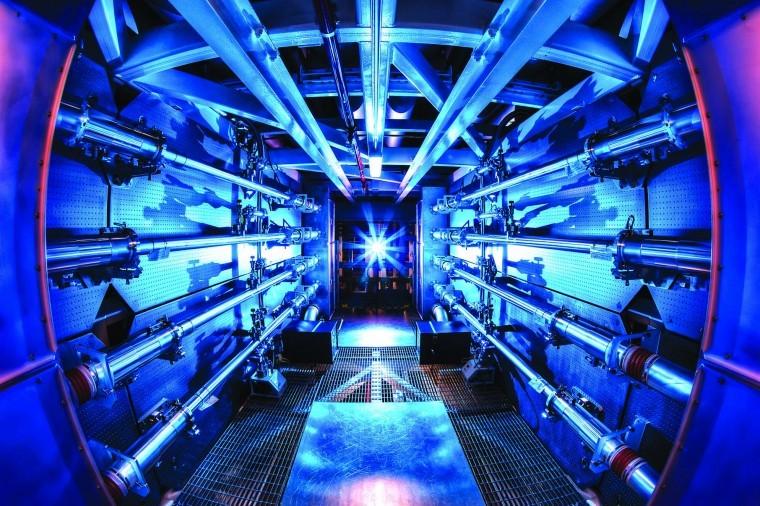
This works in a totally different way, by heating a tiny target fuel pellet with a laser to cause it to collapse and trigger fusion through basically heating and squeezing: more like how a bomb works. It's not easy to see a direct path from this approach to a power plant, but it might involve lining up a steady stream of fuel targets and doing this in a sort of pulsed mode.
Other approaches attempt to create a continuous plasma where fusion can occur confined in a powerful magnetic field, and heated by radio waves to get it going. So there's always fusion happening rather than in short bursts.
In principle inertial confinement is not much different from internal combustion engines where piston compresses the mix, and the explosion energy is harvested. Here lasers compress the mix, and the explosion energy is not yet harvested (but measured).
Tokamaks (the other approach) are more like jet engines in that they sustain burning. But currently the burning in tokamaks requires more energy than it generates.
For the Fusion the particles need to get close - but not to close. So the particles in the Tokamak get heated up to reach that. Also it's designed to run continuously but the challenge is the magnetic field so the particles won't hit the wall. (And cool down very quickly)
The Inertia based fusion works by providing the heat/energy with lasers, so the fuel would have to be replaced continuously.
Comments (1,021) 82 threads
Earlier comments"LLNL’s experiment surpassed the fusion threshold by delivering 2.05 megajoules (MJ) of energy to the target, resulting in 3.15 MJ of fusion energy output"
From newscientist, the same info followed by a rider:
"generated a power output of 3.15 megajoules from a laser power output of 2.05 megajoules – a gain of around 150 per cent. However, this is far outweighed by the roughly 300 megajoules drawn from the electrical grid to power the lasers in the first place"
In other words: it's a net-positive output for that reaction, not the whole process, there is still a lot of work to be done before you and I exchange comments on a server powered by fusion energy in homes powered by fusion energy.
> in much the same way that the 3.15MJ of output won't convert to 3.15MJ of electricity as the conversion is not loss less
...and very much touche! That's a good point. But I do feel the overall loss should have been made clear and distinct from the gain in one part of the whole. Gross vs net perhaps?
That's an important piece of information - the thing is gigantic!
> This is indeed a promising and exciting result, but we need to remember that this does not take into account the energy required to run the lasers that confine the reaction and other inefficiencies and losses.
https://www.sciencemediacentre.org/expert-reaction-to-fusion...
It's still entirely possible that we will not see a fusion reactor in production within our lifetimes.
Continue this thread — 3 replies
Continue this thread — 3 replies
So this is the first time that a fusion reactor has been net positive for energy production
https://en.wikipedia.org/wiki/Tokamak
https://en.wikipedia.org/wiki/ITER
Other approaches attempt to create a continuous plasma where fusion can occur confined in a powerful magnetic field, and heated by radio waves to get it going. So there's always fusion happening rather than in short bursts.
Tokamaks (the other approach) are more like jet engines in that they sustain burning. But currently the burning in tokamaks requires more energy than it generates.
Continue this thread — 1 reply
The Inertia based fusion works by providing the heat/energy with lasers, so the fuel would have to be replaced continuously.
All comments shown.
Couldn't load more comments. Check your connection and try again.