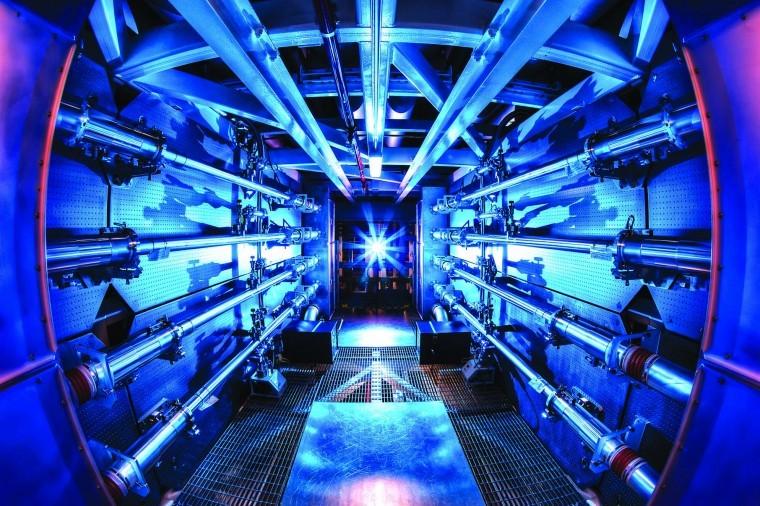
> LLNL’s experiment surpassed the fusion threshold by delivering 2.05 megajoules (MJ) of energy to the target, resulting in 3.15 MJ of fusion energy output, demonstrating for the first time a most fundamental science basis for inertial fusion energy (IFE). Many advanced science and technology developments are still needed to achieve simple, affordable IFE to power homes and businesses, and DOE is currently restarting a broad-based, coordinated IFE program in the United States. Combined with private-sector investment, there is a lot of momentum to drive rapid progress toward fusion commercialization. It's fusion Manhattan project time.
Yeah, I think we have a lot of sleeper geniuses out there
I'm a pretty smart dude. I'm no big deal on HackerNews or in Silicon Valley, but I look easily 10x as smart as most of the normal people I come across in the real world. And I regularly come across people so much smarter than me, they have to explain things to me the same way I talk to a toddler I'll bet a lot of geniuses are congregating in cool orgs like those where they can make a real difference in the world.
This generation was classically educated, without TV or social media in their childhood. They spent the time we're wasting on HN reading _books_ and following the discipline their elders learned in WWI. They had plenty of occasions to tinker. I claim the brains of those generation was structurally different from ours, and we're talking about the best minds of this generation. It's a trope to say that our "best minds are working on ads" - the reality is that, no, we webshits are not the "best minds".
> they're working on getting you to click on an ad
They're not, and there's zero evidence to back that frequently floated premise up. That's a particularly laughable myth created by those same industry people to feel better about their terrible life choices. If you can't do something meaningful, at least you can pretend to be a genius doing nothing meaningful. It turns out that both things are false, they're not brilliant and they're wasting their lives. No, the brilliant people are working at TSMC, Intel, AMD, nVidia, Applied Materials, ASML, Illumina, ARM, TI, et al. They're working on CRISPR. They're working on mRNA vaccines. They're working on stem cells. They're trying to cure HIV just as the same type of people cured hepatitis C. They're working for Moderna, Pfizer, BioNTech, Roche, Novartis, Amgen, Regeneron, Sanofi, Gilead, Merck, Glaxo, et al. They're trying to figure out how to roll back or cure Alzheimer's. They're dedicating a lifetime of work into exploring the human genome, so that future generations have a much better, much more useful map. They're working on robotics at Intuitive Surgical or Boston Dynamics. They're working on self-driving tech. They've been building out the massive, global cloud infrastructure. They're at NASA, or SpaceX, or ESA and they're doing the work to get us a base on the moon or to Mars. They just got done building rockets that can land upright. They're building a massive, extraordinary, global satellite system in Starlink. They're working on fusion. And so on and so forth. Ad clicks? Yeah right. They're not even in the room.
Do more powerful bombs really make any difference? Seems a bit like worrying about the impact of climate-driven ocean rise on the pressure at the bottom of the Marianas Trench.
Fusion bombs have existed since the early 1950s. Technology rapidly developed to the point that they can essentially be built to be arbitrarily large, far beyond any practical war purpose. There is no need for any larger bomb than what was built many decades ago. None of this research is necessary for bombs. All of the difficult problems fusion power generation faces with long-term plasma confinement go away when you're just trying to squeeze as hard as you can and are willing to use fission bombs to do it in an otherwise uncontrolled manner.
And yet that's exactly why the NIF was actually built. They do plenty of weapons research: https://wci.llnl.gov/facilities/nif I'm told the building was even built to switch over between civilian and classified use unusually quickly, but I'm having trouble turning up a citation for that right now with just my phone and 2022-Google. > All of the difficult problems fusion power generation faces with long-term plasma confinement go away when you're just trying to squeeze as hard as you can and are willing to use fission bombs to do it in an otherwise uncontrolled manner. Not if you want them to fit in a submarine warhead. This sort of work is not easy to do well.
It is necessary since they banned the testing of nuclear weapons. Before they would do this kind of research by imploding a cylinder of uranium encasing a hydrogen core with X-rays produced by a "Fat Man" style bomb. Now they implode a cylindrical casing full of hydrogen by x-rays caused by a laser vaporizing an outer layer.
“It’s a big milestone, but NIF is not a fusion-energy device,” says Dave Hammer, a nuclear engineer at Cornell University in Ithaca, New York. Herrmann acknowledges as much, saying that there are many steps on the path to laser fusion energy. “NIF was not designed to be efficient,” he says. “It was designed to be the biggest laser we could possibly build to give us the data we need for the [nuclear] stockpile research programme.” https://www.nature.com/articles/d41586-022-04440-7
That isn’t what this would be used for. In fact, yields for the largest deployed H-bombs today I think are smaller than they once were (due to better targeting capabilities).
This is true. The issue is that already a relatively small nuclear weapon is perfectly sufficient to wipe out most to all civilian structures. However, it does so in a roughly circular area, and you need to increase the initial explosion a royal lot to increase the devastated area by a bit. And as you increase the overall spherical blast of the weapon in order to increase the circle of doom on the ground, more and more explosive power just vaporizes air.
That's why MIRV was introduced. One ICBM delivering 10 - 20 small warheads result in much greater devastation than an equally heavy warhead in one package, because less power is wasted on air and space. It's morbid math, but it makes sense.
You should be very excited because we live on a planet with independent competing countries and well... you don't want to live in the US or Europe with China or other not so friendly countries building a bigger more powerful nuke. If a weapon can be built, it will be built. How, when and if it can be used are things you can control not whether someone somewhere will develop it. Especially in war time, all bets are off.
Although, it would be interesting to see fusion reactors on planes and ships powering other types of weapons like lasers and more powerful railguns or faster icbms.
Good things often have dubious or downright evil origins (which would never be justifiable a priori).
A relatively recent example: development of cancer chemotherapy began with the incidental finding that the chemical warfare agent nitrogen mustard reduced the white cell count of affected soldiers. We make progress building on the shoulders of giants, but those giants are often standing in dung.
Most of the funding for the Manhattan project went into the industrial infrastructure required to produce plutonium and enriched uranium.
It will be time to unleash resources once they have a working fusion reactor design in order to build fusion power plants and the industrial infrastructure required to supply them. Until then they should of course get the resources they need but I don't think throwing money at them will necessarily speed things up.
A uranium-gun bomb has a very simple theoretical basis, but enriching uranium is very expensive (and was even more expensive in the 1940s. Producing enough enriched uranium was the only hard problem in making that bomb; in fact they did not even test the bomb before dropping it on Hiroshima because they were fairly sure it was going to work and wouldn't have enough enriched uranium for a second bomb on the timelines involved.
Plutonium was significantly more easy to produce, but it did require some novel engineering for the implosion lens. They weren't sure it was going to work and did, in fact, test the bomb before dropping it on Nagasaki. I think the Manhattan project is a great example of where more funds can help; if the funds were more restricted, it's entirely possible they would have gone with the "sure thing" of the uranium bomb instead of spending resources on the less sure plutonium bomb. Trying out multiple ideas in parallel often "wastes" money since if you try ideas in tandem, you will always try the high-percentage ideas first.
Given it's Musk and his stated primary life goal, the most ridiculous aspect of the Twitter debacle for him, is: not only of course did he overpay for Twitter by at least 2x; not only is his net worth going to contract as Tesla's stock compresses (such that the poor Twitter decision is going to be that much more painful in relation to his overall wealth); but the $40x billion could have probably paid for getting Starship to Mars. He's not going to be as rich in the future as he was in that moment, and he'll be relentlessly mocked for the context as his ship takes on water (eg when he's worth $60-$80 billion and spent $44 billion buying Twitter and SpaceX needs $10+ billion infused into it to keep pursuing Mars).
Comments (1,021) 82 threads
Show all comments
Showing thread 2 of 82
> LLNL’s experiment surpassed the fusion threshold by delivering 2.05 megajoules (MJ) of energy to the target, resulting in 3.15 MJ of fusion energy output, demonstrating for the first time a most fundamental science basis for inertial fusion energy (IFE). Many advanced science and technology developments are still needed to achieve simple, affordable IFE to power homes and businesses, and DOE is currently restarting a broad-based, coordinated IFE program in the United States. Combined with private-sector investment, there is a lot of momentum to drive rapid progress toward fusion commercialization.
It's fusion Manhattan project time.
they're working on getting you to click on an ad
I'm a pretty smart dude. I'm no big deal on HackerNews or in Silicon Valley, but I look easily 10x as smart as most of the normal people I come across in the real world. And I regularly come across people so much smarter than me, they have to explain things to me the same way I talk to a toddler
I'll bet a lot of geniuses are congregating in cool orgs like those where they can make a real difference in the world.
This generation was classically educated, without TV or social media in their childhood. They spent the time we're wasting on HN reading _books_ and following the discipline their elders learned in WWI. They had plenty of occasions to tinker.
I claim the brains of those generation was structurally different from ours, and we're talking about the best minds of this generation.
It's a trope to say that our "best minds are working on ads" - the reality is that, no, we webshits are not the "best minds".
Continue this thread — 7 replies
They're not, and there's zero evidence to back that frequently floated premise up. That's a particularly laughable myth created by those same industry people to feel better about their terrible life choices. If you can't do something meaningful, at least you can pretend to be a genius doing nothing meaningful. It turns out that both things are false, they're not brilliant and they're wasting their lives.
No, the brilliant people are working at TSMC, Intel, AMD, nVidia, Applied Materials, ASML, Illumina, ARM, TI, et al.
They're working on CRISPR. They're working on mRNA vaccines. They're working on stem cells. They're trying to cure HIV just as the same type of people cured hepatitis C. They're working for Moderna, Pfizer, BioNTech, Roche, Novartis, Amgen, Regeneron, Sanofi, Gilead, Merck, Glaxo, et al. They're trying to figure out how to roll back or cure Alzheimer's. They're dedicating a lifetime of work into exploring the human genome, so that future generations have a much better, much more useful map.
They're working on robotics at Intuitive Surgical or Boston Dynamics. They're working on self-driving tech. They've been building out the massive, global cloud infrastructure. They're at NASA, or SpaceX, or ESA and they're doing the work to get us a base on the moon or to Mars. They just got done building rockets that can land upright. They're building a massive, extraordinary, global satellite system in Starlink.
They're working on fusion.
And so on and so forth.
Ad clicks? Yeah right. They're not even in the room.
Continue this thread — 4 replies
Continue this thread — 2 replies
I'm not very excited in hearing we'll get even more powerful thermo-nuclear bombs.
And yet that's exactly why the NIF was actually built. They do plenty of weapons research: https://wci.llnl.gov/facilities/nif I'm told the building was even built to switch over between civilian and classified use unusually quickly, but I'm having trouble turning up a citation for that right now with just my phone and 2022-Google.
> All of the difficult problems fusion power generation faces with long-term plasma confinement go away when you're just trying to squeeze as hard as you can and are willing to use fission bombs to do it in an otherwise uncontrolled manner.
Not if you want them to fit in a submarine warhead. This sort of work is not easy to do well.
Continue this thread — 2 replies
“It’s a big milestone, but NIF is not a fusion-energy device,” says Dave Hammer, a nuclear engineer at Cornell University in Ithaca, New York.
Herrmann acknowledges as much, saying that there are many steps on the path to laser fusion energy. “NIF was not designed to be efficient,” he says. “It was designed to be the biggest laser we could possibly build to give us the data we need for the [nuclear] stockpile research programme.”
https://www.nature.com/articles/d41586-022-04440-7
You're right that increasing the yield was a bad example from my side, but the purpose is to improve the weapons, nothing else.
Continue this thread — 2 replies
That's why MIRV was introduced. One ICBM delivering 10 - 20 small warheads result in much greater devastation than an equally heavy warhead in one package, because less power is wasted on air and space.
It's morbid math, but it makes sense.
Although, it would be interesting to see fusion reactors on planes and ships powering other types of weapons like lasers and more powerful railguns or faster icbms.
https://en.wikipedia.org/wiki/Tsar_Bomba
A relatively recent example: development of cancer chemotherapy began with the incidental finding that the chemical warfare agent nitrogen mustard reduced the white cell count of affected soldiers.
We make progress building on the shoulders of giants, but those giants are often standing in dung.
It will be time to unleash resources once they have a working fusion reactor design in order to build fusion power plants and the industrial infrastructure required to supply them.
Until then they should of course get the resources they need but I don't think throwing money at them will necessarily speed things up.
Plutonium was significantly more easy to produce, but it did require some novel engineering for the implosion lens. They weren't sure it was going to work and did, in fact, test the bomb before dropping it on Nagasaki.
I think the Manhattan project is a great example of where more funds can help; if the funds were more restricted, it's entirely possible they would have gone with the "sure thing" of the uranium bomb instead of spending resources on the less sure plutonium bomb. Trying out multiple ideas in parallel often "wastes" money since if you try ideas in tandem, you will always try the high-percentage ideas first.
Maybe he doesn't actually believe in Starship.
Continue this thread — 6 replies
But yes, it was clearly a mistake.
Continue this thread — 3 replies
Continue this thread — 4 more replies