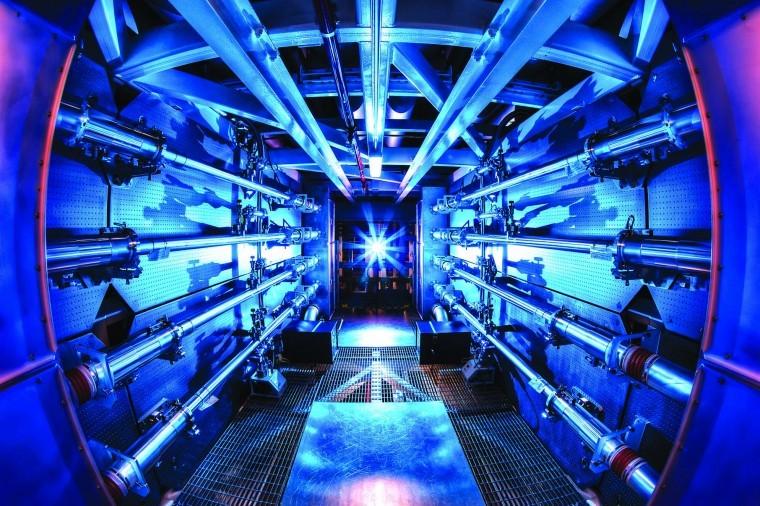
> LLNL’s experiment surpassed the fusion threshold by delivering 2.05 megajoules (MJ) of energy to the target, resulting in 3.15 MJ of fusion energy output, demonstrating for the first time a most fundamental science basis for inertial fusion energy (IFE). Many advanced science and technology developments are still needed to achieve simple, affordable IFE to power homes and businesses, and DOE is currently restarting a broad-based, coordinated IFE program in the United States. Combined with private-sector investment, there is a lot of momentum to drive rapid progress toward fusion commercialization. It's fusion Manhattan project time.
Do more powerful bombs really make any difference? Seems a bit like worrying about the impact of climate-driven ocean rise on the pressure at the bottom of the Marianas Trench.
Fusion bombs have existed since the early 1950s. Technology rapidly developed to the point that they can essentially be built to be arbitrarily large, far beyond any practical war purpose. There is no need for any larger bomb than what was built many decades ago. None of this research is necessary for bombs. All of the difficult problems fusion power generation faces with long-term plasma confinement go away when you're just trying to squeeze as hard as you can and are willing to use fission bombs to do it in an otherwise uncontrolled manner.
And yet that's exactly why the NIF was actually built. They do plenty of weapons research: https://wci.llnl.gov/facilities/nif I'm told the building was even built to switch over between civilian and classified use unusually quickly, but I'm having trouble turning up a citation for that right now with just my phone and 2022-Google. > All of the difficult problems fusion power generation faces with long-term plasma confinement go away when you're just trying to squeeze as hard as you can and are willing to use fission bombs to do it in an otherwise uncontrolled manner. Not if you want them to fit in a submarine warhead. This sort of work is not easy to do well.
It is necessary since they banned the testing of nuclear weapons. Before they would do this kind of research by imploding a cylinder of uranium encasing a hydrogen core with X-rays produced by a "Fat Man" style bomb. Now they implode a cylindrical casing full of hydrogen by x-rays caused by a laser vaporizing an outer layer.
“It’s a big milestone, but NIF is not a fusion-energy device,” says Dave Hammer, a nuclear engineer at Cornell University in Ithaca, New York. Herrmann acknowledges as much, saying that there are many steps on the path to laser fusion energy. “NIF was not designed to be efficient,” he says. “It was designed to be the biggest laser we could possibly build to give us the data we need for the [nuclear] stockpile research programme.” https://www.nature.com/articles/d41586-022-04440-7
That isn’t what this would be used for. In fact, yields for the largest deployed H-bombs today I think are smaller than they once were (due to better targeting capabilities).
This is true. The issue is that already a relatively small nuclear weapon is perfectly sufficient to wipe out most to all civilian structures. However, it does so in a roughly circular area, and you need to increase the initial explosion a royal lot to increase the devastated area by a bit. And as you increase the overall spherical blast of the weapon in order to increase the circle of doom on the ground, more and more explosive power just vaporizes air.
That's why MIRV was introduced. One ICBM delivering 10 - 20 small warheads result in much greater devastation than an equally heavy warhead in one package, because less power is wasted on air and space. It's morbid math, but it makes sense.
You should be very excited because we live on a planet with independent competing countries and well... you don't want to live in the US or Europe with China or other not so friendly countries building a bigger more powerful nuke. If a weapon can be built, it will be built. How, when and if it can be used are things you can control not whether someone somewhere will develop it. Especially in war time, all bets are off.
Although, it would be interesting to see fusion reactors on planes and ships powering other types of weapons like lasers and more powerful railguns or faster icbms.
Good things often have dubious or downright evil origins (which would never be justifiable a priori).
A relatively recent example: development of cancer chemotherapy began with the incidental finding that the chemical warfare agent nitrogen mustard reduced the white cell count of affected soldiers. We make progress building on the shoulders of giants, but those giants are often standing in dung.
Most of the funding for the Manhattan project went into the industrial infrastructure required to produce plutonium and enriched uranium.
It will be time to unleash resources once they have a working fusion reactor design in order to build fusion power plants and the industrial infrastructure required to supply them. Until then they should of course get the resources they need but I don't think throwing money at them will necessarily speed things up.
A uranium-gun bomb has a very simple theoretical basis, but enriching uranium is very expensive (and was even more expensive in the 1940s. Producing enough enriched uranium was the only hard problem in making that bomb; in fact they did not even test the bomb before dropping it on Hiroshima because they were fairly sure it was going to work and wouldn't have enough enriched uranium for a second bomb on the timelines involved.
Plutonium was significantly more easy to produce, but it did require some novel engineering for the implosion lens. They weren't sure it was going to work and did, in fact, test the bomb before dropping it on Nagasaki. I think the Manhattan project is a great example of where more funds can help; if the funds were more restricted, it's entirely possible they would have gone with the "sure thing" of the uranium bomb instead of spending resources on the less sure plutonium bomb. Trying out multiple ideas in parallel often "wastes" money since if you try ideas in tandem, you will always try the high-percentage ideas first.
Given it's Musk and his stated primary life goal, the most ridiculous aspect of the Twitter debacle for him, is: not only of course did he overpay for Twitter by at least 2x; not only is his net worth going to contract as Tesla's stock compresses (such that the poor Twitter decision is going to be that much more painful in relation to his overall wealth); but the $40x billion could have probably paid for getting Starship to Mars. He's not going to be as rich in the future as he was in that moment, and he'll be relentlessly mocked for the context as his ship takes on water (eg when he's worth $60-$80 billion and spent $44 billion buying Twitter and SpaceX needs $10+ billion infused into it to keep pursuing Mars).
It appears to be working/progressing properly so far (and quite rapidly compared to norms in the industry), including the Raptor engines. I doubt that's it.
Musk has very obviously poor impulse control. Someone more contained, patient, less impulsive, would have waited and taken a more strategic approach to acquiring Twitter (which would have left an opening to let the stock implode with the rest of the tech market, after which one could have pounced and grabbed it for far cheaper). On the flip side, that less impulsive person probably wouldn't have started SpaceX in the first place (given the suicidal fiscal task involved and context at the time in the industry), or wouldn't have gone to the financial extremes required to make it succeed (betting essentially all of his wealth on Tesla and SpaceX).
I know it is popular/easy to hate on the man right now, but this is a really strange take. Given that Musk has been talking about mars since at least 2001, many years before he had the resources he has now, and almost went bankrupt funding spacex's first orbital rocket, it's hard to believe he's pretending. People seem happy to believe all negative things they hear about him, but discount anything that doesn't gel with this negative image. It's like how the same people who put all missteps of Tesla/SpaceX at Elons feet, will also discount any of the successes and say he has nothing to do with them.
Comments (1,021) 82 threads
Show all comments
Showing thread 2 of 82
> LLNL’s experiment surpassed the fusion threshold by delivering 2.05 megajoules (MJ) of energy to the target, resulting in 3.15 MJ of fusion energy output, demonstrating for the first time a most fundamental science basis for inertial fusion energy (IFE). Many advanced science and technology developments are still needed to achieve simple, affordable IFE to power homes and businesses, and DOE is currently restarting a broad-based, coordinated IFE program in the United States. Combined with private-sector investment, there is a lot of momentum to drive rapid progress toward fusion commercialization.
It's fusion Manhattan project time.
they're working on getting you to click on an ad
Continue this thread — 16 replies
Continue this thread — 2 replies
I'm not very excited in hearing we'll get even more powerful thermo-nuclear bombs.
And yet that's exactly why the NIF was actually built. They do plenty of weapons research: https://wci.llnl.gov/facilities/nif I'm told the building was even built to switch over between civilian and classified use unusually quickly, but I'm having trouble turning up a citation for that right now with just my phone and 2022-Google.
> All of the difficult problems fusion power generation faces with long-term plasma confinement go away when you're just trying to squeeze as hard as you can and are willing to use fission bombs to do it in an otherwise uncontrolled manner.
Not if you want them to fit in a submarine warhead. This sort of work is not easy to do well.
Continue this thread — 2 replies
“It’s a big milestone, but NIF is not a fusion-energy device,” says Dave Hammer, a nuclear engineer at Cornell University in Ithaca, New York.
Herrmann acknowledges as much, saying that there are many steps on the path to laser fusion energy. “NIF was not designed to be efficient,” he says. “It was designed to be the biggest laser we could possibly build to give us the data we need for the [nuclear] stockpile research programme.”
https://www.nature.com/articles/d41586-022-04440-7
You're right that increasing the yield was a bad example from my side, but the purpose is to improve the weapons, nothing else.
Continue this thread — 2 replies
That's why MIRV was introduced. One ICBM delivering 10 - 20 small warheads result in much greater devastation than an equally heavy warhead in one package, because less power is wasted on air and space.
It's morbid math, but it makes sense.
Although, it would be interesting to see fusion reactors on planes and ships powering other types of weapons like lasers and more powerful railguns or faster icbms.
https://en.wikipedia.org/wiki/Tsar_Bomba
A relatively recent example: development of cancer chemotherapy began with the incidental finding that the chemical warfare agent nitrogen mustard reduced the white cell count of affected soldiers.
We make progress building on the shoulders of giants, but those giants are often standing in dung.
It will be time to unleash resources once they have a working fusion reactor design in order to build fusion power plants and the industrial infrastructure required to supply them.
Until then they should of course get the resources they need but I don't think throwing money at them will necessarily speed things up.
Plutonium was significantly more easy to produce, but it did require some novel engineering for the implosion lens. They weren't sure it was going to work and did, in fact, test the bomb before dropping it on Nagasaki.
I think the Manhattan project is a great example of where more funds can help; if the funds were more restricted, it's entirely possible they would have gone with the "sure thing" of the uranium bomb instead of spending resources on the less sure plutonium bomb. Trying out multiple ideas in parallel often "wastes" money since if you try ideas in tandem, you will always try the high-percentage ideas first.
Maybe he doesn't actually believe in Starship.
Musk has very obviously poor impulse control. Someone more contained, patient, less impulsive, would have waited and taken a more strategic approach to acquiring Twitter (which would have left an opening to let the stock implode with the rest of the tech market, after which one could have pounced and grabbed it for far cheaper). On the flip side, that less impulsive person probably wouldn't have started SpaceX in the first place (given the suicidal fiscal task involved and context at the time in the industry), or wouldn't have gone to the financial extremes required to make it succeed (betting essentially all of his wealth on Tesla and SpaceX).
I know it is popular/easy to hate on the man right now, but this is a really strange take.
Given that Musk has been talking about mars since at least 2001, many years before he had the resources he has now, and almost went bankrupt funding spacex's first orbital rocket, it's hard to believe he's pretending.
People seem happy to believe all negative things they hear about him, but discount anything that doesn't gel with this negative image. It's like how the same people who put all missteps of Tesla/SpaceX at Elons feet, will also discount any of the successes and say he has nothing to do with them.
Continue this thread — 2 replies
Continue this thread — 1 more reply
But yes, it was clearly a mistake.
Continue this thread — 3 replies
Continue this thread — 4 more replies