Show HN: I spent 2 years building a personal finance simulator (opens in a new tab)projectionlab.com
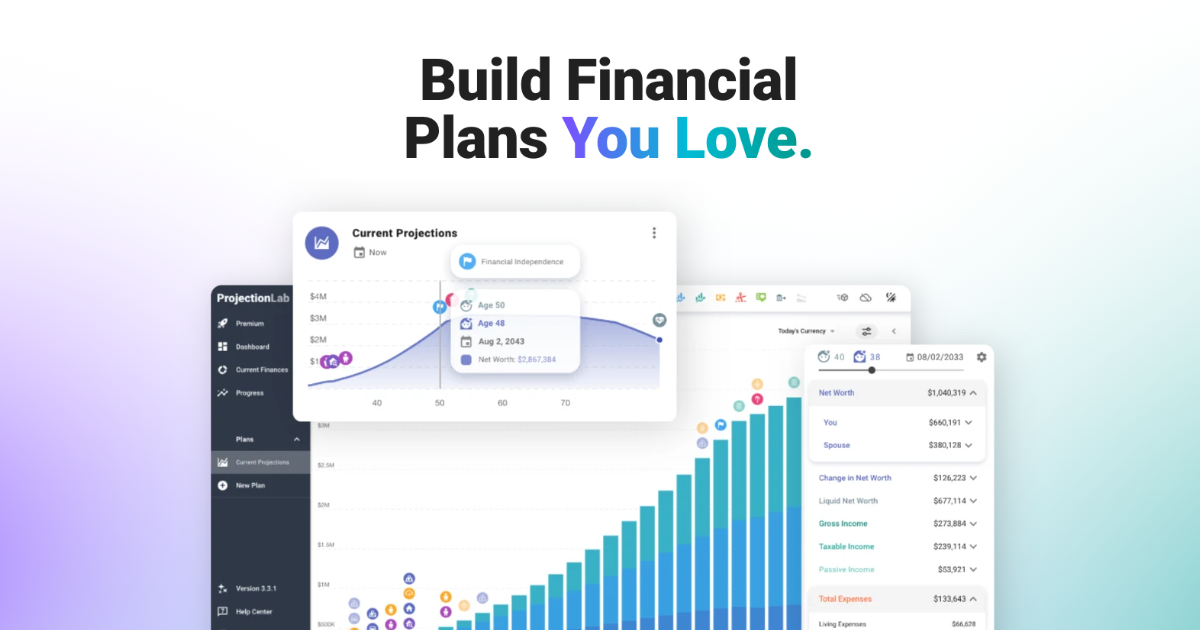
766 pointsTL;DR - ProjectionLab (https://projectionlab.com) is a privacy-friendly personal finance planning tool where you can create financial plans that go beyond the standard online retirement calculators. And by popular request, it now supports self-hosting for Lifetime users!
Something I'm grateful for is that our community here on HN is the difference between PL existing and not. There was actually a time early on when I was one day away from halting work on it. I posted here on a whim, and was shocked to receive some really constructive and energizing feedback that went on to power my indie dev journey over the past two and a half years.
As a quick recap, the story started when I dove head-first down the financial independence rabbit hole. I wanted a hands-on and visual way to explore the trade-offs between different life paths. One thing led to another, and I decided to build ProjectionLab.
After last year's Show HN, I really put my nose to the grindstone, and here are some of the big developments:
- Self-hosting for Lifetime users (spin up your own private deployment, based on Docker Compose, includes support for auth/encryption)
- Cash-flow visualization for each simulated year (sankey charts)
- Tax analytics (detailed breakdowns for projected income, taxes, marginal rates, effective brackets, etc)
- Major redesign of entire app, with landing page and resources now split into separate project
- Filing separately option to improve support for international locations that don't have joint filing
- Roth Conversions and 72t (SEPP) distribution modeling
- Improvements to US tax estimation (Secure 2.0 updates, rental property tax deductions, Medicare + IRMAA, NIIT, principal residence exclusion, etc)
- Better support for planning as a couple
- More modeling options for cash-flow priorities to support different budgeting philosophies and goals
- Extra liquidity + withdrawal options, ability to fund expenses with specific accounts or route income to specific accounts
- Customization options for Monte Carlo simulations (characterization of success rates and outcome types, option to set random seed, etc)
- And a whole bunch more! (https://projectionlab.com/changelog)
The HN community has had a huge role in shaping my overall direction with PL, and I can't wait to hear what you all think of the updates and where you would like to see things go from here.
As always, PL is free to try, with no need to create an account. It does not ask to link your financial accounts, and it has a sandbox mode if you just want to hop in and see how it works.
--Kyle
Comments (288) 77 threads
Earlier commentsOr I hope it’s just a bug… the cash flow chart lists “House” with something that looks like my mortgage amount. But then, it also lists mortgage payment separately. Is it double counting it?
Edit: oooh, the house as its own expenses within its asset. Like taxes and maintenance. This makes more sense…
To be fair, my finances are simple to a fault, so I haven't felt like using it. But, once things ramp up, this will be the first tool I subscribe to.
It's a great tool. I recommend.
Personally I use it more on a monthly or even quarterly basis to consider new decisions, update stuff, etc. That fits with the usage pattern I initially imagined for a long-term planning app, but I'm always open to other ideas.
P.S. I started working on PL in 2021, so we're not quite in "every few years" territory yet ;)
I tried to forecast buying a house, but it seems to have defaulted to 0% APR for Infinity. I don't know anything about buying houses; that's why I'm using a tool like this in the first place!
I poked around and was finally able to open a screen to enter values for a bunch of things but I don't know what's reasonable.
It kinda feels like your onboarding wizard is too good -- it creates the illusion that I can use your site even if I don't really know anything about anything, but then trying to forecast expects me to know a lot more.
I know that's not very actionable feedback, but that's what has put me off actually paying for a subscription so far.
Are there sections in the app that jump out to you as good places to inject more educational content? As you point out, one of the input fields when you add as house and choose "financed" is APR. Maybe that could link to a dedicated page with common rates based on a few parameters like credit score, or perhaps even a separate tool dedicated to estimating that sort of thing?
Continue this thread — 3 replies
Once you see the power of these things and combine them, taking the right decisions actually becomes quite simple.
For example, if you take a 7% average long-term return, as a rule of thumb, your money doubles every 10 years. (1.07^10 = 2, more or less). That means if you save $1k at 25yo, in 40 years you'd have 4 doublings, or 16k, at age 65. That's a pretty powerful multiplier. And 7% is roughly the long-term inflation-adjusted (real) return on the S&P500 (no guarantees it holds, of course).
Many companies will 100% match your retirement investments. So if you put in 1k at age 25, a 100% match will mean your employer puts in 1k as well. Combined with the above, the $16k would become $32k.
Now, if you instead took the $1k as salary, you'd have paid income tax at the marginal rate, a 30% marginal rate is quite common. i.e. the $1k in salary would've netted you $700 in spending at age 25. By instead putting it in your 401k, it'd grow out to $32k in the above example at age 65, or 45 as much. If you moved at that age to a state with no income tax (there's 8), you'd net it all. For every $1 you put in, you'd have gained $45.
That's such a crazy multiplier, and note it's already inflation-adjusted. For 1 unit of work/time, you gained 45 units of work/time. Take such a multiplier in the context of retirement: 40 hours (= 1 week) of work would allow you 45 weeks (almost a year) of earlier retirement.
These simple fundamentals explain why starting early on personal finance is helpful. But it also explains why it's completely unnecessary to spend decades looking at a graph/UI of all of this unfolding, once a week, and updating the planning.
In fact, the only thing I really did after a lot of personal finance education, was to set-up some automated contributions to investment / retirement accounts from my salary. Every few years I reconsider the balance between 'pleasure today' vs 'pleasure one day' (i.e. retirement), and rebalance how much of my income I spend, and how much I allocate to these automatic contributions. It takes about 30 minutes a year to make these arrangements, and with that the vast majority of my personal finance arrangements are made. That's why additional tooling isn't really necessary. Of course at some point some analysis will be useful before pulling the trigger on retirement, and some analysis/advise is useful around major decisions like a house purchase, or selling your company. But for the most part, financial planning tools are just really unnecessary because the fundamentals for an ordinary person to arrange are so, so simple: allocate a portion of your income towards tax-optimised investment/retirement accounts, and set-up automatic payments.
I don't see why this would be a positive? I'd love an alternative to Personal Capital (since it got bought out), but without a direct connection to my banks/creditcards/etc, that connection just ends up being less secure.
If a (strictly optional) account linking feature is something you'd like to see added though, there's an item on the public roadmap for it that you might like to upvote. It’s currently still in the Suggestions category because it’s a bit of a contentious topic within the PL community, and we’ve had a few discussion threads about that on the discord.
In the past, I’ve tried account linking in some other tools, but always ran into syncing issues (especially on 2FA accounts). From what I understand, that’s still somewhat common even with solutions like Plaid.
With PL, I also wanted to initially steer clear of that support/maintenance tar pit (especially since I’m a solo dev), and design a tool where the focus is more on long-term projection rather than fixating on the latest daily stock price fluctuations.
The tricky thing about a service whose main value prop is aggregating all your account data together is that 99% of them working isn't that much better than 1% of them working. Looking at your financial dashboard is pretty useless if it can't sync one of your 401k accounts, or one of your loans is using 90-day old data.
I think this is actually a positive for the non-aggregators like ProjectionLab. If I spend 10 minutes manually updating everything when I check it once a month (or however often), I know everything is up-to-date and don't need to spot check things.
There are some interesting things about those pensions though (and the related VA compensation metrics). I have a spreadsheet I use to advise veterans who get sent my way because there are no decent tools out there for that population.
Otherwise it looks awesome!
Curious what you feel is missing for modeling military pensions. Have you checked out the configuration options for Custom income streams, the Advanced change-over-time editor, and/or binding the start/end of things to milestones?
Continue this thread — 3 replies
All comments shown.
Couldn't load more comments. Check your connection and try again.