Show HN: I spent 2 years building a personal finance simulator (opens in a new tab)projectionlab.com
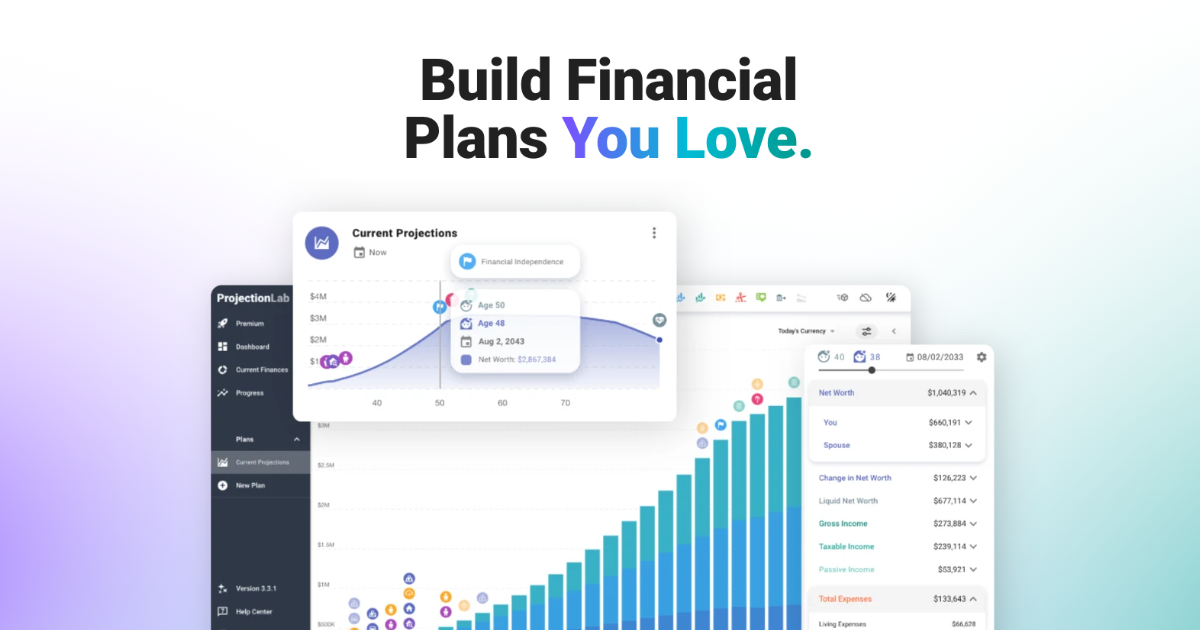
766 pointsTL;DR - ProjectionLab (https://projectionlab.com) is a privacy-friendly personal finance planning tool where you can create financial plans that go beyond the standard online retirement calculators. And by popular request, it now supports self-hosting for Lifetime users!
Something I'm grateful for is that our community here on HN is the difference between PL existing and not. There was actually a time early on when I was one day away from halting work on it. I posted here on a whim, and was shocked to receive some really constructive and energizing feedback that went on to power my indie dev journey over the past two and a half years.
As a quick recap, the story started when I dove head-first down the financial independence rabbit hole. I wanted a hands-on and visual way to explore the trade-offs between different life paths. One thing led to another, and I decided to build ProjectionLab.
After last year's Show HN, I really put my nose to the grindstone, and here are some of the big developments:
- Self-hosting for Lifetime users (spin up your own private deployment, based on Docker Compose, includes support for auth/encryption)
- Cash-flow visualization for each simulated year (sankey charts)
- Tax analytics (detailed breakdowns for projected income, taxes, marginal rates, effective brackets, etc)
- Major redesign of entire app, with landing page and resources now split into separate project
- Filing separately option to improve support for international locations that don't have joint filing
- Roth Conversions and 72t (SEPP) distribution modeling
- Improvements to US tax estimation (Secure 2.0 updates, rental property tax deductions, Medicare + IRMAA, NIIT, principal residence exclusion, etc)
- Better support for planning as a couple
- More modeling options for cash-flow priorities to support different budgeting philosophies and goals
- Extra liquidity + withdrawal options, ability to fund expenses with specific accounts or route income to specific accounts
- Customization options for Monte Carlo simulations (characterization of success rates and outcome types, option to set random seed, etc)
- And a whole bunch more! (https://projectionlab.com/changelog)
The HN community has had a huge role in shaping my overall direction with PL, and I can't wait to hear what you all think of the updates and where you would like to see things go from here.
As always, PL is free to try, with no need to create an account. It does not ask to link your financial accounts, and it has a sandbox mode if you just want to hop in and see how it works.
--Kyle
Comments (288) 77 threads
I discovered projectionlab (formerly projectfi) on HN a while back and have been loving it. Every other "retirement calculator" I found was a dozen text fields and a simple output graph or two - Projection Lab gave me what I really wanted, which was the ability to do much more involved modeling of various scenarios:
- What happens if I buy a house in X years?
- What happens if my old company IPOs and I get a windfall of $Y in X years?
- What happens if I change assumptions on investment returns or inflation rates?
- What happens if I retire at various different ages?
- What happens if my salary increases by 2, 5, 10, 30% each year?
- What happens if we do this kind of mortgage or that kind of mortgate?
- All of the above, but also modeling my in wife's finances?
- All of the above, but with beautiful, interactive graphs instead of my ugly spreadsheet outputs
- All of the above, but without the several formula typos that I made while building my spreadsheet
Anyway, it's amazing, I love it, and nothing else out there really seemed to compare. I found your free plan more than met my needs, but I wound up subscribing just to support it. I'm quite hoping you're able to make this successful long-term so that I can keep using it until I eventually retire. :)
Is there a particular direction in which you'd like to see me build from here? The public roadmap is overflowing with ideas at this point, and I'm curious how folks would rack and stack them.
Having the abilty to perhaps build our own models and keep them to ourselves, or maybe have them available to share might not be a bad idea.
I'm not sure if this is reporting, or setting up a sequence or frequency of payments, etc. Depends on the backend I suppose.
Continue this thread — 7 replies
Iirc the last time I was using it heavily, the only issue I was having trouble with was modeling drawdowns of existing funds. It kept drawing down my wife's account to build up mine. It didn't affect the overall outcome (we had the same dollar amount together regardless), but it was a little annoying and made it harder to figure out which account was actually running low. That said, it's extremely possible that I was just doing something wrong and just hadn't configured it correctly. Whenever I get back to it, I'll work up a minimal repro case and ask about it in the discord. :)
What about getting units of work to start working right now, instead of hoping some big company will make people’s money “grow” into the future?
Invest in local economy. Invest in people. Folks thinking about retirement backwards.
Continue this thread — 2 replies
For me personally, I fail to understand the point of doing this level of analysis, at lest for some of the things you listed that seem highly hypothetical and uncertain (e.g. raises, IPOs, even future mortgage rates). I guess that's the nature of any financial forecasting, but this just seems like it's taken to a level that I would not find helpful. Take for example the kind of mortgage to choose, a decision that all home buyers face and can be daunting (there's so much mortgage/lender lingo that is foreign to most people). The "right" answer is to go with a shorter-term, variable rate, because on average you'll pay less interest than longer-term/fixed rates. But that's also the wrong answer for some people who don't want, or can't handle variability in their biggest monthly expense. Layering those factors into an overall retirement calculator/projector just seems like overkill and over complicated for that decision. MHO...
1. Track my current expenses (I use https://lunchmoney.app/, but a spreadsheet works fine). Looks like I'm spending $X/month
2. Build a reasonably complete model of my financial life assuming $X expenses per month (I use ProjectionLab)
3. Do I run out of money before the end of my life? If yes, look at my expense breakdown and look for areas to reduce it (fewer ubers, eat out less, cut back on diamond-encrusted tiaras, etc). My new budget is $Y/mo. Goto 2.
4. Do I have a ton of money left at the end of my life? If yes, I can increase my budget a bit for things I like (more ubers, eat out more, more diamond-encrusted tiaras, etc).
I can revisit this over time as my income changes, or my retirement account value changes based on real-world market performance, or I get a windfall, or I get married, etc etc.
My 30 year fixed-rate mortgage at 2.6% begs to differ ;) Yes, I had lucky timing; I was able to refinance right at the start of 2022 when rates were pretty much at their lowest.
But overall, I think your assertion isn't correct. It really just depends on conditions. If rates are in general very low, you probably want that fixed-rate mortgage, even if the variable one is -- at least for now -- a little bit lower. In the US, most people get 30-year mortgages, and it's pretty much impossible to predict what rates will be like in 10, 15, 20, 25 years.
If rates are higher, and you believe the reason for that is temporary (like the inflation reduction measures going on now), a variable-rate mortgage is probably a good gamble. If rates drop, you can always refinance (either into another variable-rate mortgage, or to a fixed rate).
Honestly, the 7% now on a 30-year-fixed isn't that bad, historically. It just feels bad because we had such low rates in recent years.
On the trial topic, I'm using Paddle for subscriptions/billing, and when you add a free trial stage to a product in Paddle, they do charge after the trial ends. For anyone who forgets to cancel in time, I'm happy to issue a refund.
I also offer general discounts and extended trials on request (per the pricing page).
But if there's still a concern, the easiest way to try out the basic features without worrying about any of this is to just hop into the sandbox, which you don't even need to create an account for.
> Billed annually for $540 + tax.
The dollar amount doesn't quite line up, but it's close. Unless there's very clear confirmation before pulling the trigger on the trial, I would agree this feels on the shady side - at that price point after a 7-day trial, and without a lot of messaging at every stage, I would expect to see an elevated rate of chargebacks.
If it helps, this is via the "Upgrade" option when the app is trying to recover a sandbox session from localStorage; I haven't navigated to the pricing page any other way.
I tend to think the Paddle checkout flow is clear enough on how their free trial period works, and I don't recall anyone else taking issue with that in the past.
But if the sentiment is shared that Paddle's checkout copy needs improvement, I can certainly pass that along to the Paddle team.
Was the OP here talking about Premium or Pro though? b/c I'm still wondering where that $592 came from.
Continue this thread — 23 replies
> We won’t charge you during the free trial. Once it ends, your subscription will renew at $15.82 unless you cancel
Main concerns are around price tbh (I’m a cheap bastard) and I think $14 a month is steep for something I’d use loads one evening and then probably use once every quarter after that.
I think the persistent storage is the key thing to make someone want to pay and the way it’s presented feels wrong to me. If I revisit the site you basically say ‘hey I’ve got all your data stored, sign up to premium and you can have it back without entering it all’ to me that comes across a bit of a ransom. I think that’s fine I’d say a couple of days/weeks have passed. But I think if you Accidentally closed the tab or it timed out it might put people off.
I think the real money maker here is likely financial planners who can pay a large fee and share/use it with their clients over zoom or whatever. Or perhaps some kind of insights/ yearly/monthly forecast summaries for a fee.
All in all amazing job, I hope it’s a great success.
Sounds like your notional usage pattern fits with how I use the tool as well, i.e. more like monthly/quarterly. If a discount or extended trial of the annual plan would be helpful, always happy to set those up as mentioned on the pricing page.
The read-only idea outside of those windows is an interesting idea. I don't have a mechanism for that at the moment, but I'll consider it if some other folks express interest in this kind of plan.
Continue this thread — 8 replies
And you can always export your data to JSON too, if you prefer to have a local backup just to be safe.
Perhaps a "one shot access pass" or something that lets you in for a few months while you do financial planning may be useful.
It might also be a good opportunity to check back in with people later (say in 12 months time) and get them to sign up again, if you can provide them with valuable insights and help them stick to their plan
Interestingly, I still get messages fairly often from new users that (in their opinion) pricing is actually too low... so I wonder if more pricing / feature tiers could eventually be helpful to appeal to the different segments.
But in other places, $6 can already buy you a cocktail :-D
I fall into the camp where I like to play around with spreadsheets (free -£time) or other online calculators (free) just to make loose projections and see where I'm at. I make a good salary (for the UK) but don't pay for any financial advice (and probably wouldn't unless my situation got really complicated). I think if it was priced at £30-50 a year or £4-5p/m I (personally) might go for premium because the tool is honestly really great!
One completely different avenue you might consider is to selling direct to companies to provide to this a service to their employees. I'm not talking financial companies, but more as part of the benefit package. My company added something to their benefits, called bippit - which is awful (or at least not useful to me), but provides virtual one-one financial advisors and some very basic online tools.
Continue this thread — 2 replies
I looked at your lifetime subscription and was keen on that for the reasons above but $500USD is eye watering.
For me financial planning feels like a "once every 5 years" process with possible lightweight annual check ins to see how I'm tracking towards the plan and tweek some details. A monthly subscription doesn't map well to this model. This is why I suggested something like an "access pass" might be a better fit for somebody like me.
I went down this road in 2016. Spent about a year on an incredibly sophisticated retirement planner, with customizable scenarios. It was personally very useful so I started down the commercialization path.
I found that a bunch of people had tried this with a direct-to-consumer model and it ended up being small potatoes every time. All of the companies who had achieved any scale at all were doing so through partnerships with banks or financial planners.
In the end, I decided it wasn't something I wanted to spend years of my life with. I found OnTrajectory, which was a "good enough" solution at the time (and still is).
In a way, my hope was that "small potatoes" for a large company might still translate into "sustainable lifestyle business" for an indie/solo dev.
Rarely as an individual are you running into such complex financial modeling where the selling point "This has great UI/UX and allows me to accomplish task XYZ 20% faster" actually matters. It's actually kind of the opposite, where the slicker and more "magical" the tool is, the more I'm suspicious that I'm missing something and would prefer to just do it myself.
When I was initially casting about for alternate tools that might be a step up from that spreadsheet, I found myself frustrated when I ran into anything opaque or where methodology / assumptions weren't clear. With PL, I've made an effort to expose as many of those as I can directly to the user (while packaged into a UI that tries not to overwhelm), but I'm sure at the end of the day it's always going to be a reflection of the parameters and decision space I had in mind when designing it.
If you ever check it out and run into areas where you feel the model needs more clarity, definitely let me know.
All comments shown.
Couldn't load more comments. Check your connection and try again.