Show HN: I spent 2 years building a personal finance simulator (opens in a new tab)projectionlab.com
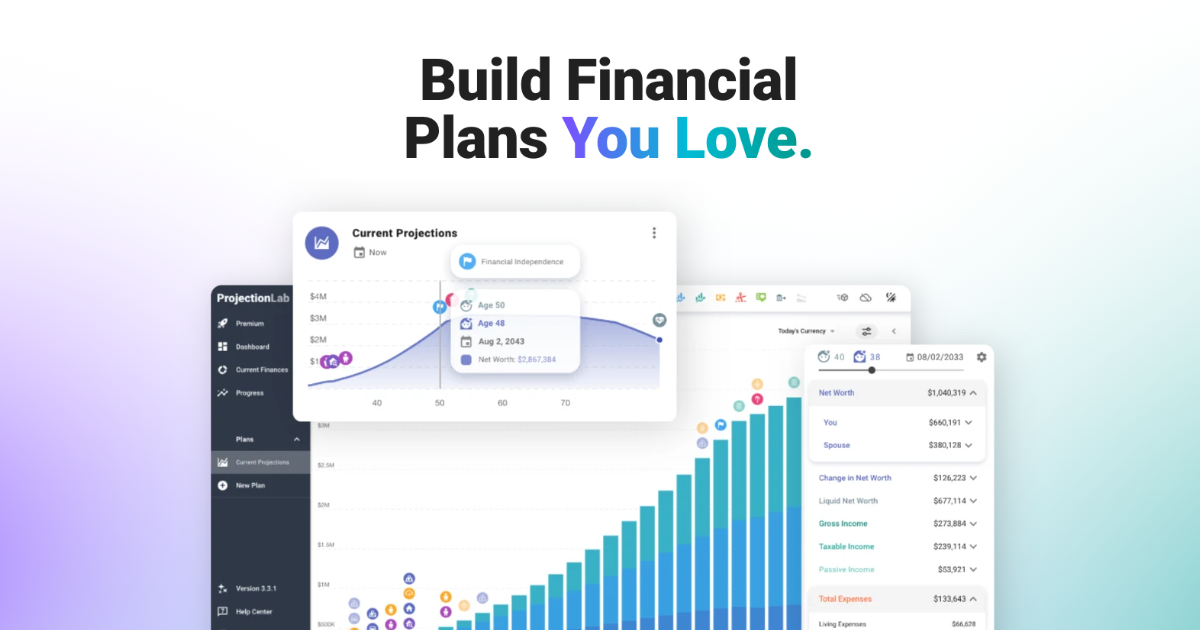
766 pointsTL;DR - ProjectionLab (https://projectionlab.com) is a privacy-friendly personal finance planning tool where you can create financial plans that go beyond the standard online retirement calculators. And by popular request, it now supports self-hosting for Lifetime users!
Something I'm grateful for is that our community here on HN is the difference between PL existing and not. There was actually a time early on when I was one day away from halting work on it. I posted here on a whim, and was shocked to receive some really constructive and energizing feedback that went on to power my indie dev journey over the past two and a half years.
As a quick recap, the story started when I dove head-first down the financial independence rabbit hole. I wanted a hands-on and visual way to explore the trade-offs between different life paths. One thing led to another, and I decided to build ProjectionLab.
After last year's Show HN, I really put my nose to the grindstone, and here are some of the big developments:
- Self-hosting for Lifetime users (spin up your own private deployment, based on Docker Compose, includes support for auth/encryption)
- Cash-flow visualization for each simulated year (sankey charts)
- Tax analytics (detailed breakdowns for projected income, taxes, marginal rates, effective brackets, etc)
- Major redesign of entire app, with landing page and resources now split into separate project
- Filing separately option to improve support for international locations that don't have joint filing
- Roth Conversions and 72t (SEPP) distribution modeling
- Improvements to US tax estimation (Secure 2.0 updates, rental property tax deductions, Medicare + IRMAA, NIIT, principal residence exclusion, etc)
- Better support for planning as a couple
- More modeling options for cash-flow priorities to support different budgeting philosophies and goals
- Extra liquidity + withdrawal options, ability to fund expenses with specific accounts or route income to specific accounts
- Customization options for Monte Carlo simulations (characterization of success rates and outcome types, option to set random seed, etc)
- And a whole bunch more! (https://projectionlab.com/changelog)
The HN community has had a huge role in shaping my overall direction with PL, and I can't wait to hear what you all think of the updates and where you would like to see things go from here.
As always, PL is free to try, with no need to create an account. It does not ask to link your financial accounts, and it has a sandbox mode if you just want to hop in and see how it works.
--Kyle
Comments (288) 77 threads
Earlier commentsIt runs a million scenarios in a few milliseconds which is fast enough to update the results (the percentage at the bottom) in real time as you drag sliders. It's several orders of magnitude faster than other Monte Carlo retirement simulators; so fast that it may not even feel like it's doing anything. But it really does run a million scenarios instantly.
I also have the simulation implemented on the CPU as well to validate the correctness of the results.
Continue this thread — 1 reply
It looks great. I'd love to dig in to it more.
I know you've seen this elsewhere but I don't think I'd pay quite that much for the product, and the blow-away-everything of the free model means I'd probably not come back again.
The housing screen should let you fill in your full payment amount but ask if any of it is escrow/PII or anything else beyond P&I.
A pet peeve with mortgage offers I get in the mail, email, from my bank, etc, is they all know my monthly payment but that payment includes escrow for taxes and insurance. This leads to me getting offers telling me how much I'll save when their offer is actually higher than what I've got (especially true now that rates are higher). I felt the same moment of annoyance when I entered my payment amount and saw I'd have it paid off in half the time I actually will.
Back to cost for a moment.
Like many others, I do my own tracking today, which has a cost in time of course. Since it's coming from my free time I tend to value it in terms of what else I could be doing, and mentally to me that's the "movie model". I spend perhaps 15 minutes twice a month tracking my expenses, debt, etc and in movie terms (a ticket is $18 and provides about 2.5 hours of entertainment) that's about worth about $3 to me.
And because I take the time to look at my expenses regularly, I really, really, really try to avoid any kind of recurring costs when possible. I think this is probably true for a lot of your audience.
And maybe I should do something to make this more clear, but the "years to pay off" text embedded in the house form is just a preliminary estimate -- other things like cash-flow priorities you create to make extra payments can impact the actual pay-off time in the full simulation.
On the cost topic, are you familiar with the pricing for other products in the planning space? I've made an effort to position PL competitively, and a piece of unsolicited feedback I get a lot in the wild is that current pricing is actually still too low.
Do you think dicing up the feature set to create a cheaper pricing tier could be helpful? If so, I'd be curious to hear opinions on which features should fall into each tier.
FWIW I do also offer general discounts on request (info on pricing page).
The real issue is the trial. Auto charge trials, especially ones I'm unsure of, are a turnoff. This brings me to 3 issues...
* 7 days is psychologically a short time to try this. For me, this means I have to set aside time in this coming week to set everything up and see how it works. A longer trial period might help.
* The auto charge at the end of the trial is, as mentioned, a dark pattern that I avoid whenever possible. If I'm not 90% sure I'm going to use the product, I won't sign up for something that needs my credit card in advance.
* The free option is too limited for me to start entering data and come back later. It's also missing functionality I think I'll need later. I have to pay at least $14, and setup an auto-charge, to pick up where I left off later, so this is a non-starter for determining if the product is worth the $14 to begin with.
In short, it might be worth $14 a month and it is even likely to be worth the ~ $100 a year, but the limitations and requirements around the trial keep me from feeling comfortable finding out. The most off-putting is the auto-charge, which make me nervous in any case.
I also grant extended trials on request. So if you'd like a longer trial (e.g. a month for free), you can just shoot me an email :)
Oh and to answer your question on DB vs DC -- if you're talking about the workplace pension cash-flow priority, that would be for modeling Defined Contribution pensions. For DB, that's an integrated section within the corresponding income stream.
Also I have to add that your sentences saying, "workplace pension cash-flow priority" and " corresponding income stream" are very confusing.
I think the figures for the UK example are not great. Living expenses, health care, and medical expenses are a lot larger than seems correct.
Also you should probably put a tool tip defining concessional vs non-concessional Australian superannuation. Also that should be in AUD rather than £
Amazing interface BTW
When you add a new account or cash-flow priority for super contributions, the choices should have subtitles distinguishing Concessional from Non-Concessional. But sounds like there are some other places it would be helpful to show those subtitles too?
Always happy to tweak/update the sandbox examples based on what folks would like to see. Any good data sources you'd recommend for more typical UK expense figures?
Continue this thread — 1 reply
It just doesn't really make sense as a coupling, if I'm early career with a DB pension or mid-career with DC it's not clear which is the better pick or how much it matters. As far as I can tell having selected one and played with it just briefly, it doesn't matter at all because all it does is set some numbers you can change anyway, there's no built-in knowledge/logic of specific country pension schemes or tax treatments?
Does that help clarify? And/or do you feel like a different approach for the sandbox would have been better?
Continue this thread — 2 replies
I'm slightly confused by the pricing. Is the free plan persistent only in 1 browser? Have I understood that right?
My thought process was that I wanted to make as much of the planning functionality as I could free to try and low-friction. I'm always open to feedback on pricing model though. Sounds like you would prefer to see a level of persistence in the free tier? If you have more thoughts on how that should work, let me know!
Continue this thread — 1 reply
All comments shown.
Couldn't load more comments. Check your connection and try again.