Show HN: I spent 2 years building a personal finance simulator (opens in a new tab)projectionlab.com
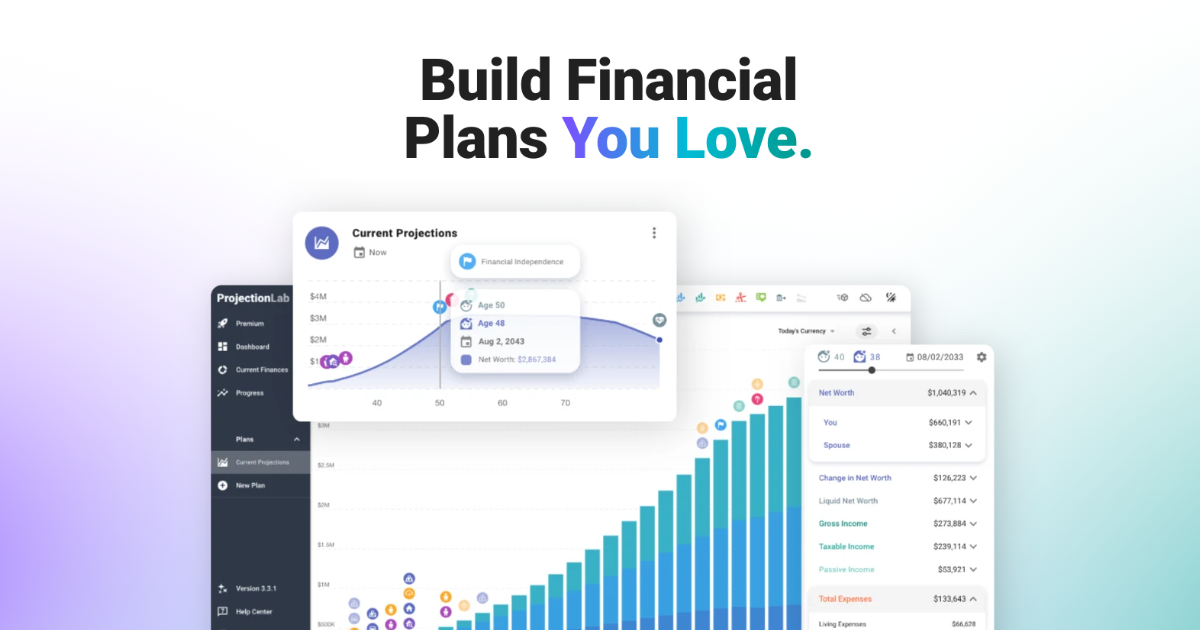
766 pointsTL;DR - ProjectionLab (https://projectionlab.com) is a privacy-friendly personal finance planning tool where you can create financial plans that go beyond the standard online retirement calculators. And by popular request, it now supports self-hosting for Lifetime users!
Something I'm grateful for is that our community here on HN is the difference between PL existing and not. There was actually a time early on when I was one day away from halting work on it. I posted here on a whim, and was shocked to receive some really constructive and energizing feedback that went on to power my indie dev journey over the past two and a half years.
As a quick recap, the story started when I dove head-first down the financial independence rabbit hole. I wanted a hands-on and visual way to explore the trade-offs between different life paths. One thing led to another, and I decided to build ProjectionLab.
After last year's Show HN, I really put my nose to the grindstone, and here are some of the big developments:
- Self-hosting for Lifetime users (spin up your own private deployment, based on Docker Compose, includes support for auth/encryption)
- Cash-flow visualization for each simulated year (sankey charts)
- Tax analytics (detailed breakdowns for projected income, taxes, marginal rates, effective brackets, etc)
- Major redesign of entire app, with landing page and resources now split into separate project
- Filing separately option to improve support for international locations that don't have joint filing
- Roth Conversions and 72t (SEPP) distribution modeling
- Improvements to US tax estimation (Secure 2.0 updates, rental property tax deductions, Medicare + IRMAA, NIIT, principal residence exclusion, etc)
- Better support for planning as a couple
- More modeling options for cash-flow priorities to support different budgeting philosophies and goals
- Extra liquidity + withdrawal options, ability to fund expenses with specific accounts or route income to specific accounts
- Customization options for Monte Carlo simulations (characterization of success rates and outcome types, option to set random seed, etc)
- And a whole bunch more! (https://projectionlab.com/changelog)
The HN community has had a huge role in shaping my overall direction with PL, and I can't wait to hear what you all think of the updates and where you would like to see things go from here.
As always, PL is free to try, with no need to create an account. It does not ask to link your financial accounts, and it has a sandbox mode if you just want to hop in and see how it works.
--Kyle
Comments (288) 77 threads
Show all comments
Showing thread 10 of 77
MaxiFi Planner is the best consumer tool I know; my advisor also uses it. A puzzle that's too hard for it, making me want to script scraping its reports: Should I choose an annuity for part of my TIAA-CREF retirement savings? Even if one understands that the answer is generally no, there's always a number that flips the decision. TIAA annuities pay more than market, but enough more? There's an annuity paradox that programs like MaxiFi Planner reveal: Even a poorly priced annuity lets one plan to spend more. On the other hand we want to optimize our daughter's inheritance.
Economists optimize varying notions of "utility". The above is a game, scoring what one gets to spend adapting to market conditions, taking into account the inheritance as one's year of death varies. This is beyond any planning software I've seen, yet it's exactly the game I will instead play out badly by hand.
Using that you can also try out alternate scenarios like "what if I converted x00k of my savings to an annuity in exchange for a predictable cash flow" and see how it affects your withdrawal rate.