The first picture on the page is the editor, and dammmnnnm wowwww. From it's bullet point:
> Diagram Editor: A drag-and-drop interface to combine Nim apps into scenes. Fork and edit existing apps like "OpenAI image", and "Text overlay" to suit your needs. Overwrite all fields with inline code snippets. This looks really slick. It feels like it must be a huge effort! I wonder what they used to build this. Is the editor written in Nim? What do you run once you write a scene: a runtime similar-ish to the editor but with a presentation mode, or does it spit out a new Nim program to run the other nim programs? Do apps get once-off invoked or is there persistent communication for apps to keep running? What triggers a frame to start, how does composting happen? I feel like they've built a very cool generic flow-based programming system here, that happens to be used for smart frames.
The editor/controller itself is just a React+Kea app using React Flow for the diagramming part, and Flask for the backend. For now to test that the app you built works, you must deploy it on a frame. I have a fast RPi 5 for testing, and the feedback loop is typically ~30sec. It's about a minute with a Zero W2, and about 2min with a Zero W. This is not ideal, and I'd like to improve that. Ideally I'd like to use Nim's JS backend to build a "frame" that can be run directly in the browser for testing. As for the other questions, the FrameOS system runs at boot, and all the apps are compiled in to that one binary and run as the scene dictates. New frames get rendered when a render event is dispatched, which can happen automatically on an interval, or as requested. Frames send logs back to their controller, but can otherwise operate completely independently.
You're technically right (the best kind?), but there's some nuance to the question.
FrameOS is a compiled binary that runs on top of Linux. At present you need to install the "Raspberry Pi OS Lite" (without the desktop environment) on a SD card before you can install FrameOS itself on top of that. So it's "just an application". However, this is mostly because it's an early project, and this was the fastest way to get going. The next step is to see how much can be removed. Since FrameOS is a statically compiled single binary, it shouldn't need that much more than the Linux kernel? Will FrameOS be a true OS then? Android seems to be considered its own OS despite using the Linux kernel. Once activated, FrameOS takes over your entire system, has its own `apps/` and `drivers/` folders, and in many ways already behaves like an Operating System. I'm also pondering about getting it running on an ESP32 (will need to add `drivers/wifi/`?). Without any OS below it, will it then be worthy of being called an OS? You all tell me. :shrug: Thus is it an Operating System? It is to me, but you can choose to disagree. At my actual job (PostHog), we sometimes call ourselves the "Product OS". This annoys me more, as a suite of webapps definitely isn't an "Operating System" in its traditional sense. I've seen -OS at the end of other things as well that aren't pure Operating Systems. It slightly bothers me, but mostly because I was around when "what OS you're using" was a defining question. Language is evolving, and "operating system" seems to describe more things to different people, than it does to you and me.
What is an OS? Genuine question, not being sarcastic here. "OS" is a pretty loosely defined term at the moment. Clearly Android and Ubuntu are very different operating systems, despite having roughly the same kernel.
FrameOs uses Nim, which means it can be ported to run on bare-metal with no kernel. The async dispatch means that Nim also provides some light-weight co-operative multitasking. I'd say that FrameOs is an OS (or userpsace if you prefer) that currently only runs on top of the linux kernel, but there's no reason it couldn't be ported to run directly on a microcontroller.
Looks cool! I've been wanting to set up an e-ink display with my HomeAssistant, so I'll be checking this out.
In your "Why FrameOS" post, you have a photo that looks like an e-ink display displaying a HomeAssistant dashboard, and under it you say "However the software side of things was rubbish." What exactly were the issues you had before writing FrameOS? It looks like it's working great in the picture at least! I'm also curious what this actually means: > GPT4 Support: Ask your favourite LLM to write and debug FrameOS apps for you.
RE ChatGPT: I think it's a clever joke highlighting that it is a product that often needs no further integration (to make blockchain powered self driving social AI clouds, or whatever sells best on private equity markets these days).
Idk I think it’s real… hopefully a sobering moment for people who think of LLMs as the successors to blockchain, OOP, beanie babies, etc. There is real value here and you don’t need think pieces to see it: it’s already delivering it.
I look forward to seeing this project cited as one of the first frameworks/OSs to offer first party developer assistants.
Oh it's real. When coding an app inside the web editor, you can click a button that effectively sends your code to the GPT4 API, along with some instructions on what it should be. It then displays back the response.
The author integrated GPT-4 into the "app builder" that FrameOS has for building custom views, so you can ask GPT to make improvements to the underlying code. See https://frameos.net/blog/gpt4-support
My first thought seeing this was that it validates that new apps from now on will be LLM-integrated from the start. Why not, right? LLMs used right are a great UX-improvement for almost any app.
> My first thought seeing this was that it validates that new apps from now on will be LLM-integrated from the start. Why not, right? LLMs used right are a great UX-improvement for almost any app.
Well, any apps that you can actually build yourself. This excludes the vast majority of them.
Hard to predict the future, but my guess is that most apps will have a natural language input component going forward. Why navigate a million menus or compose complex rulesets by hand when you can describe in natural language what you want the app to do. I'm working on making such use-cases become reality in a tech company, for all our products and apps, and it would be strange if other companies aren't thinking the exact same thing right now.
The bootloaders have been locked; and the 2015 models (iirc) were the last ones where a bug allowed unlocking them by shorting some pins. Without an unlocked bootloader, you might be able to root Android, but you can't replace Android or the ROM.
Not that it matters anyway - it's MediaTek. Their partition layout and driver model from those eras is generally a disaster. There's no way you'd be able to make FrameOS in a reasonably elegant way work on that hardware.
You can unlock the bootloader of the 2018 Fire HD 8 if you force it into download mode by opening it up and shorting the CLK test point to ground. Older tablets don't need to be opened up, it's all just software. Everything after that though has been unable to have the bootloader unlocked.
Ignorant Q: Could one ostensibly replace the ROM? Surely there has to be some Chinese company that can get you a custom ROM built and replace it on the device?
EDIT: Yes, I meant physically de-solder/replace of the ROM - is that a nightmare? What if you could find the economics of having people ship you their devices and either donating (to schools (NOT UNIVERSITY SLURPS)) or paying for their device to be up-ROM'd or e-cycled? (My first job as a freshman in Highschool was desoldering ROMs and soldering new ROM chips into the boards of Amigas and Apple ][e's -- I had tons of these new ROMs on a strip and in tubes - but I never had any use for them... I with I had kept them.) ((Also, just to let you know the difficulty level - replacing a ROM chip on an Apple ][e etc was as simple as receiving an instruction set: "Desolder the red guys. Resolder with these green guys." That was the extent of my knowledge to ROMs in ][Es I had no Idea at the time what I was doing.
Use Fire Toolbox to disable all the bloatware. Buy a license for Fully Kiosk to convert it into many different practical things.
Personally, I use Amazon Fire Tablets as audio drivers around my house for Snapcast. Each tablet has USB, wifi, 3.5mm Aux, and a built in battery, which make them great for this task, especially on sale at $45 a tablet
Comments (112) 26 threads
Earlier comments> Diagram Editor: A drag-and-drop interface to combine Nim apps into scenes. Fork and edit existing apps like "OpenAI image", and "Text overlay" to suit your needs. Overwrite all fields with inline code snippets.
This looks really slick. It feels like it must be a huge effort! I wonder what they used to build this. Is the editor written in Nim?
What do you run once you write a scene: a runtime similar-ish to the editor but with a presentation mode, or does it spit out a new Nim program to run the other nim programs? Do apps get once-off invoked or is there persistent communication for apps to keep running? What triggers a frame to start, how does composting happen?
I feel like they've built a very cool generic flow-based programming system here, that happens to be used for smart frames.
Edit: I’m wrong, it’s actually React Flow!
https://github.com/FrameOS/frameos/blob/037af53e94a3b47ce5df...
https://reactflow.dev/
The editor/controller itself is just a React+Kea app using React Flow for the diagramming part, and Flask for the backend.
For now to test that the app you built works, you must deploy it on a frame. I have a fast RPi 5 for testing, and the feedback loop is typically ~30sec. It's about a minute with a Zero W2, and about 2min with a Zero W. This is not ideal, and I'd like to improve that.
Ideally I'd like to use Nim's JS backend to build a "frame" that can be run directly in the browser for testing.
As for the other questions, the FrameOS system runs at boot, and all the apps are compiled in to that one binary and run as the scene dictates. New frames get rendered when a render event is dispatched, which can happen automatically on an interval, or as requested. Frames send logs back to their controller, but can otherwise operate completely independently.
FrameOS is a compiled binary that runs on top of Linux. At present you need to install the "Raspberry Pi OS Lite" (without the desktop environment) on a SD card before you can install FrameOS itself on top of that. So it's "just an application".
However, this is mostly because it's an early project, and this was the fastest way to get going. The next step is to see how much can be removed. Since FrameOS is a statically compiled single binary, it shouldn't need that much more than the Linux kernel? Will FrameOS be a true OS then? Android seems to be considered its own OS despite using the Linux kernel.
Once activated, FrameOS takes over your entire system, has its own `apps/` and `drivers/` folders, and in many ways already behaves like an Operating System. I'm also pondering about getting it running on an ESP32 (will need to add `drivers/wifi/`?). Without any OS below it, will it then be worthy of being called an OS? You all tell me. :shrug:
Thus is it an Operating System? It is to me, but you can choose to disagree.
At my actual job (PostHog), we sometimes call ourselves the "Product OS". This annoys me more, as a suite of webapps definitely isn't an "Operating System" in its traditional sense. I've seen -OS at the end of other things as well that aren't pure Operating Systems. It slightly bothers me, but mostly because I was around when "what OS you're using" was a defining question. Language is evolving, and "operating system" seems to describe more things to different people, than it does to you and me.
FrameOs uses Nim, which means it can be ported to run on bare-metal with no kernel. The async dispatch means that Nim also provides some light-weight co-operative multitasking.
I'd say that FrameOs is an OS (or userpsace if you prefer) that currently only runs on top of the linux kernel, but there's no reason it couldn't be ported to run directly on a microcontroller.
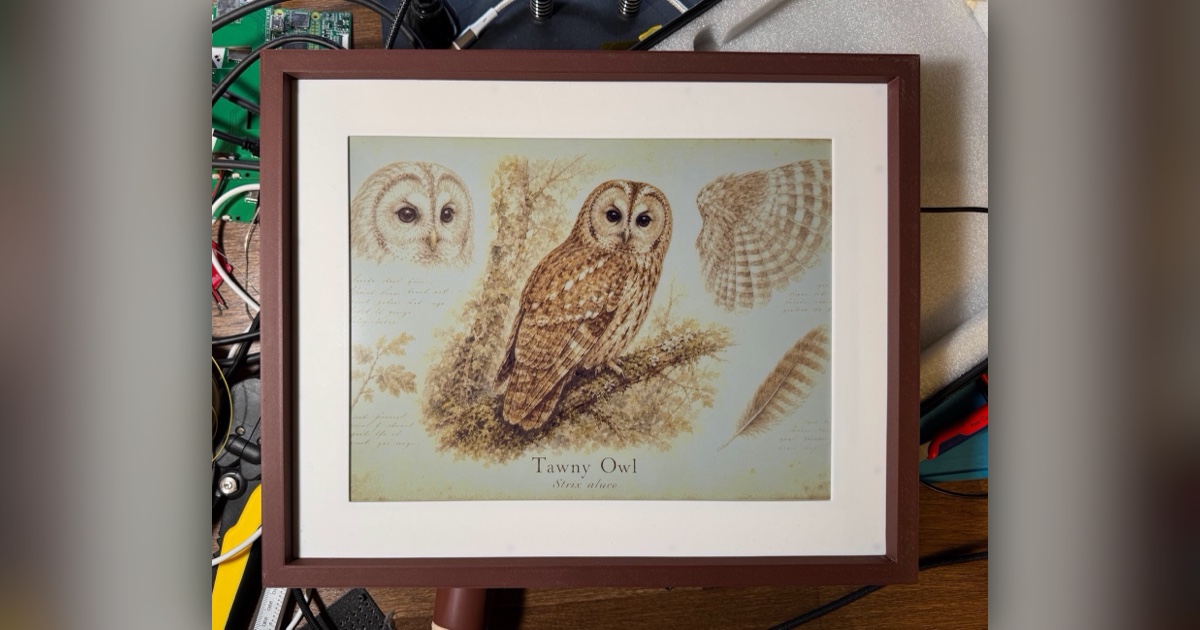
In your "Why FrameOS" post, you have a photo that looks like an e-ink display displaying a HomeAssistant dashboard, and under it you say "However the software side of things was rubbish." What exactly were the issues you had before writing FrameOS? It looks like it's working great in the picture at least!
I'm also curious what this actually means:
> GPT4 Support: Ask your favourite LLM to write and debug FrameOS apps for you.
I look forward to seeing this project cited as one of the first frameworks/OSs to offer first party developer assistants.
It's really basic, but has already been useful: https://frameos.net/blog/gpt4-support
It doesn't mean the value isn't overstated.
Continue this thread — 1 reply
My first thought seeing this was that it validates that new apps from now on will be LLM-integrated from the start. Why not, right? LLMs used right are a great UX-improvement for almost any app.
Well, any apps that you can actually build yourself. This excludes the vast majority of them.
Continue this thread — 1 reply
Not that it matters anyway - it's MediaTek. Their partition layout and driver model from those eras is generally a disaster. There's no way you'd be able to make FrameOS in a reasonably elegant way work on that hardware.
EDIT: Yes, I meant physically de-solder/replace of the ROM - is that a nightmare?
What if you could find the economics of having people ship you their devices and either donating (to schools (NOT UNIVERSITY SLURPS)) or paying for their device to be up-ROM'd or e-cycled?
(My first job as a freshman in Highschool was desoldering ROMs and soldering new ROM chips into the boards of Amigas and Apple ][e's -- I had tons of these new ROMs on a strip and in tubes - but I never had any use for them... I with I had kept them.)
((Also, just to let you know the difficulty level - replacing a ROM chip on an Apple ][e etc was as simple as receiving an instruction set:
"Desolder the red guys. Resolder with these green guys."
That was the extent of my knowledge to ROMs in ][Es
I had no Idea at the time what I was doing.
Continue this thread — 2 replies
Personally, I use Amazon Fire Tablets as audio drivers around my house for Snapcast. Each tablet has USB, wifi, 3.5mm Aux, and a built in battery, which make them great for this task, especially on sale at $45 a tablet
All comments shown.
Couldn't load more comments. Check your connection and try again.