Show HN: Open-source x64 and Arm GitHub runners (opens in a new tab)ubicloud.com
475 pointsOur first use-case is GitHub Actions. We support x64 and arm64 Linux runners; and reduce your Github Actions bill by 10x. We can give you hardware similar to default GitHub runners because of the very high margins on the cloud. One difference with our hardware is that we use local NVMes for better disk performance.
Ubicloud and our GitHub Actions integration is also open source. You can check out our integration here: https://github.com/ubicloud/ubicloud/blob/main/routes/web/we...
For security and isolation, we give you a clean and ephemeral VM for each job. When the job completes, we deprovision the VM and wipe out the block storage device attached to the VM. We set up your firewall rules to lock down access to the VM; and also encrypt your data at rest and in-transit.
(We use Linux KVM and the Cloud Hypervisor as our underlying VM tech. For our block device, we use and extend SPDK: https://www.ubicloud.com/blog/building-block-storage-for-clo...)
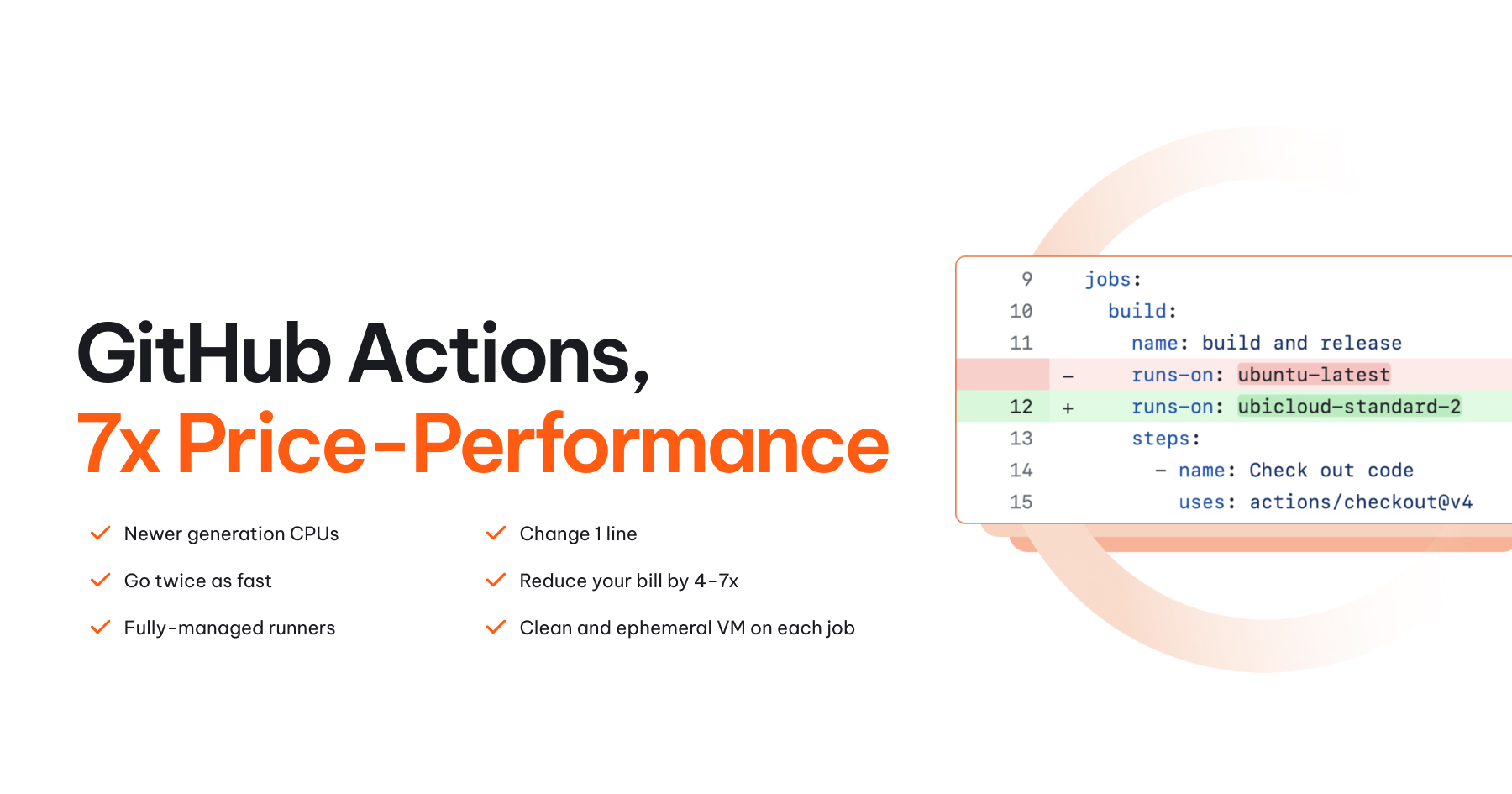
Ubicloud runners are also fully compatible with GitHub runners. To get started, all you need to do is change 1-line in your workflow file. Each account gets 1,250 free build minutes per month with standard-2 runners.
We’d love to hear your feedback!
https://www.ubicloud.com/docs/github-actions-integration/qui...
Comments (124) 38 threads
Show all comments
Showing thread 24 of 38
Does this provide guarantee that subsequent job won't be able to recover the data?
We completely shut down the VM and remove the block device (all files associated with the block device).
Although we have a KEK and DEK code for regular VMs, they are not operative on GHA...yet. The reason has to do with a technical conflict with copy-on-write we aim to close, not least of which because Ubicloud needs to grow its own copy-on-write features for block device snapshots, things we lack today.
I expect within a few months, all expired GHA vms will be cryptoshredded upon their deletion. This is already true for regular virtual machines or managed postgres machines.
Just, why? CoW (or your own CoA) are ripe with performance problems. How exactly do you benefit from their use?
Continue this thread — 3 replies