Show HN: Open-source x64 and Arm GitHub runners (opens in a new tab)ubicloud.com
475 pointsOur first use-case is GitHub Actions. We support x64 and arm64 Linux runners; and reduce your Github Actions bill by 10x. We can give you hardware similar to default GitHub runners because of the very high margins on the cloud. One difference with our hardware is that we use local NVMes for better disk performance.
Ubicloud and our GitHub Actions integration is also open source. You can check out our integration here: https://github.com/ubicloud/ubicloud/blob/main/routes/web/we...
For security and isolation, we give you a clean and ephemeral VM for each job. When the job completes, we deprovision the VM and wipe out the block storage device attached to the VM. We set up your firewall rules to lock down access to the VM; and also encrypt your data at rest and in-transit.
(We use Linux KVM and the Cloud Hypervisor as our underlying VM tech. For our block device, we use and extend SPDK: https://www.ubicloud.com/blog/building-block-storage-for-clo...)
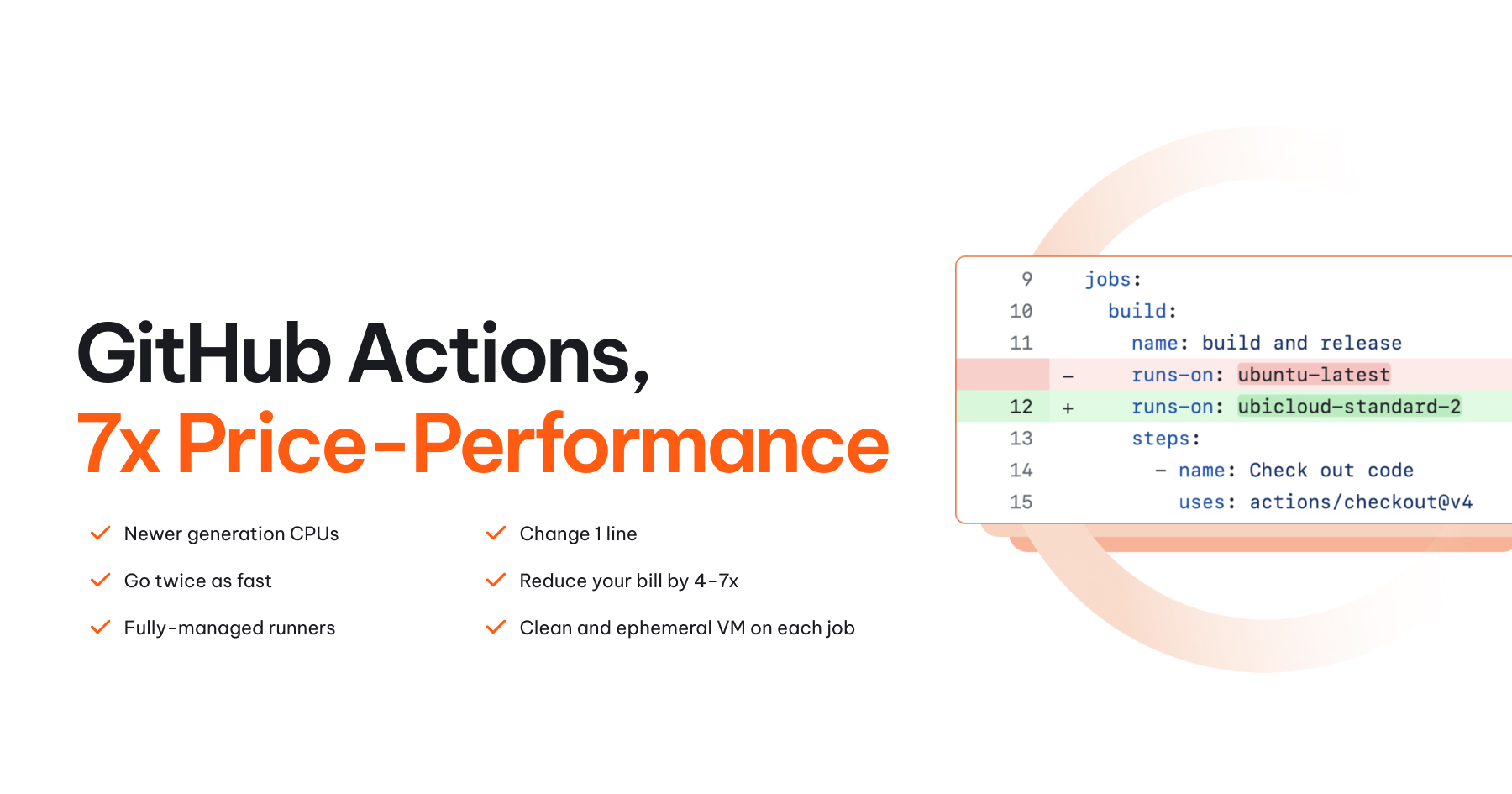
Ubicloud runners are also fully compatible with GitHub runners. To get started, all you need to do is change 1-line in your workflow file. Each account gets 1,250 free build minutes per month with standard-2 runners.
We’d love to hear your feedback!
https://www.ubicloud.com/docs/github-actions-integration/qui...
Comments (124) 38 threads
Show all comments
Showing thread 2 of 38
One counter-intuitive thing we found is that it's slow to save and restore caches, but the machines have good CPU, so for us it's been faster to disable cache entirely and just redo everything on each build.
[0] https://github.com/ArroyoSystems/arroyo
The link to SPDK was very interesting: https://www.ubicloud.com/blog/building-block-storage-for-clo.... I use filesystems for very high performance applications, and I've found ZFS to often be the limiting factor when compared to simpler solutions of XFS +- mdadm +- encryption.
It's a controversial point, but others have made similar findings: https://klarasystems.com/articles/virtualization-showdown-fr... : "Although I suspect this will surprise many readers, it didn’t surprise me personally—I’ve been testing guest storage performance for OpenZFS and Linux KVM for more than a decade, and zvols have performed poorly by comparison each time I’ve tested them"
OpenZFS seems to be starting to consider optimizations to better perform on modern drivers (SSD, NVMe) which have very different performance profiles to what ZFS was built for (spinning rust)
In the SPDK summary they say "To make VM provisioning times go faster, we changed our host OS from ext4 to btrfs" (...) "Also, when we switched the host filesystem to btrfs, our disk performance degraded notably. Our disk throughput dropped to about one-third of what it was with ext4."
Ubicloud: the problem seems to be generic to CoW filesystems, and it's interesting you came with a slight variation (CoA) but have you considered the even simpler alternative of any journaling filesystems (XFS, Ext4...) with overlays?
Or just UFS2 + snapshots to restore from a given state (initialized, ready for each test) then restore to this state between tests?
I think customers finding that disabling cache works better means the CoA has similar issues to CoW.
Personally, I'd have just tried to using SR-IOV with a namespace per customer, and call it a day instead of bringing extra complexity, but there must be good reasons for it. I'd love to know what these reasons are.
Yes, that is correct. We are also working on implementing our own caching, which should speed up cache downloads/uploads significantly.
I wonder what the consequential "carbon footprint" of this is, but at scale for all companies/all jobs of similar nature
It's really kinda impossible to judge the carbon footprint for these kinds of things, and if it's justified. Consider the carbon footprint of all the dumb AI feature rolled out at Facebook, Google, etc. Consider the carbon footprint of everyone trying to use ChatGPT now. Do you know how much power GPUs are guzzling to give each little answer? It's really huge, compared to a traditional google search! Is it worth it? ... who can judge eh
The numbers are obviously very rough; there’s a LOT of factors to consider and which vary from one node to another. But the methodology is quite comprehensive, e.g. they factor in power consumption of the end user’s device while waiting for the data to transfer over the wire
Green software engineering is interesting to me because it seems like a good way to impact greenhouse gases _without_ requiring consumers to change anything about their lifestyle (which is the hard part of climate change…) There’s a cool presentation from Rasmus Lerdorf from around the time when PHP7 released where he estimated a 50% adoption rate of PHP7 would result in a saving of 3.5B kg CO2/year iirc, purely because of the compute efficiency gains from PHP6 -> PHP7.
I used their numbers to calculate that swapping our CI/CD clones at my day job over to shallow clones saved (maybe) 5.5 kg/week of CO2 emissions [2]. Not quite as impressive as the PHP7 figures, but I still think it’s kinda neat.
[1] https://theshiftproject.org/en/lean-ict-2/
[2] https://sophiabits.com/blog/the-cost-of-bandwidth
Continue this thread — 1 reply
[1]: https://runs-on.com
Continue this thread — 1 reply
I should say we also use BuiltJet for docker builds because of their arm support. Now that ubicloud has arm we may switch those over as well.
In your case your workflow can run in less than 5 minutes on AWS ephemeral machines, for the same price as ubicloud: https://github.com/runs-on/arroyo/actions/runs/7723361513/jo...