Lurker News
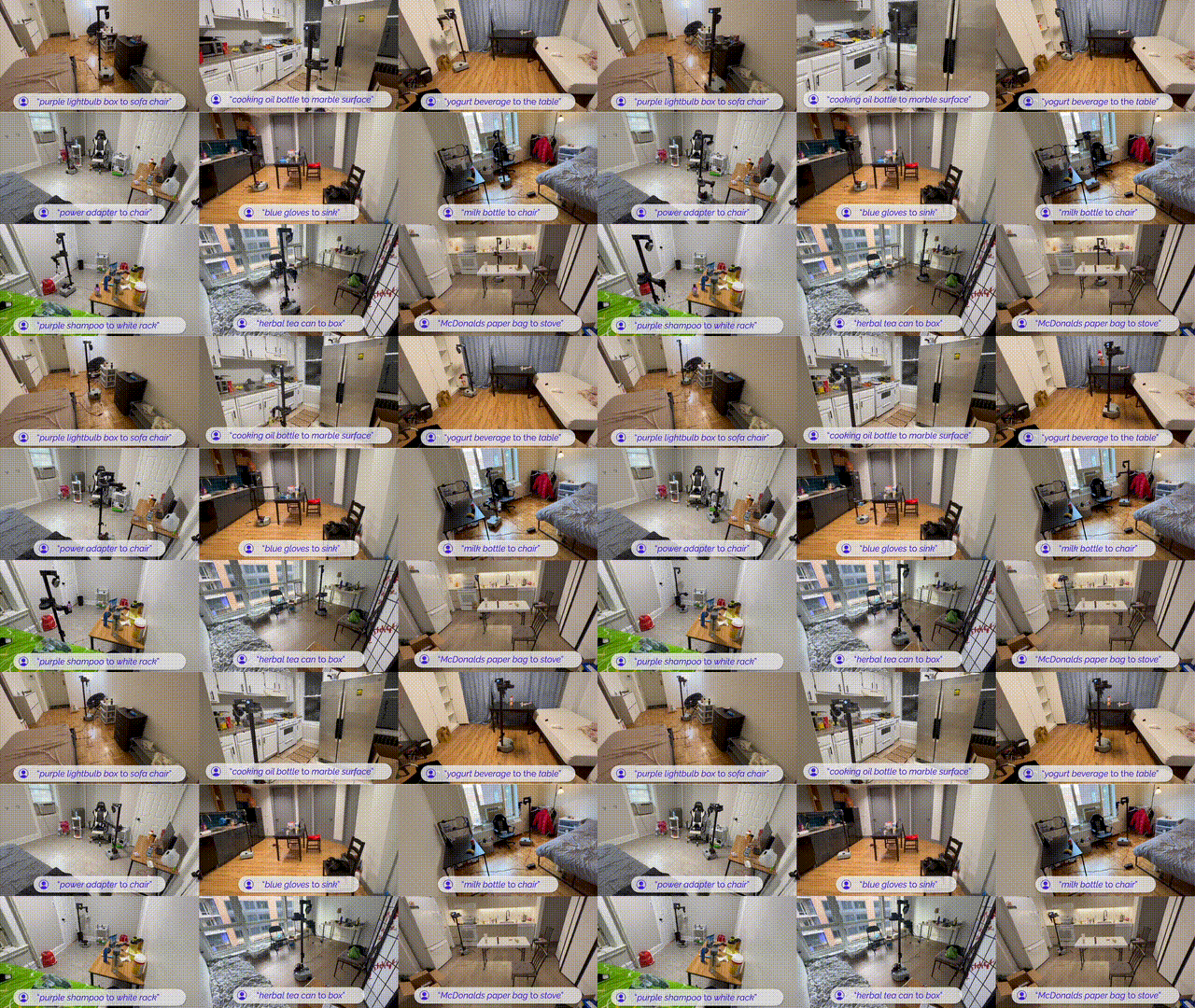
Hi all, excited to share our latest work, OK-Robot, which is an open and modular framework to perform navigation and manipulation with a robot assistant in practically any homes without having to teach the robot anything new! You can simply unbox the target robot, install OK-Robot, give it a "scan" (think a 60 second iPhone video), and start asking the robot to move arbitrary things from A to B. We already tested it out in 10 home environments in New York city, and one environment each in Pittsburgh and Fremont.

We based everything off of the current best machine learning models, and so things don't quite work perfectly all the time, so we are hoping to build it together with the community! Our code is open: https://github.com/ok-robot/ok-robot and we have a Discord server for discussion and support: https://discord.gg/wzzZJxqKYC If you are curious what works and what doesn't work, take a quick look at https://ok-robot.github.io/#analysis or read our paper for a detailed analysis: https://arxiv.org/abs/2401.12202
P.S.: while the code is open the project unfortunately isn't fully open source since one of our dependencies, AnyGrasp, has a closed-source, educational license. Apologize in advance, but we used it since that was the best grasping model we could have access to!
Would love to hear more thoughts and feedback on this project!
Comments (110) 28 threads

Show all comments

Showing thread 12 of 28

taco_emoji1 reply#
I know nothing about robotics, but can someone ELI5 why the robot makes so many extraneous movements? E.g. the video that shows it moving Takis from the desk to the nightstand, it approaches the desk, and then the arm mechanism moves all the way down (an unnecessary maneuver), then rises again before reaching the level needed to pick up the Takis.
throwup2381 reply#
A lot of those movements are there to zero out the axes so that each movement starts from a known good position and orients itself against the camera. Usually there's a switch that, for example, senses when the body goes all the way to the bottom, which is the origin for the whole positioning system. Several other movements are for safety since it doesn't have a bunch of cameras and really complex logic for collision avoidance so it resets to a smaller profile between moving around.

Since motors are capable of very precise movements and errors accumulate, this is a best practice when starting new movements. Humans instead have a complex hand-eye coordination system that trained all of our lives (and some people are better at it than others).

leptons1 reply#
>A lot of those movements are there to zero out the axes so that each movement starts from a known good position and orients itself against the camera. Usually there's a switch that, for example, senses when the body goes all the way to the bottom, which is the origin for the whole positioning system.

Ideally the "zeroing" should be done once when the robot "wakes up" or only once in a while, and there should be digital encoders on all motors, the position should always be known within a tiny margin of error, and not enough to cause a problem for positioning. At least that's how I'd do it, I'm not sure how they built this thing.

MahiShafiullah1 reply#
It's always a trade-off! You could have more accurate sensors and motors that are more expensive, or you can have cheaper motors with no sensors and higher accumulated errors. Since this is more of a research project than a product, we went for a cheap robot with the slower-but-more-accurate approach.

Continue this thread — 1 reply