Lurker News
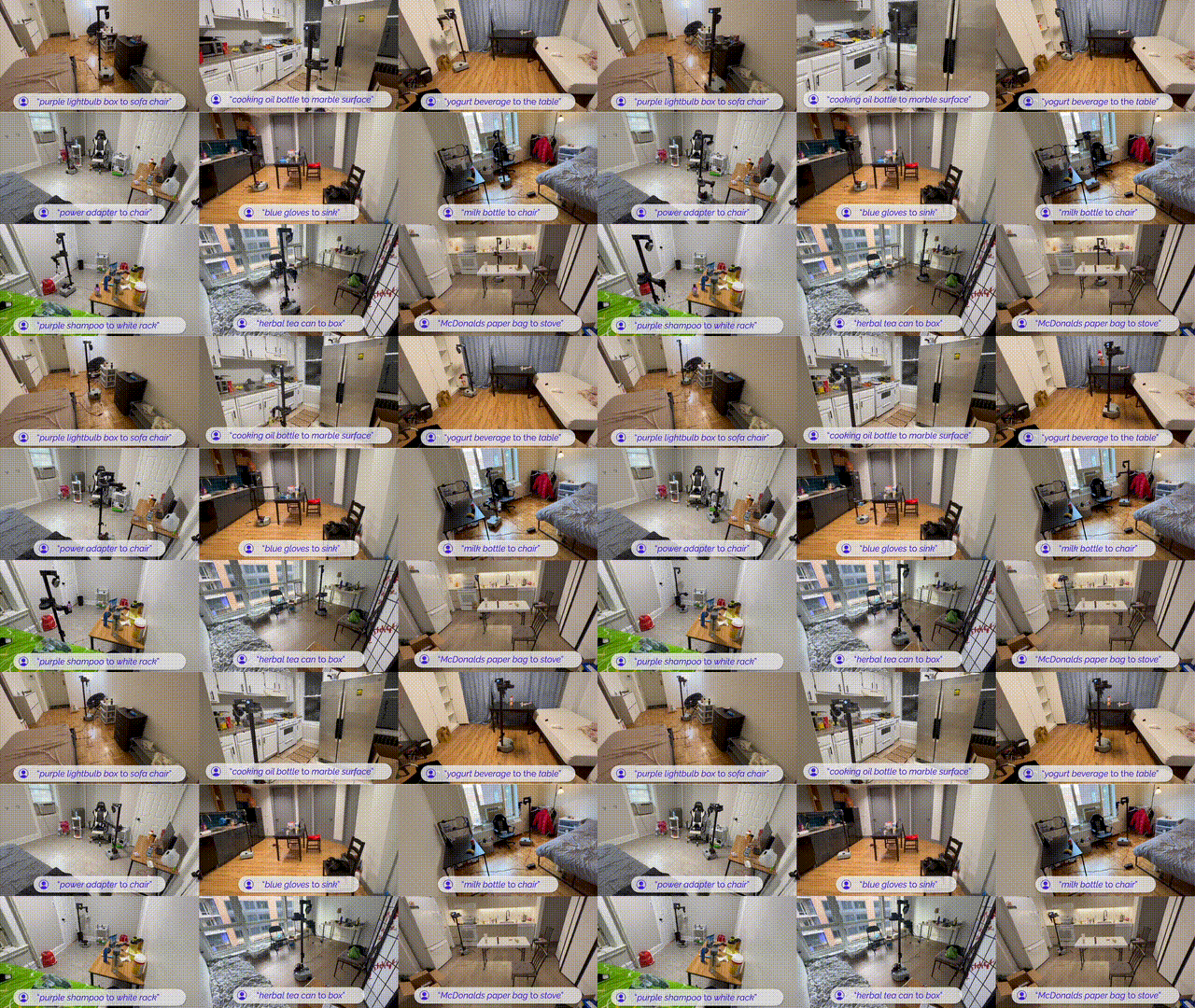
Hi all, excited to share our latest work, OK-Robot, which is an open and modular framework to perform navigation and manipulation with a robot assistant in practically any homes without having to teach the robot anything new! You can simply unbox the target robot, install OK-Robot, give it a "scan" (think a 60 second iPhone video), and start asking the robot to move arbitrary things from A to B. We already tested it out in 10 home environments in New York city, and one environment each in Pittsburgh and Fremont.

We based everything off of the current best machine learning models, and so things don't quite work perfectly all the time, so we are hoping to build it together with the community! Our code is open: https://github.com/ok-robot/ok-robot and we have a Discord server for discussion and support: https://discord.gg/wzzZJxqKYC If you are curious what works and what doesn't work, take a quick look at https://ok-robot.github.io/#analysis or read our paper for a detailed analysis: https://arxiv.org/abs/2401.12202
P.S.: while the code is open the project unfortunately isn't fully open source since one of our dependencies, AnyGrasp, has a closed-source, educational license. Apologize in advance, but we used it since that was the best grasping model we could have access to!
Would love to hear more thoughts and feedback on this project!
Comments (110) 28 threads

Show all comments

Showing thread 3 of 28

fnordpiglet2 replies#
This is remarkable and could be life changing for the disabled, elderly, gamers, or profoundly lazy and their caretakers.
marci6 replies#
I forgot where I saw that, but generally, improving things for people with disabilities improves things for everyone, like making sidewalks wheelchair friendly helps parents with a stroller, or people carrying heavy stuff, walking with a cane, young children on bicycles, people who can't see well...
sandworm1013 replies#
>> improving things for people with disabilities improves things for everyone

Everything has its limits. Many years ago I was involved in building a series of staircases in a rock climbing area inside a park. There were about a hundred steps in a handful of orientations to get from the parking lot over a rocky hill to the small valleys behind. The project was primarily to prevent trail erosion and falls. These steps weren't going to even have handrails. (Think 2x6 framed boxes filled with dirt and bolted to the rock.) Then someone in government said if we wanted to use donated money inside a park we would have to somehow make the project wheelchair accessible. All stop. Project over. No stairs were built. Access trail remained a mess.
We were going to replicate these stairs from another climbing area in BC. There is no way to make such a thing wheelchair accessible.
https://sonnybou.ca/ssbou2001/skaha01.jpg

developerDan2 replies#
It’s so frustrating that city leaders can’t even try to use common sense. Where I live a parking requirement blocked a restaurant from being built and our city council publicly acknowledged that there isn’t enough space for parking and a building, but “that’s the law” so they blocked it. Lazy idiots.

Continue this thread — 2 replies

fnordpiglet2 replies#
In the US? I assume ADA was the kicker. A lot of folks even in government don’t realize the ADA isn’t unthinking. If the activity or environment doesn’t lend itself to accessibility it’s not required. Cutting a wheel chair ramp into a mountain face is a good example where the ADA wouldn’t apply because it’s impractical given the environment to do so. Even national parks only offer a subset set of activities ADA complaint.
sandworm1018 replies#
No, it wasn't an ADA thing. It was a purely local thing. The local authority had adopted some resolution that no further "development" would happen before they added some sort of accessibility. So we couldn't move forwards even using donated money. We could repair things but not make substantive improvements.

Rock climbing areas tend to be inaccessible or at least very rough terrain. Ironically, a vertical rock surface can be made accessible. There are actually many disabled climbers out there. But with a mixed dirt/rock/scree slope you basically need to install a mile-long ramp.

Continue this thread — 8 replies

samatman#
Making an on-the-record decision to not provide accessibility is grounds for a lawsuit on that basis. It doesn't matter if they think they'd win that lawsuit, it's a chilling effect, and a big one.
marci#
This is not a limit of making things accessible. This is a bureaucratic/legal/funds limit. Had they told you "for accessibility, we will build an alternative route and handle the cost", would you have said "No, thanks"?

"improving things" and "mandatory requirements that, in some cases, can go against common sense" are not the same things.

Iv#
... daleks
hoc#
While I would agree in general, I once slipped on one of those overly steep carved-out kerbs in SF and broke my elbow... I guess if you hit a bad spot you might need a wheelchair afterwards (ok, but it really did hurt!)

So you have to do it right to keep the potential harm as low as possible and not forget about security in the face of rewarding improvements. And watch your step, of course.
Might also be applicable in the context of self-learning household robots and their potential to burn down that house :)

xanderlewis#
‘Designing things like door handles for people with only one arm is a good idea not just because it helps those with only one arm, but also because all of us sometimes have only one arm. If we’re carrying a hot cup of tea, for instance…’

…to (very liberally) paraphrase Rory Sutherland.

MahiShafiullah#
Thank you! A large motivation behind this line of home-robot work for me is thinking about the elderly, people with disabilities, or busy parents who simply don't have enough time to do it all. I am personally hopeful that we can teach AI to take the jobs that no one wants rather than the jobs that everyone wants :)