Show HN: Reverse-Engineering a Switch Lite with 1,917 wires (opens in a new tab)usoldering.com
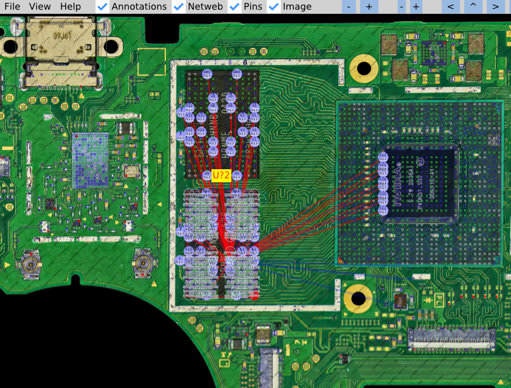
513 pointsMost public boardviews are almost entirely the result of industrial espionage, other than a few encrypted subscription based software platforms that provide extensive access. The process output is released as donationware, as my main concern is that even released as a low-cost purchase, there is a very strong culture to share this type of information at no cost. I would like to have a more sophisticated suggested donation system adaptive to user country, but I wasn't able to find a good solution.
In terms of 'good startup ideas', I don't think this is one of them. The very high level of soldering skill required makes it difficult to scale, and the prevailing piracy culture makes it challenging to monetize. My main advantage is that costs are very low now that I have the entire thing working. Other than forge ahead at a loss and hope for the best, or to pivot hard leveraging the imaging technology, I'm not sure what other options I have. It feels too complicated and repetitive for shoft-form video content. If you have any feedback, questions, suggestions, etc., I'd love to hear them.
Comments (114) 22 threads
Show all comments
Showing thread 4 of 22
I’d take a handful of automated probes in a 3D printer chassis, and some vision/registration/classical computer vision algorithms.
This type of thing already exists but I’d rather have an open source one.
Is it possible to make an open-source X-ray machine to do this kind of CT scan?
It really seems like it ought to be, but I don't know enough about the source and the CCD detectors to think about how to assemble it.
The big question is how to get an X-ray source with enough energy to penetrate metals and a detector with enough resolution.
Everything else can be cheap.
Edit: found it ( http://www.rtftechnologies.org/physics/faxitron-DX50-CT-scan... )
These machines are good for up to 8-10 layers of 1-oz copper.
Famous last words: how hard could it be?