Show HN: 5 Years Ago I made the Recovery Kit, I just made the RK2 (opens in a new tab)doscher.com
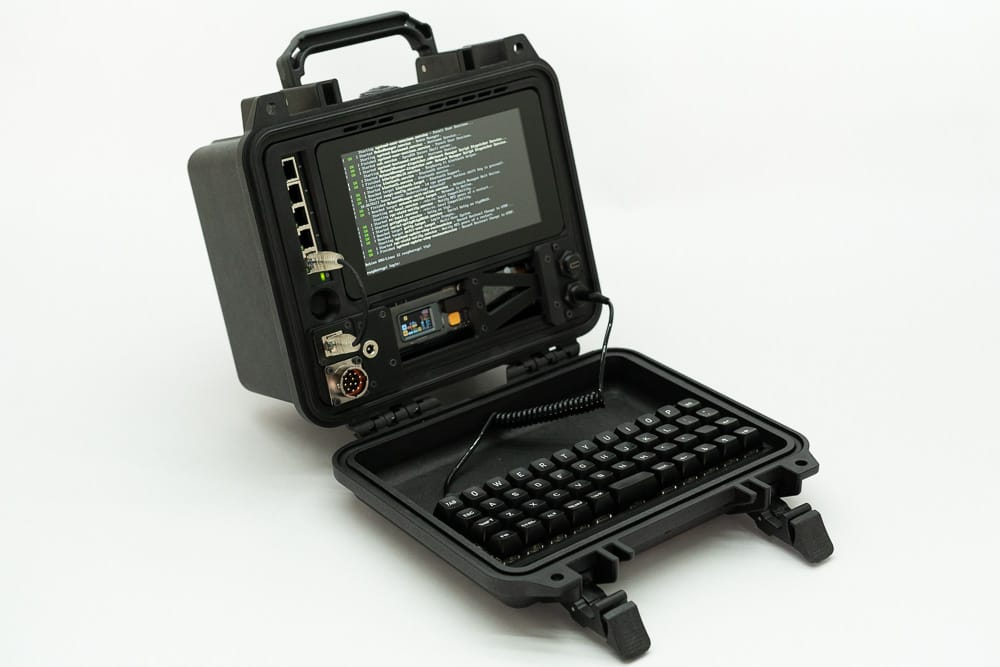
403 pointsThe Recovery Kit 2 is another cyberdeck that for me is part computer, part backup device, and part functional movie prop. It's been fun to build, and the HN community has been great with ideas- especially around hosting and getting me off Squarespace. I hope you all enjoy!
Comments (81) 21 threads
I started collecting screws to put together for my "workshop" were I repair whatever family, friends, enemies want me to look at. I am not great at it, not even good, but I am who they bring things to, and over time I have learned a bit of skills. (Also I fail, sometimes I break stuff and sometimes I hide in my bag and take to a pro without telling anyone.)
Back to screws. I often need one. but there are entirely too many different sizes and shapes. I have spent decent time sourcing various standardized sizes from far and near. Stil I have project where I need two screws and I dont have the right one. I also keep any screw that I come across. If something is broken I harvest the once that are easikly available.
That ends up in a cubbord with lots of different tiny shelves. BUT looking through them so see if one of them is right is again time consuming.
What does this have to do with anything?
Well the design went from 1 type of screws to multiple sizes. (All of well knownm standarized types thank you)
I think it wise to design projects around as few different ones as possible. The previous model managed with one. Clearly somehow V2 could have as well.
Is there I pray an app I have not seen, where I can take a photo of a screw and the app will tell me the exact specifications of it, its name, and where to order them?
Huge selection including obscure styles and finishes. Nuts, bolts, screws, hardware, etc.
One of the best things about them is that they sell small lots including single screws if that is all you need.
Another great thing is that they ship quickly and if your order is relatively small it arrives in your mailbox instead of needing to be delivered by UPS or another shipper. They ship orders in packages appropriate to the order, unlike Amazon.
They also add products to their inventory if customers need something they don't normally carry.
Prices are also reasonable.
I found them years ago and now they are one of my main suppliers. McMaster Carr is another.
[0] https://belmetric.com/
They do seem to suffer from the other part that prevented me from ordering from places like this before though; its hard for a hobby project to break the high free shipping minimum order size. This may again be a problem with being in Canada not the US though :)
Continue this thread — 1 reply
It's actually hundreds of screws, bolts, and nuts, I did the sorting as a relaxing week while watching some shows :D
Someone mentioned M* screws and that got me searching to find out what it is and then ended up on the above amazon page. So I like the indexing scheme there and question OP that it can't be done by image and machine learning. Basically, all those indexes [minus material which you can just select] should be trivially recognizable and that just leaves the precision measures.
[0] https://www.amazon.com/tenluno-Checker-SWTC-44-MaleFemale-Id...
BoltDepot has some fantastic pages (and printable reference posters) that explain how fasteners are measured and described: https://boltdepot.com/Fastener-Information/Fastener-Basics
Once you've got the terminology, it's pretty straightforward to take the measurements. Thread diameter is easy to do with a $2 plastic vernier caliper (I use mine constantly), or fit into the holes in any screw checker. https://www.amazon.com/Stainlesstown-Bolt-Thread-Gauge-Blue/...
Thread pitch is best done with a thread gauge, which is a fold-out affair sort of like a feeler gauge. I've got an inch/metric combo one like this: https://www.amazon.com/ChgImposs-Imperial-Whitworth-Industri...
And then length is easy to do with the ruler on the side of the screw checker, or the calipers themselves. (Use the jaws for the overall length of a flush-type screw, the step-shoulder part for the length of a cap screw.)
There are also combo gauges, I'm intrigued by this type and I should pick one up to see how I like it: https://www.amazon.com/WEN-ME210G-Imperial-Multi-Gauge-Carry...
i don’t know if it is good enough for this use case but theoretically possible without a reference object.
> Building Internet-connected things seems obvious today, but what about when there’s no Internet?
> The concept often feels like something out of a science fiction movie or a doomsday prepper’s handbook- and while this device can work in both scenarios, it’s also about understanding resiliency for your projects and being a good steward of the systems in place today.
[1] https://www.doscher.com/work-recovery-kit/
https://na.panasonic.com/us/computers-tablets/computers/lapt...
http://www.ruggedpcreview.com/3_notebooks_itronix_gd8200.htm...
In the event of something so catastrophic happening that the internet stops functioning for an extended period of time, you're not going to be hauling this enormous brick around with you. It's absurd.
In an end-of-society situation you're likely on foot, maybe on bicycle (until the bike breaks down in a way you can't fix, or gets flats and you can't find tubes), and your available weight and space is going to be prioritized towards basics like food, shelter, clothing, basic health/tool items, and self defense.
How you get 90% of the way there: a USB solar panel, a bluetooth keyboard, and a smartphone with an external storage memory device. Maybe a USB to ethernet adapter and a USB hub.
Many modern phones are even water/dust proof to a pretty reasonable degree, more so if you put them in a ruggedized case.
I dare him to carry that thing 10 miles...
> In the event of something so catastrophic happening that the internet stops functioning for an extended period of time, you're not going to be hauling this enormous brick around with you. It's absurd.
Yeah, I've always thought these kinds of things were more of a LARP gizmo than any kind of actual "prepping." The priorities are all wrong. IMHO, if society collapses, the things you need will drastically change from your needs now. You don't need an offline Wikipedia or Youtube, even if you use them all the time today, you need something a lot more compact and practical.
IMHO, a real post-apocalyptic "recovery kit" is a cubic meter of K12 textbooks, plus university-level ones on farming, engineering, and medicine locked a away in a time-capsule for a century post-event.
This - I think it's really just a Fallout-aesthetic prop and bunch of text making pretend arguments that it's useful for anything.
I'd replace this with an old Chromebook with regular Linux installed (very cheap, ~ $20 USD), and a 1TB micro-SD card. All solid-state (no hard drive), and good battery life.
I build things that roughly resemble this (low volume, custom, solving use cases that are too niche for an industrial offering to be created), for money. I'd hire this guy in a minute to outsource things to or collaborate with, so I see the project as a kind of personal resume.
IMO he should find a specific scenario where something along these lines would be valuable. One I am personally involved in is marine electronics diagnosis. Primarily NMEA2000 networks and the devices on them, and the same devices on Ethernet. It's too much detail to go into, plus I'm on a flight after spending a week in Vegas for a trade show, but with just a little bit of reconfiguration work this could be a Thing that higher end marine electronics techs would really dig. Then I think you could also delve deeper into the considerations put into the design and component selection details.
All comments shown.
Couldn't load more comments. Check your connection and try again.