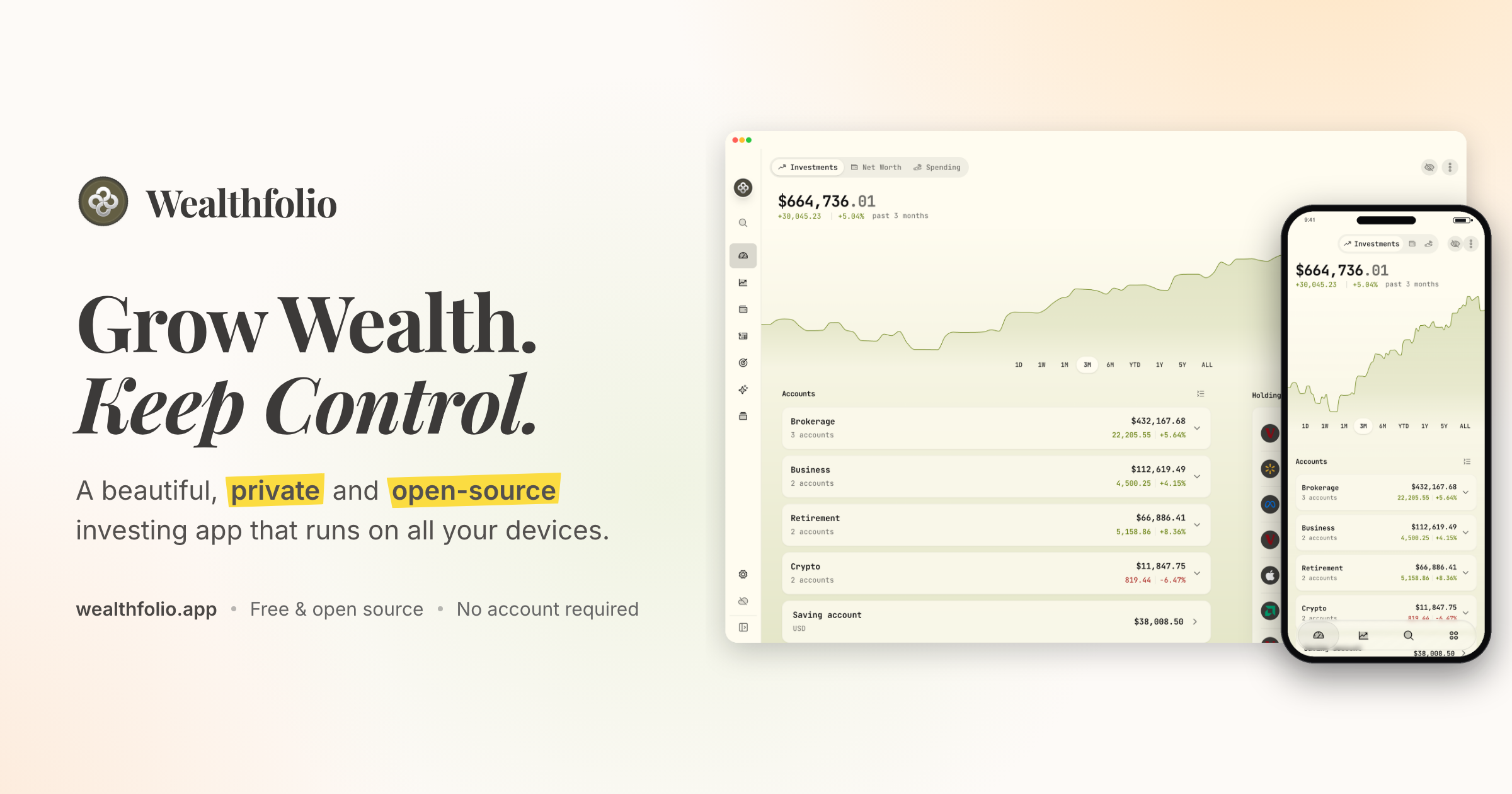
Show HN: Wealthfolio: Private, open-source investment tracker (opens in a new tab)wealthfolio.app
924 pointsThank you for your comments, just some context:
- The app is a simple desktop application that works on macOS, Windows, and Ubuntu.
- I developed this app for my own needs. Getting tired of SaaS app subscriptions and privacy concerns.
- For now, the activities are logged manually or imported from a CSV file. No integration with Plaid or other platforms.
- No monetization is planned for now (only a "buy me a coffee" if you use and appreciate the app).
Comments (263) 80 threads
Show all comments
Showing thread 1 of 80
> Import your statements from your broker or bank.
Exactly what brokers/banks that are supported should be listed somewhere and linked here, as that's a "make or break" feature for a lot of people I bet. Not much point in replacing my homegrown "Banks CSV export -> Data processing > Import into spreadsheet" workflow unless I just replace that last step but the previous ones remain the same.
Unfortunately, depending on an open-source tool to do this is a double edged sword if it had these features, because we would be opening the risk of supply-chain attacks -- malicious actors getting commits into the repository code which cause the program to send your data elsewhere -- or worse, deplete accounts' funds.
I never used it, but didn't that ask you for the username/password in order to do its job? If so, I wouldn't touch it with a ten-foot pole.
> cause the program to send your data elsewhere -- or worse, deplete accounts' funds.
Again, seemingly because their shitty architecture would that even be possible.
There are modern (possibly only European?) standards nowadays that forces the banks to expose proper APIs for doing things like that. Would require a business entity to deploy to production (I think that's one of the requirements?) but otherwise wouldn't be a huge task compared to manually scraping stuff.
Continue this thread — 1 reply
This is FUD. You’re describing open-commit, which I don’t think anyone does. Open source is not more susceptible to supply chain attacks than closed source software.
(Example of richness: splitting am Amazon CC charge into the multiple expense accounts for the items that went into the order, and also accounting for the CC rewards and the Gift Card balance that contributed.)
I tried taking a break from GnuCash for maybe year, and going to a spreadsheet, and found: (1) it was still substantial work to maintain an accurate view of balances, and (2) I was missing a lot of information I found I needed in practice.
Same purchase from amazon? Difficult, because you have two layers of indirection: checking account > credit card > amazon > it equipment.
Currently testing a new spreadsheet approach to deal with such scenarios, but not easy.
Then again I'd never trust rules to do everything right anyway, so I'm reviewing at least once to reconcile.
Not to mention the second paragraph is "no more worries about SaaS services playing around with your data"
Continue this thread — 2 replies
I ended up coding a small exporter[2] since I already had some stack in place that queries SimpleFI[3], which essentially allows querying balance and transaction information for most US-based banks (read only); most similar to plaid but a lot more developer-friendly afaik.
[1] https://actualbudget.com/
[2] https://github.com/eduser25/simplefin-bridge-exporter
[3] https://beta-bridge.simplefin.org/
SimpleFIN on the other hand seems to be pretty good for dev work; plus very responsive in terms of questions and requests. Can only speak good of them.
Continue this thread — 1 reply
Woob does a great job of providing a good API for automating the web, and sure, not everything works, but it's a good start. Unfortunately, it seems it's not very well known still.
[0] https://woob.tech/
Continue this thread — 6 more replies