Show HN: iFixit created a new USB-C, repairable soldering system (opens in a new tab)hackaday.com
928 pointsIt's a USB-C powered soldering iron and smart battery power hub. Super repairable, of course. Our goal is to make soldering so easy everyone can do it:
https://www.ifixit.com/fixhub
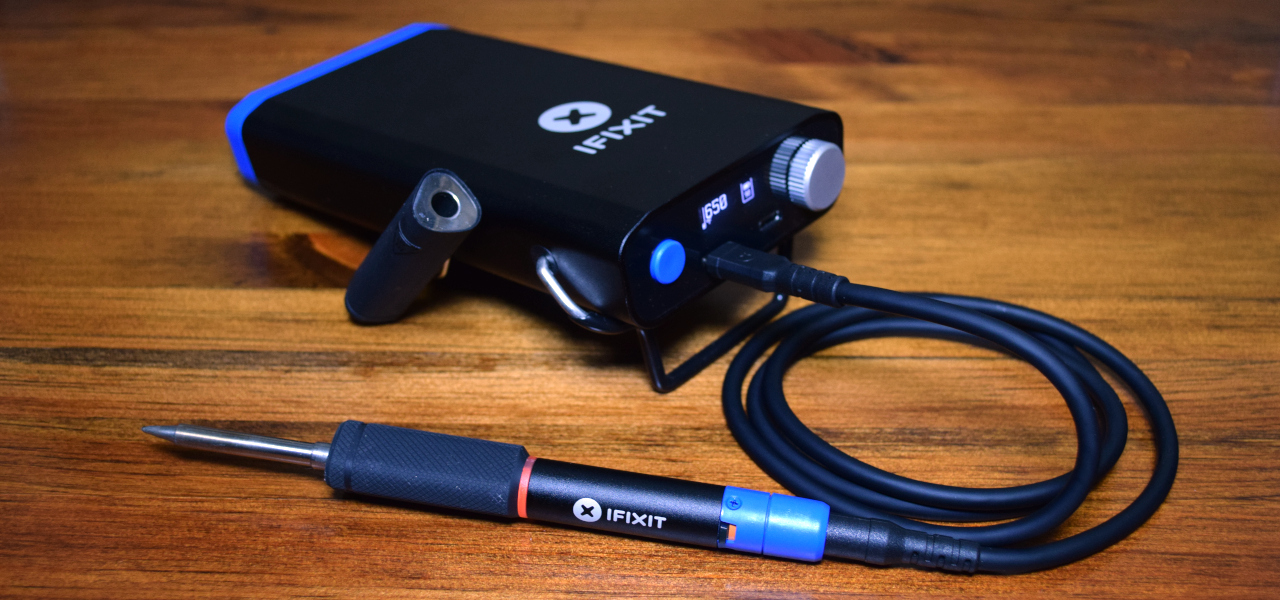
We didn’t want to make just another iron, so we spent years sweating the details and crafting something that met our exacting standards. This is a high-performance iron: it can output 100W of heat, gets to soldering temperature in under 5 seconds, and automatically cools off when you set it down. The accelerometer detects when you pick it up and heats it back up. Keeping the iron at a lower temperature while you’re not soldering shouold prolong the life of the tip.
What’s the difference between this iron and other USB-C irons on the market? Here’s a quick list:
Higher power (our Smart Iron is 100W, competitors max out at 60W over USB-C, 88W over DC Supply)
Heat-resistant storage cap (you just have to try this out, it’s a real game changer in day-to-day use)
Polished user experience
A warranty and a local company to talk to (I can’t find any contact information for Miniware)
Comfier / more natural grip
Shorter soldering tip length
No-tangle, heat-resistant cable
Locking ring on the cable, so it can’t snag and get disconnected (this happens to me all the time on other irons)
More intuitive settings, either on the Power Station or on the computer
We used Web Serial https://caniuse.com/web-serial for the interface, which is only supported in Chromium browsers. The biggest bummer with that is that no mobile browsers support it, yet. Hopefully that changes soon.
Hardware is hard! It's been a journey for us. Happy to answer any questions about how we made it.
Schematics and repair information are online here: https://www.ifixit.com/Device/FixHub_Portable_Soldering_Stat...
Comments (405) 75 threads
Show all comments
Showing thread 1 of 75
If your experience with soldering is one of those cheap flimsy $30 dollar things from Amazon paired with fat, chunky solder… yeah you will hate soldering and you’ll never get even remotely good results. You don’t need to spend $500 dollar or anything but something like what is in this post and a $40 roll of thin gauge solder (which will last the rest of your life) will make soldering actually fun and enjoyable.
…I should also mention a solid, heavy parts holder factors into this as well.
i still have it & i'm selling handwired keyboards at a very cheap price (made with it), trying to set a non-profit that sells fair priced handwired keyboards with Vial & aims to teach the basics of electronics for teens... i can't see myself supplying anything more expensive than cheap solders, nor i can see what joy i would get from an expensive solder tool
my wiring for reference -> https://happort.org/keyboard_example.png
In case anyone else was wondering.
Continue this thread — 1 reply
A sharp knife is also quite a bit safer than a dull knife. By heating to operating temperature in 5 seconds and rapidly pouring heat into the material, you don't have to hold the hot iron as long. As soon as you're done, pop on the safety cap and instantly shield the hot metal.
Soldering isn't remotely mainstream, and part of that is the quality of tools. We set out to streamline the entire process to make soldering as accessible as possible.
Continue this thread — 3 replies
it's not that you can't overcome adversity and do the thing anyhow, but you're certainly not making it easy. In all cases, using the proper tool allows you to remove the extra difficulty factor and focus on that task at hand.
But also, cutting a tomato with a sharp knife is way, way easier than with a dull knife. Same with soldering. Ignores the rest of the parts of being a chef, but you get the comparison.
Giving an expensive knife to a new cook that has never cooked before will not make them a Michelin chef, but their progress will be faster when they don't have the knife working against them.
Continue this thread — 1 reply
A better cook knows that if her knives are dull, she won’t perform as well.
Continue this thread — 1 reply
Pick any Michelin-rated restaurant at random and visit the kitchen. You'll find plenty of $50 knives in use. It doesn't take a lot of money to build a good-enough-for-world-class-cooking knife. Once you get beyond a certain price point, it's mostly about personal preferences and "situations that apply to me but may or may not apply to you".
Continue this thread — 2 replies
That being said, I still prefer diamond stones (sharpening wise)
Tomatoes, meat, fish, I use my $4 serrated knife. Everything else is fine. With proper technique it's basically impossible to cut yourself even with a very dull knife.
It is like photographers with $5,000 worth of equipment in their camera bags telling you that equipment doesn’t matter. I mean, there is a reason why they spend all that money right? Of course a good photographer will be able to get good results with a cheap camera, but only in situations where that cheap camera can actually capture the scene. For example, if it is not sensitive enough to capture enough light at night time, you are not getting night time shots, period, no matter how good you are. (this very much used to be a thing 10 years ago)
If you employ programmers, you will buy fast workstations because it will make them MUCH more productive. A slow computer will interrupt your work by making you wait.
I think it is in fact the exact opposite, the better you are at something, the more likely it is that you become limited by your equipment. I will probably not be able to cook better if I get very expensive knives. But I would speculate that an actual professional cook or butcher will be able to work better with sharp knives that keep their edges well.
Continue this thread — 1 reply
A knife that won't hold it's edge will mean you are explicitly going to perform worse as a chef - you will get ragged cuts, you will be more at risk for injuring yourself, etc.
A slow laptop will mean you learn more slowly - doubly so if you are working with compiled languages or anything where you spend significant processing time before determining the outcome of whatever you're working on. The quicker you can get feedback on your work, be it from compilation errors, manual review of the output, your tests running, etc., the more you get to iterate and the more you get to learn.
A cheap soldering iron explicitly can make soldering more difficult and result in worse outcomes, particularly for a beginner.
Be it cooking, soldering, photographing, programming, whatever, there is frequently a point where going from a cheaper tool to a more expensive one will make the life of a beginner easier and let them produce better outcomes. As you get more skilled you can learn how to more quickly and easily sharpen knives, or produce fewer bugs in your code, or how to better handle aperture vs. ISO or whatever. But in those cases there will still often be productivity/efficiency gains from using nicer tools
Corollary: learn to sharpen. The best steel in the world isn't going to cut anything if it's dull.
For the record, I sharpen chisels almost daily and I hate sharpening kitchen knives. The carbides set at the right angle in the handle you pull down the length of the blade will keep your knives a lot sharper than a set of Japanese water stones you never use.
They'll take their knives to these services and pay $5 or $6 per knife, and it will get done to perfection in just a few minutes while they wait. You can use these same services, there is no membership card needed to get in the door.
Continue this thread — 2 replies
When you zoom out, I think home soldering is about as effective as it can reasonably get without fumigating your house.
We had leaded (Ethyl) gasoline in cars which was banned 25 years ago and that had noticeable statistical effects on IQ an emotional regulation (violence) for more than a generation.
Continue this thread — 7 replies
In all seriousness, very little. I would personally want more than just a bathroom fan to do fume evacuation. Outside on a patio/balcony is my usual spot. I also have a 120mm computer fan that I hacked onto a gooseneck mount so I can blow the fumes away from my face.
The times I can't be outside, usually due to weather, I use a table right in front of an open window, and one of those dual fan window fans set to exhaust mode, and that sucks the fumes outside effectively.
I'd call that a reasonably good setup, and, as a bonus, the fumes don't hit me directly in the face, which soldering fumes have a tendency to do.
Continue this thread — 2 replies
The fumes are flux fumes, not lead fumes. They're still bad to breathe but not specific to leaded solder.
As you say, it's so much easier to get good solder joints (especially for the fine stuff like QFN/BGA) with lead blends and flux, that having a vent hood is likely required as well.
I've used only lead-free solder for a decade. Get the good stuff with some silver in it and it's not difficult.
Continue this thread — 15 replies
That being said - leaded solder is easier to work with regardless of what iron you use. It's very easy to fix mistakes and even wicks up without a trace on most PCBs. I personally don't use it, but I think it's easy to see how people will blame their solder before their iron.
https://hakkousa.com/fx-888dx.html
Continue this thread — 23 replies
Continue this thread — 8 more replies