Show HN: iFixit created a new USB-C, repairable soldering system (opens in a new tab)hackaday.com
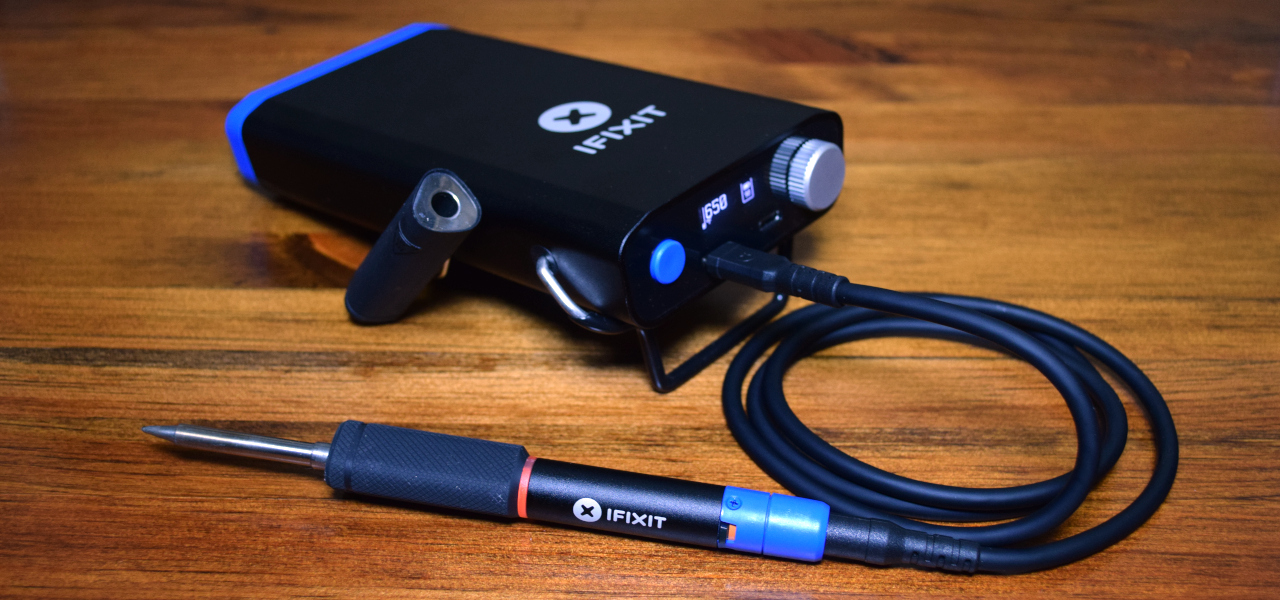
928 pointsIt's a USB-C powered soldering iron and smart battery power hub. Super repairable, of course. Our goal is to make soldering so easy everyone can do it:
https://www.ifixit.com/fixhub
We didn’t want to make just another iron, so we spent years sweating the details and crafting something that met our exacting standards. This is a high-performance iron: it can output 100W of heat, gets to soldering temperature in under 5 seconds, and automatically cools off when you set it down. The accelerometer detects when you pick it up and heats it back up. Keeping the iron at a lower temperature while you’re not soldering shouold prolong the life of the tip.
What’s the difference between this iron and other USB-C irons on the market? Here’s a quick list:
Higher power (our Smart Iron is 100W, competitors max out at 60W over USB-C, 88W over DC Supply)
Heat-resistant storage cap (you just have to try this out, it’s a real game changer in day-to-day use)
Polished user experience
A warranty and a local company to talk to (I can’t find any contact information for Miniware)
Comfier / more natural grip
Shorter soldering tip length
No-tangle, heat-resistant cable
Locking ring on the cable, so it can’t snag and get disconnected (this happens to me all the time on other irons)
More intuitive settings, either on the Power Station or on the computer
We used Web Serial https://caniuse.com/web-serial for the interface, which is only supported in Chromium browsers. The biggest bummer with that is that no mobile browsers support it, yet. Hopefully that changes soon.
Hardware is hard! It's been a journey for us. Happy to answer any questions about how we made it.
Schematics and repair information are online here: https://www.ifixit.com/Device/FixHub_Portable_Soldering_Stat...
Comments (405) 75 threads
Show all comments
Showing thread 31 of 75
They seem to have gotten so caught up in the "things should be repairable" that they've forgotten the true thing most people care about is, "I shouldn't have to replace my stuff". They are acting like parts salesmen, not consumer advocates.
$200(? looks like you get the iron when you buy the power supply) would be a fair price for the base if it allowed me to charge and use any 6 18650s(bonus points if it can accept a variety of cell sizes) as a power bank and had circuitry to do pass through as well as charging. It would also be nice if you could use it charge batteries to a specified amount, and use custom charge patterns. Considering this is iFixit, it should also have a way to use it as a DC power supply as well. $250 for a glorified power brick is pathetic.
We tried so many avenues to persuade them, from proposing 18650s with built-in safety circuitry to showing the safety system that we designed into the pack. No dice.
There are a variety of safety standards to blame, but the primary one is UL 1642. It needs to change. I'm planning to join the standards body to see if I can shift things.
Our pack is a set of six 18650s welded together with a standard connector. https://valkyrie.cdn.ifixit.com/media/2024/09/10113528/iFixi...
We'll sell replacement battery packs. Or you can make your own.
Worse, it seems like the manufacturers best suited to make the product I desire(anker and nitecore) are directly incentivized by obsolescence to not ever make it. The best thing I've found so far is the Nitecore LC10, but it was discontinued. :(
I sort of suspected that it might be the case of safety bodies getting in the way. I really hope you make progress with UL. I'm rooting for you. There should be a way of overcoming this problem.
Of course, a pack of 6x MJ1 is relatively trial to built (except it'd require some decent plastic body)- esp for 2s/3p, still not very useful aside running that particular iron/tool (and most likely end up charging it w/ the power supply...)
A compact temperature control widget without batteries at all.
It accepts the appropriate USB PD power input in a standards-compliant way. It has a knob, and also a screen for status. It talks to the soldering iron and provides power to it. It does not have batteries or any special facilities for batteries *though if a user chooses to use it with an appropriate USB PD battery then they certainly can). This all seems possible, and adherence to USB PD specifications should tend to make it safe by default.
The rub, and this may not be possible at all, is that it must be substantially cheaper than soldering iron itself.
But because you've done the right thing and documented the protocol, then maybe someone else will implement this (as DIY or otherwise) and it won't be your problem at all. :)
Spring terminals would be sub optimal drawing 10A off them as they are made of steel - high resistance. Developing any oxidation would make matters worse. Personally I'd not want 18650/21700 not properly secured (aside the rare case of running a fan with a single cell).
I would rather batteries be field swapable than having a faster charge, which I try to avoid for the sake of their longevity anyway, personally.
Continue this thread — 3 replies