This is wonderful!!! Generalizing here but we really do take the moon for granted.
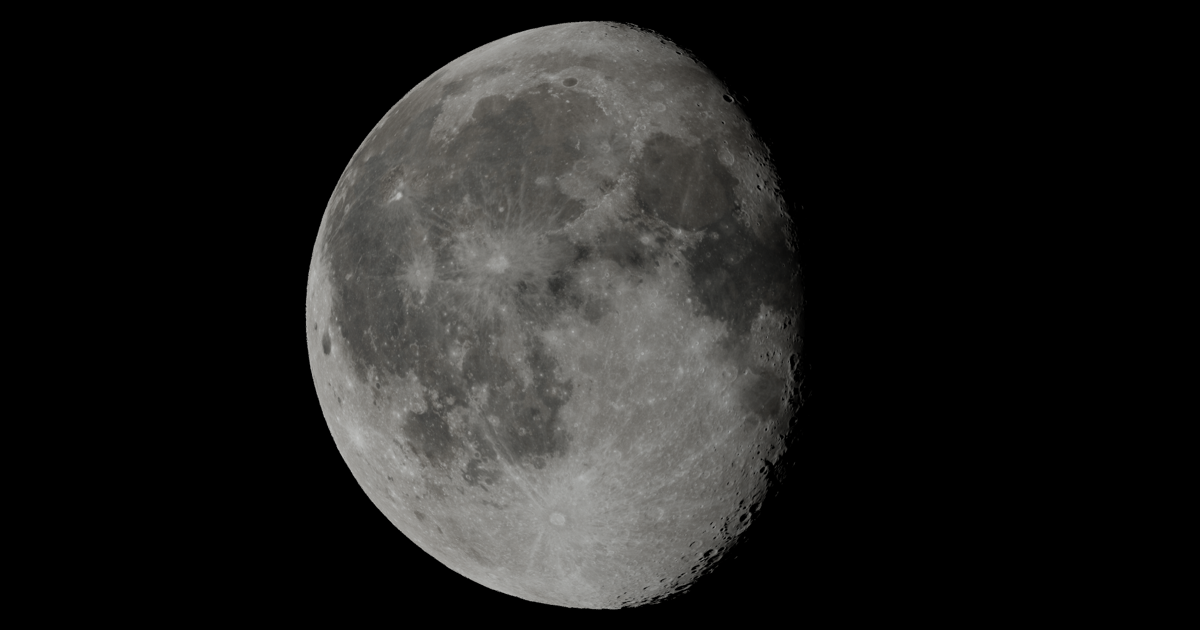
I bought a 'big ass telescope' a few years ago in an effort to bootstrap a hobby that I'd flirted with for decades but never really committed to. It's a Celestron 11" SCT and I really had no idea what I was getting into. When I think of space I think of things that are really small in the night sky, planets, galaxies, nebula...(turns out most of them aren't *that* small and I overshot the targets I had in mind) I kept trying to photo galaxies and star clusters and all of these exotic things but had a bunch of trouble with tracking with long exposures. Out of frustration I ended up just pointing it at the boring ol' moon to at least get used to the equipment and workflows. I fell in love with Luna. The magnification of this scope really allowed me to explore the surface in a way I never had before. I got to know the 'map' and suddenly related to our celestial neighbor in a whole new way. It was also the very first image I was actually not embarrassed to share - https://imgur.com/a/t9b1Uug I since then improved my knowledge and technical skill but the month of the moon at the end of 2021 was really pretty spectacular for me.
I’m sure it’s different for everyone but I think it would just be the unbridled enthusiasm and love for the subject that they would show, the tidal dopamine surge of all the mysteries that have been unlocked, the validation of all the mysteries that remain. It would be amazing.
I have the same fantasy. I think it’s appealing because I imagine they’d be able to appreciate all the amazing things behind it more than most people, dead or alive.
Welcome to the hobby (even if a few years late). Pretty much everyone has the same experience as you. You buy the telescope, and then realize you need to buy a telescope for your telescope to use as a guide scope for accurate tracking for longer exposures.
However, those long exposures are much more likely to get photobombed by an airplane or satellite. So you're really better off taking shorter exposures with the highest ISO you can get away with, and then just stacking them. I have a much wider scope that I can do 30s exposures unguided before trailing starts to become noticeable. If you can get away with 15s, you'd be amazed at what you can achieve with newer sensors. Just some hints to help the disappointment at bay and maybe get you playing with the toys
Just search for local star parties in your area. Although, be willing to bend the definition of local depending on how light polluted your area is. My local is 4 hours away. Also, some colleges have viewing nights available. Even in light polluted areas, you can still see things for public viewings. They just suck for anyone wanting to image.
Pretty much every telescope owner will happily show you the sky - after you've made an effort finding out where they gather, or if you just happen to walk by. The instagrammification of astronomy, with hordes of influencers rolling by without concern for the subject matter, just to insert themselves everywhere, is too horrible to consider. It's not hard to find. Type " astronomical society" into your search box. They have public websites, horribly outdated. Reach out to them, join the group, and you're more than welcome. But may there never be "an app for that"
Here in the EU you can look for "dark sky parks" which are basically parks or areas in nature designated for night sky viewing because of the low amount of light pollution and they are great spots to meet people, I'm pretty sure you have these in the US as well. I advise bringing a red light if you have to do some walking. Another recommendation would be to see if you have any actual observatories near you, some of them have events for the public every now and then. The people in this community are some of the friendliest I ever met and love sharing their interest and enthusiasm.
> just imagine if you could see all those galaxies and nebulae with your naked eye
I think I’d wind up buying the Vision Pro if it can realistically portray seeing the world in a wider spectrum than our eyes can. I don’t want cartoonish images of objects pasted into the sky. I want to see what I would perceive if we e.g. gene therapied a few extra cones into our eyes to see more of the EM spectrum.
Oh boy if you're willing to spend money to look at the night sky - but feel like AR falls short currently - I highly recommend looking into NODs, something like a PVS-14, you might be able to pick one up second hand for the price of a new vision pro. Unfortunately photomultiplier are still quite expensive even if they are only gen2 :( some really cool tech though.
Definitely not arguing with you! Though I have a soft spot for analog tech in this area. I think AR might still have a very bright future, especially if you're learning about the night sky. I've spent many hours scanning the sky with an app I found that had an AR feature that allows you to point your camera at the sky and get an overlay on everything (including sattelites!).
Night vision goggles have made immense improvements in recent years. Although the new technology in night vision is also very expensive. If they ever become accessible to the average consumer, they will change the world profoundly. Because you can walk during night as if it was day.
For astronomy, they probably won't make a difference, but it shouldn't be impossible to make goggle technology that converts astronomically interesting wavelengths to the visible spectrum.
It's not the wavelengths that are the problem but the exposure times; even with our best sensors we still need long exposures to capture compelling images of galaxies and nebulae. I don't think it will ever be possible in real time.
That’s incredible. Illustrates how incomprehensibly big galaxies really are. There’s a thing 2.5 million light years away which still appears 4x bigger than the Moon.
Very much incomprehensible, not only for outer celestial objects since we most probably will never fully discover our own physical earth planet or human body, let alone our thinking brain and our elusive consciousness.
Andromedia the closest galaxy to Milky Way (MW) is estimated to have one trillion stars while MW itself is estimated to have 250 billions. God really knows how many of them really exist and who's counting anyway? It's a blind faith at its worst to pretend we know the numbers since it's most likely that the earth and its sun bound astronomers (including the farthest distance ever Voyager spacecraft) are several orders of magnitudes off the marks. It's also estimated that's more than a trillion number of stars inside the two galaxies (Andromeda and MW), not number of planets, not even the number of moons (the very title of this HN post). Overall it's also estimated that there's more than a trillion number of galaxies (not stars) inside our universe. To make matter even more complicated, all of these celestial objects are moving in very high speed relative to each others and none is static. These galaxy are millions or billions light years away from earth and by the time their EM signals has reached earth, they probably have already dissappeared or morphed into something else. How about non observable part of the universe? How about other parallel universes that physicists claim to exist? My personal conclusion to this mind boggling facts is that to assume and conclude there is only earth that has living creatures is very much premature and naive.
Similarly, I came to learn some selenography writing a "voxel" (well, ray-casting) web game ... where you shuttle about the moon from crater base to crater base.
I became kind of fascinated with the craters, names of the craters (and history of those names), the "dark-side" and all the wild topology there. (Although I think I have tiles for the entire Moon, you don't have the fuel to get there.
Comments (250) 85 threads
Show all comments
Showing thread 1 of 85
I bought a 'big ass telescope' a few years ago in an effort to bootstrap a hobby that I'd flirted with for decades but never really committed to. It's a Celestron 11" SCT and I really had no idea what I was getting into. When I think of space I think of things that are really small in the night sky, planets, galaxies, nebula...(turns out most of them aren't *that* small and I overshot the targets I had in mind)
I kept trying to photo galaxies and star clusters and all of these exotic things but had a bunch of trouble with tracking with long exposures. Out of frustration I ended up just pointing it at the boring ol' moon to at least get used to the equipment and workflows.
I fell in love with Luna.
The magnification of this scope really allowed me to explore the surface in a way I never had before. I got to know the 'map' and suddenly related to our celestial neighbor in a whole new way. It was also the very first image I was actually not embarrassed to share - https://imgur.com/a/t9b1Uug
I since then improved my knowledge and technical skill but the month of the moon at the end of 2021 was really pretty spectacular for me.
"Wow so many lights" is the first answer I can think about right away
I also bought a Seestar S50 last year and have been having an absolute blast with it. Feels like a renaissance in astronomy is upon us.
However, those long exposures are much more likely to get photobombed by an airplane or satellite. So you're really better off taking shorter exposures with the highest ISO you can get away with, and then just stacking them.
I have a much wider scope that I can do 30s exposures unguided before trailing starts to become noticeable. If you can get away with 15s, you'd be amazed at what you can achieve with newer sensors.
Just some hints to help the disappointment at bay and maybe get you playing with the toys
(startup/app idea!)
There are tons of sites listing them, but I doubt there's an absolute exhaustive list as it's all self-reporting to each of the sites. Your app idea would just be another in a list of places, sort of like the xkcd app about yet another standard.
https://www.go-astronomy.com/star-parties.htm
https://skyandtelescope.org/astronomy-resources/annual-starg...
Pretty much every telescope owner will happily show you the sky - after you've made an effort finding out where they gather, or if you just happen to walk by. The instagrammification of astronomy, with hordes of influencers rolling by without concern for the subject matter, just to insert themselves everywhere, is too horrible to consider.
It's not hard to find. Type " astronomical society" into your search box. They have public websites, horribly outdated. Reach out to them, join the group, and you're more than welcome. But may there never be "an app for that"
I haven't realized Andromeda is 4x bigger than the Moon until I tried to take a picture of it
https://mikkolaine.blogspot.com/2014/01/size-of-deep-sky-obj... (not my picture)
I think I’d wind up buying the Vision Pro if it can realistically portray seeing the world in a wider spectrum than our eyes can. I don’t want cartoonish images of objects pasted into the sky. I want to see what I would perceive if we e.g. gene therapied a few extra cones into our eyes to see more of the EM spectrum.
Continue this thread — 2 replies
For astronomy, they probably won't make a difference, but it shouldn't be impossible to make goggle technology that converts astronomically interesting wavelengths to the visible spectrum.
Continue this thread — 2 replies
Andromedia the closest galaxy to Milky Way (MW) is estimated to have one trillion stars while MW itself is estimated to have 250 billions. God really knows how many of them really exist and who's counting anyway? It's a blind faith at its worst to pretend we know the numbers since it's most likely that the earth and its sun bound astronomers (including the farthest distance ever Voyager spacecraft) are several orders of magnitudes off the marks.
It's also estimated that's more than a trillion number of stars inside the two galaxies (Andromeda and MW), not number of planets, not even the number of moons (the very title of this HN post).
Overall it's also estimated that there's more than a trillion number of galaxies (not stars) inside our universe.
To make matter even more complicated, all of these celestial objects are moving in very high speed relative to each others and none is static. These galaxy are millions or billions light years away from earth and by the time their EM signals has reached earth, they probably have already dissappeared or morphed into something else.
How about non observable part of the universe?
How about other parallel universes that physicists claim to exist?
My personal conclusion to this mind boggling facts is that to assume and conclude there is only earth that has living creatures is very much premature and naive.
I became kind of fascinated with the craters, names of the craters (and history of those names), the "dark-side" and all the wild topology there. (Although I think I have tiles for the entire Moon, you don't have the fuel to get there.
https://github.com/EngineersNeedArt/Mooncraft2000
Continue this thread — 1 reply
https://www.amazon.com/dp/1739314565?ref_=pe_3052080_3975148...
Continue this thread — 1 more reply
Continue this thread — 6 more replies