Show HN: Atlas of Space (opens in a new tab)atlasof.space
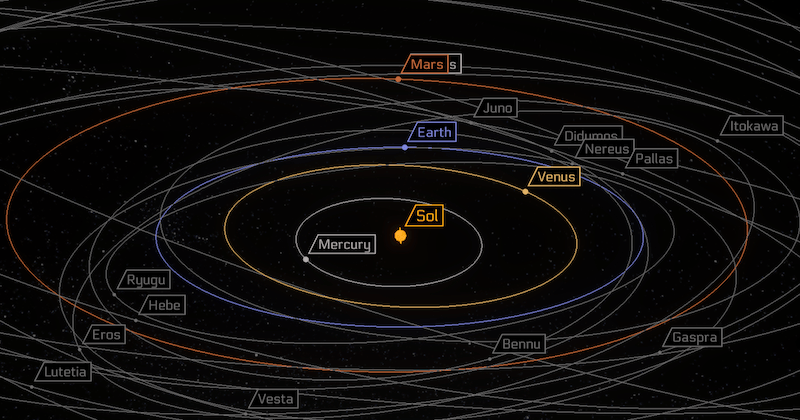
770 pointsHello HN! Sharing a recent side project of mine, the Atlas of Space, that I built out to explore the Solar System.
As a long-time space nerd, I realized recently that I didn't have a good intuition on the scale, speed, and relative orientation of the celestial bodies around us. So over the break I built out a kind of spatial Wikipedia to click around and learn about planets, moons, asteroids, and other bodies orbiting the Sun.
The physics is all simulated in the browser using simple Newtonian mechanics. There's a lot left to do from here, including modeling objects in non-Keplerian orbits and replaying different spacecraft missions.
Hope you have fun clicking around, and curious to hear what I should improve next!
Comments (124) 63 threads
Earlier commentsDid you take any inspiration from Celestia (https://celestiaproject.space)? It's been over 15 years since I last really used it (and starts with defaults not geared towards visualizing just our local solar system) but seems to have a lot of the features others have suggested. Might be useful to poke around and see how they solved things like time adjustments, selecting POIs, etc.
I noticed that when I zoom in on the Earth, the orbit line floats about one Earth radius away from the surface. The Moon is also off of its orbit line by about a Moon diameter. (This happens for me in Chrome on both desktop and mobile.)
Is it a calculation precision error? Or perhaps some spatial offset?
I recently discovered Epic Spaceman on YouTube, who makes incredible visual comparisons to help understand these scales. https://www.youtube.com/@EpicSpaceman
There’s also Universe Sandbox 2. But tbh this Atlas of Space is more accessible to me due to my various input limitations.
Space Engine let’s you explore the entire observable universe.
All comments shown.
Couldn't load more comments. Check your connection and try again.