Show HN: Atlas of Space (opens in a new tab)atlasof.space
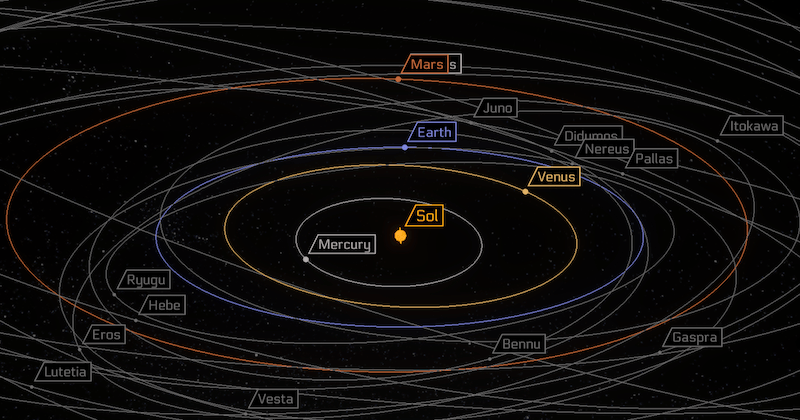
770 pointsHello HN! Sharing a recent side project of mine, the Atlas of Space, that I built out to explore the Solar System.
As a long-time space nerd, I realized recently that I didn't have a good intuition on the scale, speed, and relative orientation of the celestial bodies around us. So over the break I built out a kind of spatial Wikipedia to click around and learn about planets, moons, asteroids, and other bodies orbiting the Sun.
The physics is all simulated in the browser using simple Newtonian mechanics. There's a lot left to do from here, including modeling objects in non-Keplerian orbits and replaying different spacecraft missions.
Hope you have fun clicking around, and curious to hear what I should improve next!
Comments (124) 63 threads
Earlier commentshttps://youtube.com/shorts/HDSKuln-5qU?si=c8Uzw4zCQ22t5MyO
Can you add an option to switch drawing orbit of moon around the sun of its planet instead of its orbit around its planet?
The analog for cardinal directions is the direction of Vernal Equinox — the line in the ecliptic plane (Earth's orbit) formed from the Earth to the Sun at the March equinox. (there's an indicator for this in the corner of the app). This is usually treated as +x, with rotations within the ecliptic given relative to this axis. Then there's ecliptic north and ecliptic south that define +z and -z as the normal vector to the ecliptic plane.
What about doing something similar for the neighborhood of our solar system? E.g. all stars within 25 or so light years.
All comments shown.
Couldn't load more comments. Check your connection and try again.