Show HN: Atlas of Space (opens in a new tab)atlasof.space
770 pointsHello HN! Sharing a recent side project of mine, the Atlas of Space, that I built out to explore the Solar System.
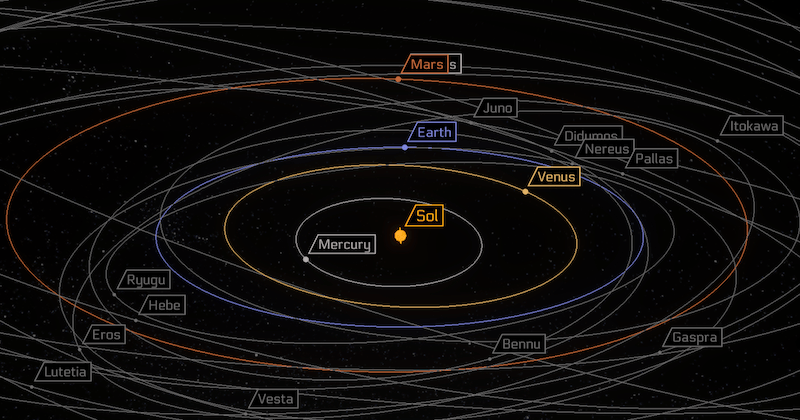
As a long-time space nerd, I realized recently that I didn't have a good intuition on the scale, speed, and relative orientation of the celestial bodies around us. So over the break I built out a kind of spatial Wikipedia to click around and learn about planets, moons, asteroids, and other bodies orbiting the Sun.
The physics is all simulated in the browser using simple Newtonian mechanics. There's a lot left to do from here, including modeling objects in non-Keplerian orbits and replaying different spacecraft missions.
Hope you have fun clicking around, and curious to hear what I should improve next!
Comments (124) 63 threads
Show all comments
Showing thread 8 of 63
It’s really easy to get lost in Space when you zoom out and back in after twisting. I can see the planets on the edge of the screen, but can never seem to find them again.
Reloading, of course, fixes all. But maybe some compass to click on to recenter on yourself (earth) like on google maps.
Spacecraft Attitude Determination, https://en.wikipedia.org/wiki/Spacecraft_attitude_determinat...
Star Tracker, https://en.wikipedia.org/wiki/Star_tracker
To wit, there are 12 Ohio class submarines each with 20 trident missiles each carrying 12 maneuverable nuclear warheads (475 kilotons each).
The missiles are launched under water, reach Mach 18 in 2 minutes, and don’t need GPS — they use the stars to deliver their payload.
I saw a test missile launch once before. It still terrifies me.
https://en.wikipedia.org/wiki/Ohio-class_submarine
The idea is to look for the X-ray signals coming from pulsars and then use the frequency of the pulse to identify the pulsar and then match that to a known map to figure out where you are. It's pretty cool and theoretically can work even for interstellar spaceflight.
https://en.wikipedia.org/wiki/Pulsar-based_navigation