Show HN: Atlas of Space (opens in a new tab)atlasof.space
770 pointsHello HN! Sharing a recent side project of mine, the Atlas of Space, that I built out to explore the Solar System.
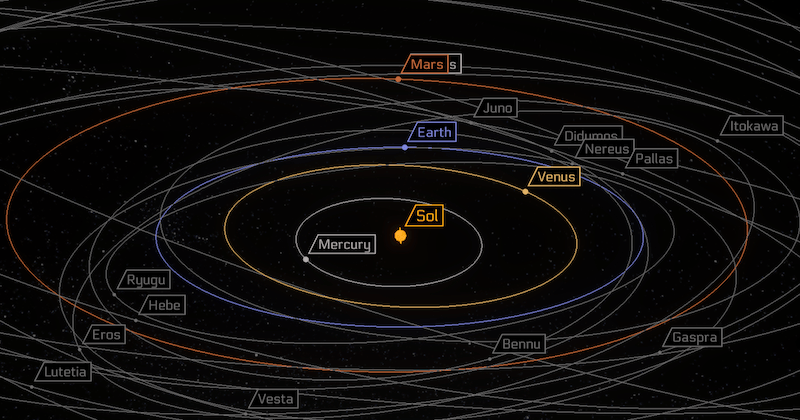
As a long-time space nerd, I realized recently that I didn't have a good intuition on the scale, speed, and relative orientation of the celestial bodies around us. So over the break I built out a kind of spatial Wikipedia to click around and learn about planets, moons, asteroids, and other bodies orbiting the Sun.
The physics is all simulated in the browser using simple Newtonian mechanics. There's a lot left to do from here, including modeling objects in non-Keplerian orbits and replaying different spacecraft missions.
Hope you have fun clicking around, and curious to hear what I should improve next!
Comments (124) 63 threads
Show all comments
Showing thread 47 of 63
I would love to read about how the orbital trajectories are calculated, and how is it done for co orbitals. Do you plan to write a blog on this?
From there everything is mapped into a consistent epoch (now) and the initial position/velocity are calculated using a Keplerian->Cartesian transformation (the math here is a more or less straightforward coordinate transformation). The physical simulation is then run by updating these 2 Cartesian vectors, applying gravitational acceleration over ∆t.
This works pretty well, all things considered, but there's a lot of room for improvement to account for solar wind, relativistic effects, planets not being perfect spheres, etc. The Keplerian elements are also just an approximation of the true orbit, and this approximation can show up at high zoom levels (it's why planets don't always line up perfectly with their ellipses when you zoom in). I'm also still figuring out how best to get the initial position/velocity for objects that aren't in simple elliptical orbits (co-orbitals like the Trojans, objects on escape trajectories like Voyager probes). There's a lot for me to learn, maybe later I will write a blog post!