Show HN: Atlas of Space (opens in a new tab)atlasof.space
770 pointsHello HN! Sharing a recent side project of mine, the Atlas of Space, that I built out to explore the Solar System.
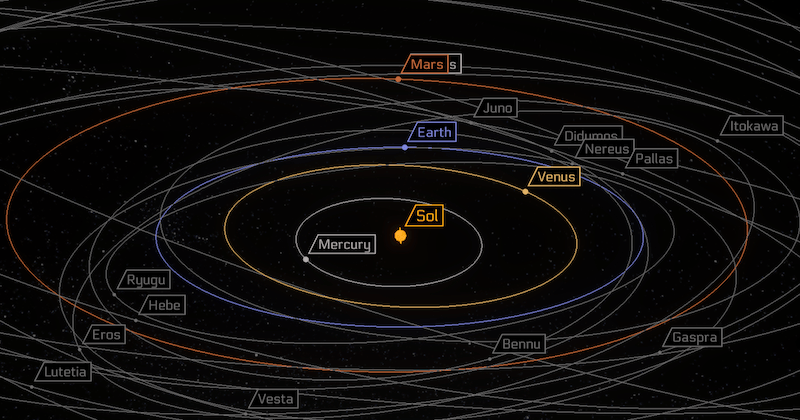
As a long-time space nerd, I realized recently that I didn't have a good intuition on the scale, speed, and relative orientation of the celestial bodies around us. So over the break I built out a kind of spatial Wikipedia to click around and learn about planets, moons, asteroids, and other bodies orbiting the Sun.
The physics is all simulated in the browser using simple Newtonian mechanics. There's a lot left to do from here, including modeling objects in non-Keplerian orbits and replaying different spacecraft missions.
Hope you have fun clicking around, and curious to hear what I should improve next!
Comments (124) 63 threads
Show all comments
Showing thread 3 of 63
It also gives me strong "The Expanse" vibes. Probably because there are so many orbital bodies shown that were mentioned in those books. I also learned that Pallas is an actual asteroid.