Show HN: Bayleaf – Building a low-profile wireless split keyboard (opens in a new tab)graz.io
735 pointsHey HN,
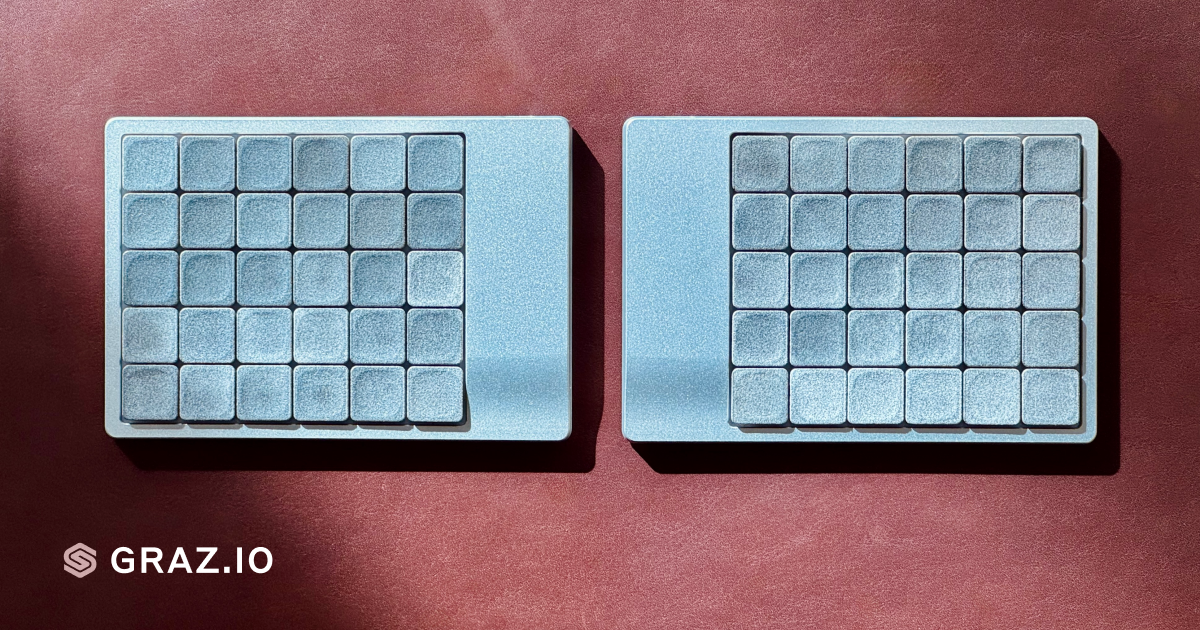
I built a wireless, split, ultra-low profile keyboard from scratch called Bayleaf. As a beginner I learned all things electronics, PCB-building, designing for manufacturing, and many other hardware-related skills to put this together.
This case study dives into the build process and of course the final result, hope you enjoy!
Comments (247) 85 threads
In this regard, I found Microsoft Sculpt really good because it ticked all ergonomic boxes but it didn't require relearning. However, quality was a bit subpar, it didn't offer a wired option, and it has been discontinued. The entire lineup was actually sold to Incase, who are releasing it again soon.
Very much so. I went through 10+ keyboards before finding one that I could type on for a day without aching joints. The only one that passed (which I'm typing this comment on), was the lowest out of all of them. Cheap Aliexpress keyboard, but it's maybe 4mm from table to keyboard. For those in a similar situation that want to try it, it's this one [1]. Definitely not "high quality", but saved me from inability to type.
Question for the keyboard-knowledgeable: it claims in this picture [2] to use scissor keys but the picture of its insides are pretty meaningless to me. Does their claim look to hold up?
[1] https://www.aliexpress.com/item/1005006265944802.html
[2] https://ae01.alicdn.com/kf/Sf4d150eda2c4441490535d5f17ebfbfc...
But I don't think that being low-profile was what was nice on the joints with that keyboard, but rather the presence of the palm rest which didn't force the wrists to bend upwards.
I now type on a "gaming" keyboard with full-size cherry switches, which is quite thick, and I don't have any wrist pain. Some 12 years ago, I used to have an Apple keyboard which was hell on my wrists, despite being quite low profile. The Apple didn't have a palm rest, the mech one does.
As to your typing speed remark, I suppose you already know that you don't have to bottom out your keys. I find I type faster on my mechanical keyboard than on laptops, and it's also easier on my fingers since there's no shock from bottoming out. It takes a while to get used to not press the keys all the way, but it's a much more pleasant experience. It's also quieter than the random HP domed keyboards we have at work or any laptop.
I think low profile is worse on joints in the long run. It probably isn't a universal truth.
I’m sure the devils in the details.
[1] https://dygma.com/products/dygma-defy
I picked up a Let's Split v2[0] when it came out years ago and never soldered it up.. maybe it's time!
[0]https://shop.beekeeb.com/product/lets-split-v2-keyboard-pcb-...
Moving to the mouse and back is pain enough that people go all-in on keyboard-only interfaces.
I velcroed a trackpad to the middle of a Kinesis Advantage. Now I use either hand for the mouse, and even stretch a finger or thumb to the pad without leaving the keys. The movement is little different from using the keyboard.
But for split keyboard, you'd need one trackpad for each side, and in dimensions not readily available. hmm.
I have a ErgoDox EZ, and I still prefer using my Framework 13 (with Kanata![0]) because having my thumbs navigate the trackpad is so convenient even with a keyboard-driven setup.
[0] https://github.com/jtroo/kanata
We should bring that back, I think I like it more than the thinkpad style
I might be at the other extreme end, but even typing on glass doesn't bother me much, and laptop keyboards are a good compromise to have just enough travel and not too much.
I tried a nuphy low profile and it was tiring after a while. The thinkpad standalone trackpoint keyboard has been my go to for a while, and tgis keyboard also looks great to me.
I was surprised as anyone when an Apple keyboard became my gaming keyboard.
I want this keyboard to put on a bookshelf and never use, haha. It is really nice looking. It sounds like it was an incredible learning experience and making something so polished and professional looking is a real accomplishment. But low profile, no pads, ortho layout, and no tenting… my eyes ache for the beauty of the thing but my hands just ache.
But anyway, ergonomics are personal so I can’t really judge.
I agree with the tenting remark, I can understand the preference against low profile, but I sincerely believe ortholinear is way better for one's hands than staggered. Maybe you mean it's a shame it's not columnar?
> ...ergonomics are personal...
Hear, hear!
[1]: https://wiki.c2.com/?RemapCapsLock
[2]: https://www.reddit.com/r/vim/comments/1442ads/mapping_capslo...
[3]: https://mattgemmell.scot/home-row-mods/
So I guess that means that the position formerly occupied by caps lock is now... 'a'? I haven't bothered to configure a caps lock. Haven't needed it.
Bonus, this is all handled in the keyboard firmware so I don't have to bother reconfiguring the OS. I just plug in the keyboard wherever and I'm all set.
So while I like your advice... I may be too far gone to take it. I can still type on a normal keyboard with their silly staggered rows to prevent typewriter jams, but I don't think I'll ever go back to feeling like it's a good idea to do so.
Continue this thread — 2 replies
There's also a common misconception that it's ergonomic to angle a keyboard "upward" (elevating the back of the keyboard), when correct ergonomics is actually to angle the keyboard downwards (elevate the front).
See if you have a long object a little shorter than your foam cushion that you can scotch tape to the bottom of the front of a low-profile Apple keyboard, so that you still use the foam cushion but the front of the keyboard is at the same level as the cushion, and then angles downwards.
And then you get the advantages of the short key travel, which just means your fingers move less and so there's less force/strain.
You may find it shockingly comfortable!
you can easily find MX switches that have equal or +- 0.5mm travel lenght as low-profiles ones... which considering how thin PCB (and even handwired) flat keyboards are, i can't see the point unless you are supporting your arms in the same table your keyboard is! i rather have my arms floating so i can use shoulder and elbow movement for distant keys other than wrist movements but who cares :P
[0] https://www.sciencedirect.com/science/article/abs/pii/S00036...
It doesn't. But to clarify: it should always be downwards relative to your forearm. And your forearm should be generally be about horizontal (or a little bit downwards is OK too).
A keyboard that is angled upwards puts constant strain on the top of your wrist. There are no circumstances where this is a good thing (assuming you don't have injury/disability that requires other accommodations).
Also, your link is about mice not keyboards, and about angling mice sideways. It has no relevance to angling keyboards up/down. (But yes, "vertical" mice, that are angled in reality, are much better too.)
Continue this thread — 9 replies
If you compare it to the Apple Magic Keyboard I'm typing on now – and that seems like a definite inspiration for the Bayleaf – it's a stark contrast. The K3, for example, is more than twice as tall (10.9mm vs 22mm backrow). The Magic Keyboard feels fine to type on without any sort of wrist support and I never feel any strain. But on the K3, even with a support (tried both their wooden support and a similarly sized foam one), I would feel strain after an hour or two.
Most low-profiles are really just a middle ground between the two sides. And, at least in my experience, you get the downsides of both without any of the positives of either.
All comments shown.
Couldn't load more comments. Check your connection and try again.