I'm guessing this is not an error. If you divide 1/normal(0,1), the full distribution would range from -inf to inf, but the 95% output doesn't have to.
I don't quite understand, probably because my math isn't good enough.
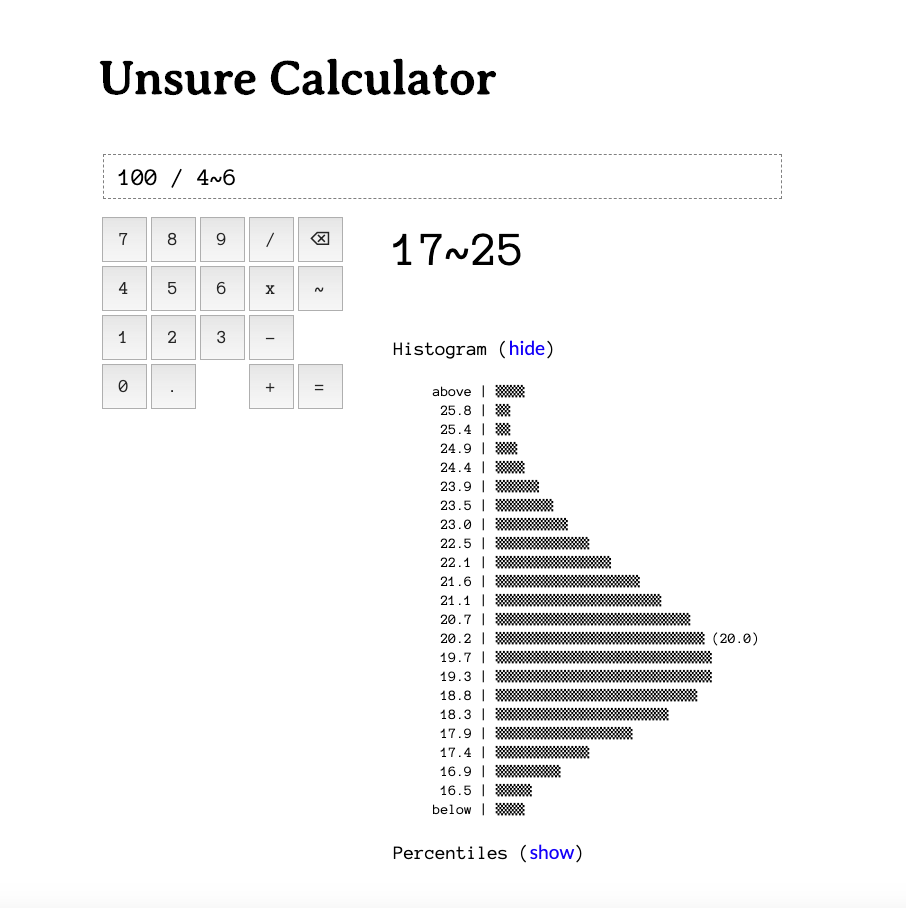
If you're treating -1~1 as a normal distribution, then it's centered on 0. If you're working out the answer using a Monte Carlo simulation, then you're going to be testing out different values from that distribution, right? And aren't you going to be more likely to test values closer to 0? So surely the most likely outputs should be far from 0, right? When I look at the histogram it creates, it varies by run, but the most common output seems generally closest to zero (and sometimes is exactly zero). Wouldn't that mean that it's most frequently picking values closest to -1 or 1 denoninator?
Interval/affine arithmetic are alternatives which do not make use of probabilities for this these kinds of calculations.
https://en.wikipedia.org/wiki/Interval_arithmetic I think arbitrary distribution choice is dangerous. You're bound to end up using lots of quantities that are integers, or positive only (for example). "Confidence" will be very difficult to interpret. Does it support constraints on solutions? E.g. A = 3~10, B = 4 - A, B > 0
Comments (162) 55 threads
Earlier commentsI really don't known how good it is.
If you're treating -1~1 as a normal distribution, then it's centered on 0. If you're working out the answer using a Monte Carlo simulation, then you're going to be testing out different values from that distribution, right? And aren't you going to be more likely to test values closer to 0? So surely the most likely outputs should be far from 0, right?
When I look at the histogram it creates, it varies by run, but the most common output seems generally closest to zero (and sometimes is exactly zero). Wouldn't that mean that it's most frequently picking values closest to -1 or 1 denoninator?
For normal it is higher but maybe not much more so.
Continue this thread — 2 replies
https://en.wikipedia.org/wiki/Interval_arithmetic
I think arbitrary distribution choice is dangerous. You're bound to end up using lots of quantities that are integers, or positive only (for example). "Confidence" will be very difficult to interpret.
Does it support constraints on solutions? E.g. A = 3~10, B = 4 - A, B > 0
All comments shown.
Couldn't load more comments. Check your connection and try again.