Lurker News
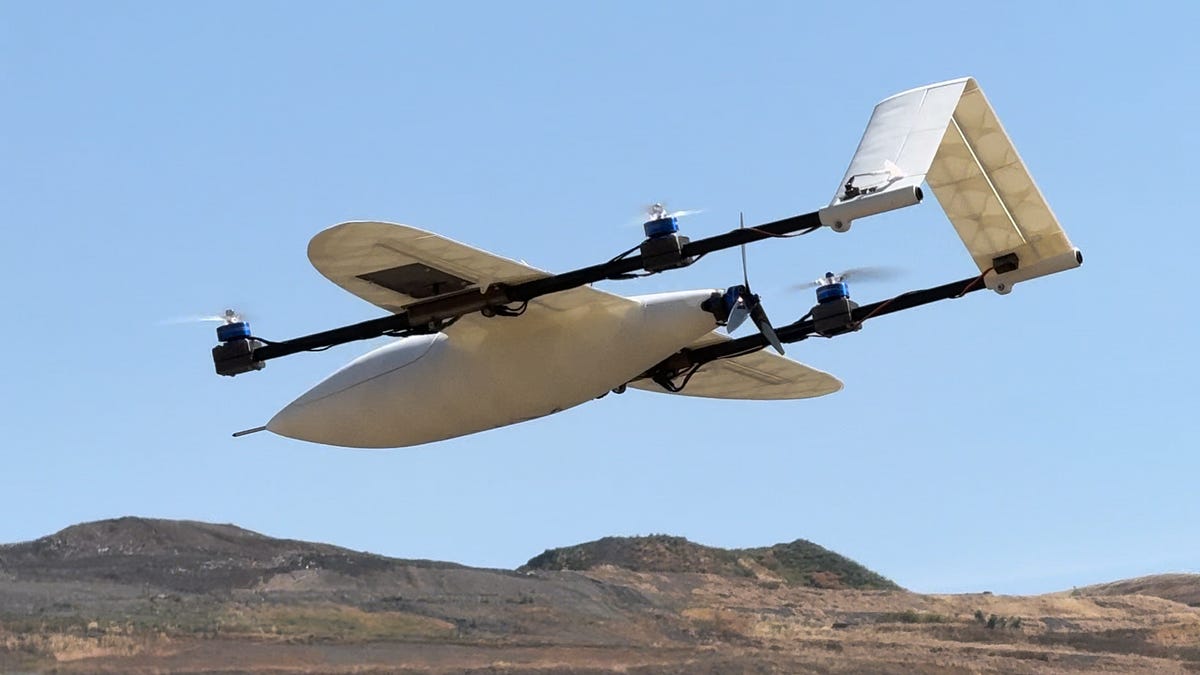
I made this 130 mile capable VTOL drone in only 90 days. It can fly for 3 hours on a single charge. That would make it one of the longest range and endurance 3D printed VTOLs in the world.

This is the thing I'm most proud of building to date!
Before this project, I was a total CAD, 3D printing and aerodynamic modeling beginner. I had only built and flown one VTOL before.
SPECS
Wingspan: 3.9 ft (1200 mm) Length: 2.5 ft (770 mm) Weight: 5.6 lb (2.55kg)
Airframe: foaming PLA (Bambu PLA-Aero) and PETG structural parts printed on A1 printer, CFRP booms and spars
Battery: Li-ion silicon anode Amprius SA08 cells, 6s2p pack by Upgrade Energy Motors: 2807 AOS for lift and cruise (unoptimized) Lifting ESCs: 4 in 1 Holybro Tekko32 F4 45A Cruise ESC: Flycolor Raptor 5 45A Lifting and cruise props: 7042 Gemfan (unoptimized)
Flight controller: Speedybee F405 Wing GPS: M10
Firmware: Ardupilot 4.6.0
---
This video edit ended up shorter than I planned. Being my first Youtube video with significant post production effort, I underestimated the work required to make a longer in-depth video with voiceover, edited footage, etc.
Comments (144) 34 threads

Show all comments

Showing thread 1 of 34

the__alchemist3 replies#
I'm curious how this compares to foam-frame designs. Being able to customize it is obviously a big advantage, as is the non-solid-infill of 3d-printed parts. I think for stiffness, 3d-printed frames don't work well for quadcopters compared to carbon fiber, but they sound like a nice alternative to foam for fixed-wing. I think the stiffness concern comes up in quads mainly when they do high-performance maneuvers that aren't a concern for the takeoff and landing this device does in that mode. (e.g. high accelerations/manevers of racing-style drones)

If anyone wants to try this: The parts he uses are all standard Chinese-made COTS you can buy on amazon and similar.
The ArduPilot firmware he uses is very flexible and robust, but setting it up is one of the worst UXs I've experienced. Commercial UASs almost universally use PX4 instead.

tsungxu1 reply#
Yes I used single wall foaming PLA which is much less impact resistant and more brittle vs any foam, even cheap foamcore and especially EPP or EPO. This has definitely been an issue with crashing and rebuilding.

But my first and only other VTOL build was foamcore Readyboard and that took a 12 ft drop onto asphalt with only a slight compression in the fuselage. Never replaced it.
I would add dovetails or other clips for printed sections if I did another printed build.
Yes avionics and propulsion parts are COTS for speed, the Amprius pack is US manufactured but others are all made in China.
I'm starting to see some more Ardupilot used commercially too but yes the UX is janky and unintuitive.

the__alchemist1 reply#
Hopefully now that it's in a polished state, you don't need to worry as much about impact resistance as you did when designing/tuning.
tsungxu#
Thanks, I did crash it again, and that's why it was half assembled on the wall at the end. But yeah foaming PLA is extremely soft, almost feels like tough, thin paper.
stavros2 replies#
PLA is pretty bad compared to foam when it comes to planes, as it's very heavy and very brittle. Any semi-hard landing will break parts off, and heavy planes fly badly.

The big advantage is that you can just print the part again, which almost makes PLA worth it.
ABS would probably be better, as it's much more durable and lighter, but it's still much heavier than foam, and printing ABS isn't great.

tsungxu1 reply#
I used single wall foaming PLA which has filament density of ~0.45 g/cm3 at 250 degree nozzle temp, about 64% lower than normal PLA. But it is even worse for impact resistance than normal PLA. Weight was the primary driver for this plane
stavros1 reply#
Yep, I've used that as well, but, as you say, it's just very bad for impact resistance. I think the sweet spot between weight and durability might be ABS or something like ASA.
tsungxu1 reply#
Yes and there is foaming ASA as well which is almost as light as foaming PLA. But I can't print ASA well on my A1 and the weight penalty was still enough that I didn't try, given the mission profile of flight time.
sandos1 reply#
Did I dream or is there even foaming TPU? TPU in general seems almost indestructible to me so should be good :)

Continue this thread — 1 reply

alvah1 reply#
Printing ABS is much improved with the later hobbyist-level 3D printers (Qidi and Bambu etc). My Qidi Plus 4 prints ABS as easily / well as PLA. Just remember to do it in a well-ventilated space.
stavros#
Sorry, I meant about the ventilation, yeah. My Bambu doesn't care what material it is, they all print perfectly, but I hate the fumes.
Karliss#
In case of commercial systems you are paying manufacturer to do the integration work and provide polished solution anyway, so setup UX not being user friendly isn't a major concern. In my opinion bigger factor for why most commercial UASs use PX4 instead of ArduPilot is licensing and PX4 maintainer friendliness towards commercial solutions. ArduPilot is GPLv3 and more geared towards community/hobbyists while PX4 is BSD. Commercial manufacturers don't want to disclose the source for their modified version of firmware with all the value added integrations they provide (or just deal with it even if their fork doesn't have anything interesting).