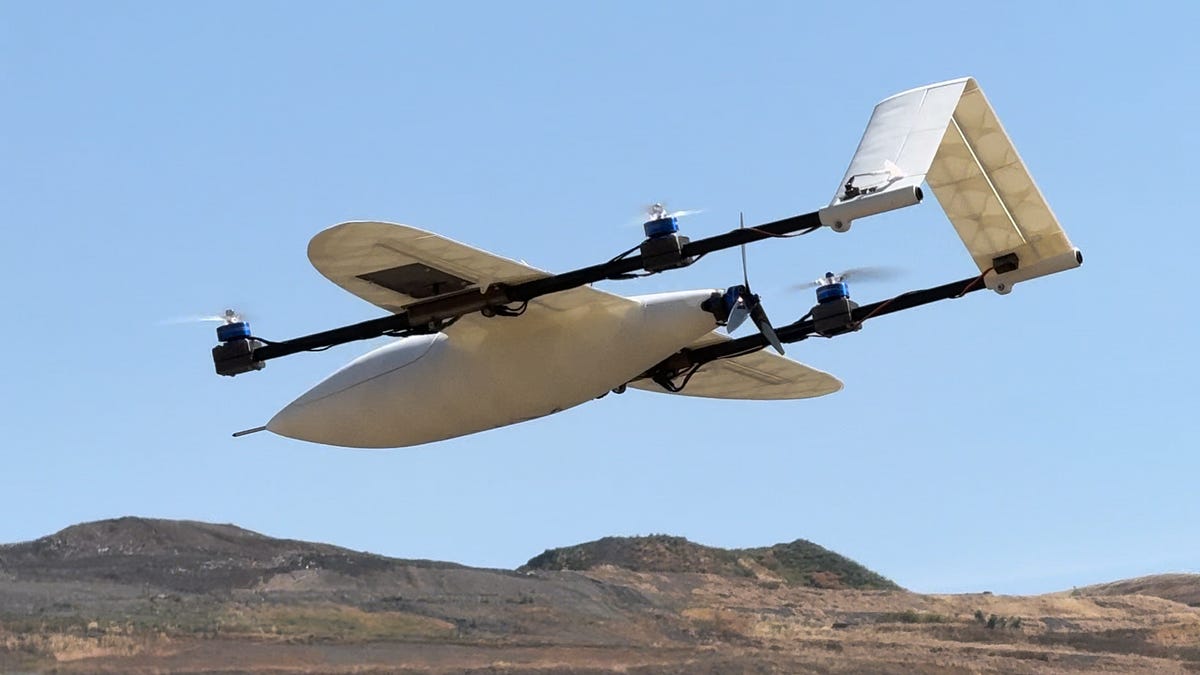
Show HN: I made a 3D printed VTOL drone (opens in a new tab)tsungxu.com
418 pointsThis is the thing I'm most proud of building to date!
Before this project, I was a total CAD, 3D printing and aerodynamic modeling beginner. I had only built and flown one VTOL before.
SPECS
Wingspan: 3.9 ft (1200 mm)
Length: 2.5 ft (770 mm)
Weight: 5.6 lb (2.55kg)
Airframe: foaming PLA (Bambu PLA-Aero) and PETG structural parts printed on A1 printer, CFRP booms and spars
Battery: Li-ion silicon anode Amprius SA08 cells, 6s2p pack by Upgrade Energy
Motors: 2807 AOS for lift and cruise (unoptimized)
Lifting ESCs: 4 in 1 Holybro Tekko32 F4 45A
Cruise ESC: Flycolor Raptor 5 45A
Lifting and cruise props: 7042 Gemfan (unoptimized)
Flight controller: Speedybee F405 Wing
GPS: M10
Firmware: Ardupilot 4.6.0
---
This video edit ended up shorter than I planned. Being my first Youtube video with significant post production effort, I underestimated the work required to make a longer in-depth video with voiceover, edited footage, etc.
Comments (144) 34 threads
Show all comments
Showing thread 3 of 34
How much customisation did you need to make to Ardupilot? Is your drone's control unique, or somehow standardised?
The HUD overlay you’re referring to is technically Mission Planner (GCS software), not ArduPilot (flight control software). Mission Planner and ArduPilot both talk Mavlink, and they’re both developed by the same community. MP is flexible. You can set it up to do almost anything you’d ever want. It’s also terrible and exceptionally janky… but extremely powerful. And they’re both free.
I think the problem with both of them is that they’re good enough that there isn’t likely to be a huge critical mass developing a better alternative. On the GCS side there is also QGroundControl and APM Planner 2 (which was a fork or reimplementation of Mission Planner). Both of them have their own upsides and downsides, but neither one of them is as mature or as powerful/flexible as Mission Planner. PX4 on the flight controller side is popular commercially because it’s BSD-licensed instead of GPL, but the net result is that it has nowhere near as many features as ArduPilot because companies build proprietary features and don’t push them back upstream.
This stuff is definitely in the worse-is-better domain. ArduPilot is free, ArduPilot is amazing and ArduPilot sucks. :)
Anyway, off to bed. I’m in a long test campaign right now and we’ve got to be up at 0430 to fly the ArduPilot-based aircraft again before the weather goes sideways.
What I started with - Had built one VTOL before from foamboard, not 3D printed. - Familiar with Ardupilot from that project and assembling a multicopter and COTS VTOL. - So I had a little experience building a structurally sound airframe for VTOL loads, but 3D printing was a wrinkle. - How I worked it out is a hard question. But it was being focused with design, flight testing and troubleshooting. LLMs, Youtube, forums, etc for help when needed. - Building in public helped paradoxically. It actually saves me time to build in public because of the motivation boost that helps me move faster and to share progress sooner. Even though there's a higher lift to document and share.