This is actually very cool. Not really replacing a browser, but it could enable an alternative way of browsing the web with a combination of deterministic search and prompts. It would probably work even better as a command line tool.
A natural next step could be doing things with multiple "tabs" at once, e.g: tab 1 contains news outlet A's coverage of a story, tab 2 has outlet B's coverage, tab 3 has Wikipedia; summarize and provide references. I guess the problem at that point is whether the underlying model can support this type of workflow, which doesn't really seem to be the case even with SOTA models.
I was thinking of showing multiple tabs/views at the same time, but only from the same source. Maybe we could have one tab with the original content optimised for cli viewing, and another tab just doing fact checking (can ground it with google search or brave). Would be a fun experiment.
In your cleanup step, after cleaning obvious junk, I think you should do whatever Firefox's reader mode does to further clean up, and if that fails bail out to the current output. That should reduce the number of tokens you send to the LLM even more
You should also have some way for the LLM to indicate there is no useful output because perhaps the page is supposed to be a SPA. This would force you to execute Javascript to render that particular page though
Interestingly, the original idea of what we call a "browser" nowadays – the "user agent" – was built on the premise that each user has specific needs and preferences. The user agent was designed to act on their behalf, negotiating data transfers and resolving conflicts between content author and user (content consumer) preferences according to "strengths" and various reconciliation mechanisms.
(The fact that browsers nowadays are usually expected to represent something "pixel-perfect" to everyone with similar devices is utterly against the original intention.) Yet the original idea was (due to the state of technical possibilities) primarily about design and interactivity. The fact that we now have tools to extend this concept to core language and content processing is… huge. It seems we're approaching the moment when our individual personal agent, when asked about a new page, will tell us:
    Well, there's nothing new of interest for you, frankly:
    All information presented there was present on pages visited recently.
    -- or --
    You've already learned everything mentioned there. (*)
    Here's a brief summary: …
    (Do you want to dig deeper, see the content verbatim, or anything else?)
Because its "browsing history" will also contain a notion of what we "know" from chats or what we had previously marked as "known".
> Well, there's nothing new of interest for you, frankly
For this to work like a user would want, the model would have to be sentient. But you could try to get there with current models, it'd just be very untrustworthy to the point of being pointless beyond a novelty
It would have to have a pretty good model of my brain to help me make these decisions. Just as a random example, it will have to understand that an equation is a sort of thing that I’m likely to look up even if I understand the meaning of it, just to double check and get the particulars right. That’s an obvious example, I think there must be other examples that are less obvious.
Or that I’m looking up a data point that I already actually know, just because I want to provide a citation. But, it could be interesting.
I can definitely see a future in which we are qch have our own personal memetic firewall, keeping us safe and cozy in our personal little worldview bubbles.
> I was thinking of showing multiple tabs/views at the same time, but only from the same source.
I think the primary reason I use multiple tabs but _especially_ multiple splits is to show content from various sources. Obviously this is different that a terminal context, as I usually have figma or api docs in one split and the dev server on the other. Still, being able to have textual content from multiple sources visible or quickly accessible would probably be helpful for a number of users
> tab 1 contains news outlet A's coverage of a story, tab 2 has outlet B's coverage, tab 3 has Wikipedia; summarize and provide references.
I think this is basically what https://ground.news/ does. (I'm not affiliated with them; just saw them in the sponsorship section of a Kurzgesagt video the other day and figured they're doing the thing you described +/- UI differences.)
I am a ground news subscriber (joined with a Kurzgesagt ref link) and it does work that way (minus the wikipedia summary). It's pretty good and I particularly like their "blindspot" section showing news that is generally missing from a specific partisan new bubble.
For me, a natural next step would be to turn this into a service -- rather than doing it in the browser, this acts as a proxy, strips away all the crud and serves your browser clean text. No need to install a new browser, just point the browser to the URL via the service.
But if we do it, we have to admit something hilarious: we will soon be using AI to convert text provided by the website creator into elaborate web experiences, which end users will strip away before consuming it in a form very close to what the creator wrote down in the first place (this is already happening with beautifully worded emails that start with "I hope this email finds you well").
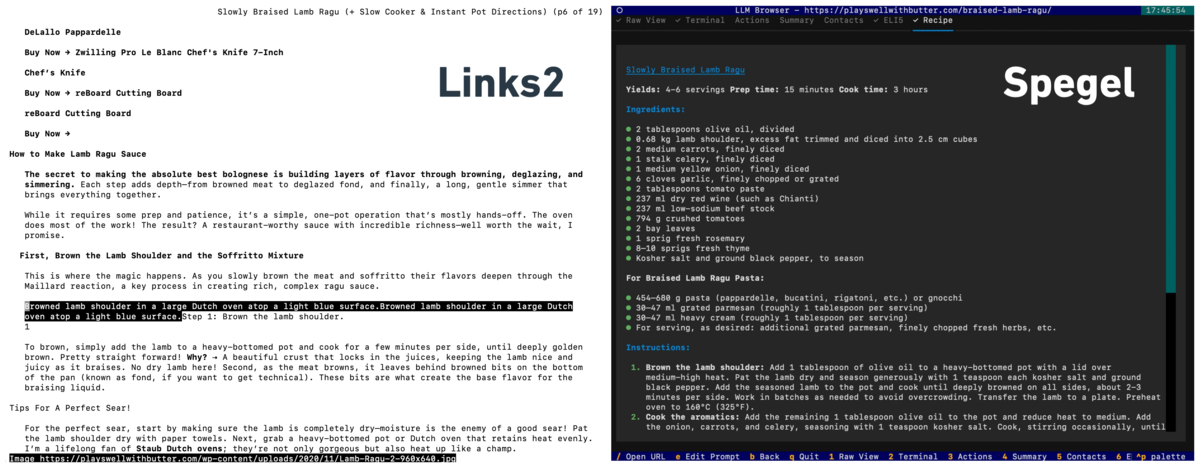
Classic that the first example is for parsing the goddamn recipe from the goddamn recipe site. Instant thumbs up from me haha, looks like a neat little project.
Which it apparently does by completely changing the recipe in random places including ingredients and amounts thereof. It is _indeed_ a very good microcosm of what LLMs are, just not in the way these comments think.
The output was then posted to the Internet for everyone to see, without the minimal amount of proofreading that would be necessary to catch that, which gives us a good microcosm of how LLMs are used.
On a more pleasant topic the original recipe sounds delicious, I may give it a try when the weather cools off a little.
It was actually a bit worse than that the LLM never got the full recipe due to some truncation logic I had added. So it regurgitated the recipe from training, and apparently, it couldn't do both that and convert units at the same time with the lite model (it worked for just flash).
I should have caught that, and there are probably other bugs too waiting to be found. That said, it's still a great recipe.
What do you mean? The recipes in the screenshot look more or less the same, the formatting has just changed in the Spiegel one (which is what was asked for, so no surprises there).
Edit: just saw the author's comment, I think I'm looking at the fixed page
There are extensions that do that for you, in a deterministic way and not relying on LLMs. For example, Recipe Filter for chrome. It just shows a pop up over the page when it loads if it detects a recipe
Another great example of LLM hype train re-inventing something that already existed [1] (and was actually thought out) but making it worse and non-deterministic in the worst ways possible.
LLMs are specifically good at a task like this because they can extract content from any webpage, regardless of it supports whatever standard that no one implements
That's a cool schema, but the LLM solution is necessary because recipe website makers will never use the schema because they want you to have to read through garbage, with some misguided belief that this helps their SEO or something. Or maybe they get more money if you scroll through more ads?
I'm genuinely a bit confused by the recipe blog business model. Like there's got to be one, right? People don't usually spew the same story about their grandma hundreds of times on a real blog.
Just hitting keywords for search? Many of them don't even have ads so I feel like that can't be it. Maybe referrals?
Can we stop with the unprovoked dissing of anyone using LLMs for anything? Or at least start your own thread for it. It's an unpleasant, incredibly boring/predictable standard for discourse (more so than the LLMs themselves lol).
It's in fact very provoked. The LLM just changes the instructions of the recipe and creates new ones. That's an unpleasant standard of user experience.
I definitely like the LLM in the middle, it’s a nice way to circumvent the SEO machine and how Google has optimized writing in recent years. Removing all the cruft from a recipe is a brilliant case for an LLM. And I suspect more of this is coming: LLMs to filter. I mean, it would be nice to just read the recipe from HTML, but SEO has turned everything into an arms race.
I foreseen this a couple years ago. We already have web search tools in LLMs, and they are amazing when they chain multiple searches. But Spegel is a completely different take.
I think the ad blocker of the future will be a local LLM, small and efficient. Want to sort your timeline chronologically? Or want a different UI? Want some things removed, and others promoted? Hide low quality comments in a thread? All are possible with LLM in the middle, in either agent or proxy mode. I bet this will be unpleasant for advertisers.
> Removing all the cruft from a recipe is a brilliant case for an LLM
Is it though, when the LLM might mutate the recipe unpredictably? I can't believe people trust probabilistic software for cases that cannot tolerate error.
I agree with you in general, but recipes are not a case where precision matters. I sometimes ask LLMs to give me a recipe and if it hallucinates something it will simply be taste bad. Not much different from a human-written recipe where the human has drastically different tastes than I do. Also you basically never apply the recipe blindly; you have intuition from years of cooking to know you need to adjust recipes to taste.
I wonder if you could use a less sophisticated model (maybe even something based on LSTMs) to walk over the DOM and extract just the chunks that should be emitted and collected into the browsable data structure, but doing it all locally. I feel like it'd be straightforward to generate training data for this, using an LLM-based toolchain like what the author wrote to be used directly.
Comments (180) 57 threads
A natural next step could be doing things with multiple "tabs" at once, e.g: tab 1 contains news outlet A's coverage of a story, tab 2 has outlet B's coverage, tab 3 has Wikipedia; summarize and provide references. I guess the problem at that point is whether the underlying model can support this type of workflow, which doesn't really seem to be the case even with SOTA models.
I was thinking of showing multiple tabs/views at the same time, but only from the same source.
Maybe we could have one tab with the original content optimised for cli viewing, and another tab just doing fact checking (can ground it with google search or brave). Would be a fun experiment.
You should also have some way for the LLM to indicate there is no useful output because perhaps the page is supposed to be a SPA. This would force you to execute Javascript to render that particular page though
https://github.com/mozilla/readability
Continue this thread — 1 reply
(The fact that browsers nowadays are usually expected to represent something "pixel-perfect" to everyone with similar devices is utterly against the original intention.)
Because its "browsing history" will also contain a notion of what we "know" from chats or what we had previously marked as "known".Yet the original idea was (due to the state of technical possibilities) primarily about design and interactivity. The fact that we now have tools to extend this concept to core language and content processing is… huge.
It seems we're approaching the moment when our individual personal agent, when asked about a new page, will tell us:
For this to work like a user would want, the model would have to be sentient.
But you could try to get there with current models, it'd just be very untrustworthy to the point of being pointless beyond a novelty
Continue this thread — 1 reply
Or that I’m looking up a data point that I already actually know, just because I want to provide a citation.
But, it could be interesting.
Continue this thread — 2 replies
Continue this thread — 1 reply
almost unrelated, but you can also compare spegel to https://www.brow.sh/
I think the primary reason I use multiple tabs but _especially_ multiple splits is to show content from various sources. Obviously this is different that a terminal context, as I usually have figma or api docs in one split and the dev server on the other.
Still, being able to have textual content from multiple sources visible or quickly accessible would probably be helpful for a number of users
I think this is basically what https://ground.news/ does.
(I'm not affiliated with them; just saw them in the sponsorship section of a Kurzgesagt video the other day and figured they're doing the thing you described +/- UI differences.)
But if we do it, we have to admit something hilarious: we will soon be using AI to convert text provided by the website creator into elaborate web experiences, which end users will strip away before consuming it in a form very close to what the creator wrote down in the first place (this is already happening with beautifully worded emails that start with "I hope this email finds you well").
On a more pleasant topic the original recipe sounds delicious, I may give it a try when the weather cools off a little.
I should have caught that, and there are probably other bugs too waiting to be found. That said, it's still a great recipe.
Edit: just saw the author's comment, I think I'm looking at the fixed page
https://schema.org/Recipe
LLMs are specifically good at a task like this because they can extract content from any webpage, regardless of it supports whatever standard that no one implements
Just hitting keywords for search? Many of them don't even have ads so I feel like that can't be it. Maybe referrals?
Continue this thread — 4 replies
Continue this thread — 2 replies
Continue this thread — 1 reply
Continue this thread — 4 replies
[0] https://research.nvidia.com/labs/lpr/slm-agents/
I think the ad blocker of the future will be a local LLM, small and efficient. Want to sort your timeline chronologically? Or want a different UI? Want some things removed, and others promoted? Hide low quality comments in a thread? All are possible with LLM in the middle, in either agent or proxy mode.
I bet this will be unpleasant for advertisers.
Is it though, when the LLM might mutate the recipe unpredictably? I can't believe people trust probabilistic software for cases that cannot tolerate error.
Continue this thread — 5 replies
Continue this thread — 1 more reply
Continue this thread — 2 replies
All comments shown.
Couldn't load more comments. Check your connection and try again.