Cool idea! but kind of wasteful..
I just feel wrong if I waste energy..
At least you could first turn it into markdown with a library that preserves semantic web structures (I authored this- https://github.com/romansky/dom-to-semantic-markdown) saving many tokens = much less energy used..
It would be cool of it were smart enough to figure out whether it was necessary to rewrite the page on every visit. There's a large chunk of the web where one of us could visit once, rewrite to markdown, and then serve the cleaned up version to each other without requiring a distinct rebuild on each visit.
The author says this is for “personalized views using your own prompts.” Though, I suppose it’s still useful to cache the outputs for the default prompt.
Each user have distinct needs, and has a distinct prior knowledge about the topic, so even the "raw" super clean source form will probably be eventually adjusted differently for most users.
But yes, having some global shared redundant P2P cache (of the "raw" data), like IPFS (?) could possibly help and save some processing power and help with availability and data preservation.
I imagine it sort of like a microscope. For any chunk of data that people bothered to annotate with prompts re: how it should be rendered you'd end up with two or three "lenses" that you could toggle between. Or, if the existing lenses don't do the trick, you could publish your own and, if your immediate peers find them useful, maybe your transitive peers will end up knowing about them as well.
If the goal is to have a more consistent layout on each visit, I think we could save the last page's markdown and send it to the model as a one-shot example...
Cache headers exist for servers to communicate to clients how long it safe to cache things for. The client could be updated to add a cache layer that respects cache headers.
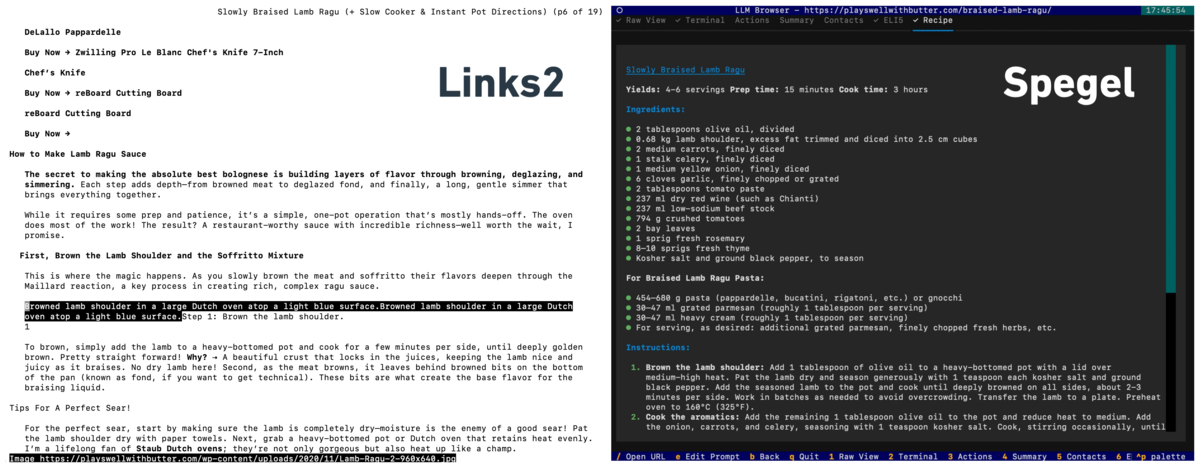
People here are not realizing that html is just the start. If you can render a webpage into a view, you can render any input the model accepts. PDF to this view. Zip file of images to this view. Giant json file into this view. Whatever. The view is the product here, not the html input.
Comments (180) 57 threads
Earlier commentsUsing a big cloud provider for this is madness.
But yes, having some global shared redundant P2P cache (of the "raw" data), like IPFS (?) could possibly help and save some processing power and help with availability and data preservation.
All comments shown.
Couldn't load more comments. Check your connection and try again.