Show HN: Edka – Kubernetes clusters on your own Hetzner account (opens in a new tab)edka.io
437 pointsI’ve been working with Kubernetes for over a decade, since the alpha days, and was involved in kube-aws project before AWS launched EKS. For the past four years, I’ve been helping friends and small businesses cut costs by running Kubernetes on Hetzner Cloud, which I’ve found to be rock solid and by far the best priced provider.
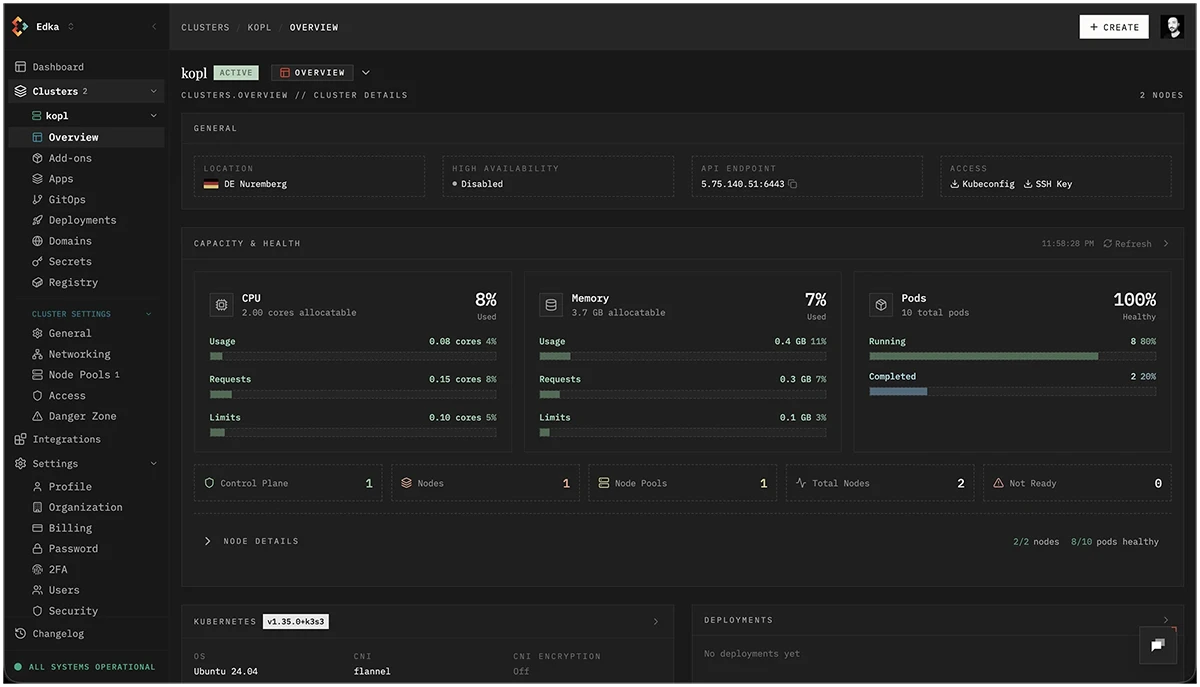
Provisioning a cluster on Hetzner is now straightforward, thanks to tools like k3s and hetzner-k3s, but configuring it for your specific needs still takes time and expertise. I built Edka to make that part easy: spin up a production ready cluster in ~2 minutes, then choose how low level or automated you want to go.
How it works:
Layer 1 – Cluster provisioning
- Creates a k3s-based Kubernetes cluster on Hetzner (lightweight, easy to manage, scales well).
Layer 2 – Add-ons
- One-click deploy for metrics-server, cert-manager, and various operators; preconfigured for Hetzner, no extra setup needed.
Layer 3 – Applications
- Minimal config UIs for apps built on top of add-ons.
- Example: Need PostgreSQL? Fill a few fields → platform installs CloudNativePG → provisions HA PostgreSQL with PITR → gives ready to use endpoints. Backups can be restored to any point in time with a click. Quick demo: https://edka.io/apps/
Layer 4 – Deployments
- Connect your CI to push container images to a public/private registry.
- Edka updates deployments automatically (with semantic versioning rules), supports instant rollbacks, autoscaling, persistent volumes, secrets/env imports, and quick public exposure. Quick demo: https://edka.io/deployments/
Tech stack: TypeScript, React + Tailwind CSS, PostgreSQL, Redis, BullMQ, Vault + AWS KMS to encrypted sensitive data.
The platform is still in beta and I’m building it in my spare time, so there are some rough edges, but I’d love feedback from anyone running Kubernetes on Hetzner, exploring alternatives to EKS/GKE/AKS or looking to automate their infrastructure with Kubernetes.
More details: https://edka.io/
Thank you!
Comments (130) 58 threads
Show all comments
Showing thread 12 of 58
Setting up kubernetes yourself with k3s and deploying a HA database with cnpg is so simple nowadays. It works great until some day you face an issue that you can't fix without diving deep into the details e.g. debugging your CNI or the implementations of specific operators to understand reconciliation errors. I faced countless of these issues such as:
- your Postgres CNPG failed during failover and can't recover on it's own - Postgres WAL archiving suddenly doesn't work anymore after an update. - Cluster networking on some nodes doesn't work anymore due to an incompatibility of kube-proxy and Cilium after an update
Unless it's your core business I'd limit myself to deploying applications on Kubernetes instead of managing Kubernetes itself. At least for use cases where reliability matters.
There are some reasonably priced managed Kubernetes offerings out there. For example syself (https://syself.com) built a managed Kubernetes on Hetzner. The prices are super reasonable. For 300 Euros per month you can enjoy Hetzner prices with an experience that beats AWS.
We're running our entire PaaS platform (Sherpa.sh) on top of Hetzner with Syself. We are 5x more affordable than Vercel and a big piece of that is because Syself allows us to operate autoscaling k8s clusters without an army of ops engineers.
We tried hetzner-k3s, and many other solutions. But ran into many of these same problems. Syself on the other hand, has solved all the sticky hardware and networking challenges at scale with their own customer operators. Plus they're support is super responsive and helpful.
The one downside, is they don't have a dashboard yet, so you need to be comfortable in the CLI. But I'm sure they are working on it.
I don't think I would manage kubernetes any other way at this point.