Lurker News
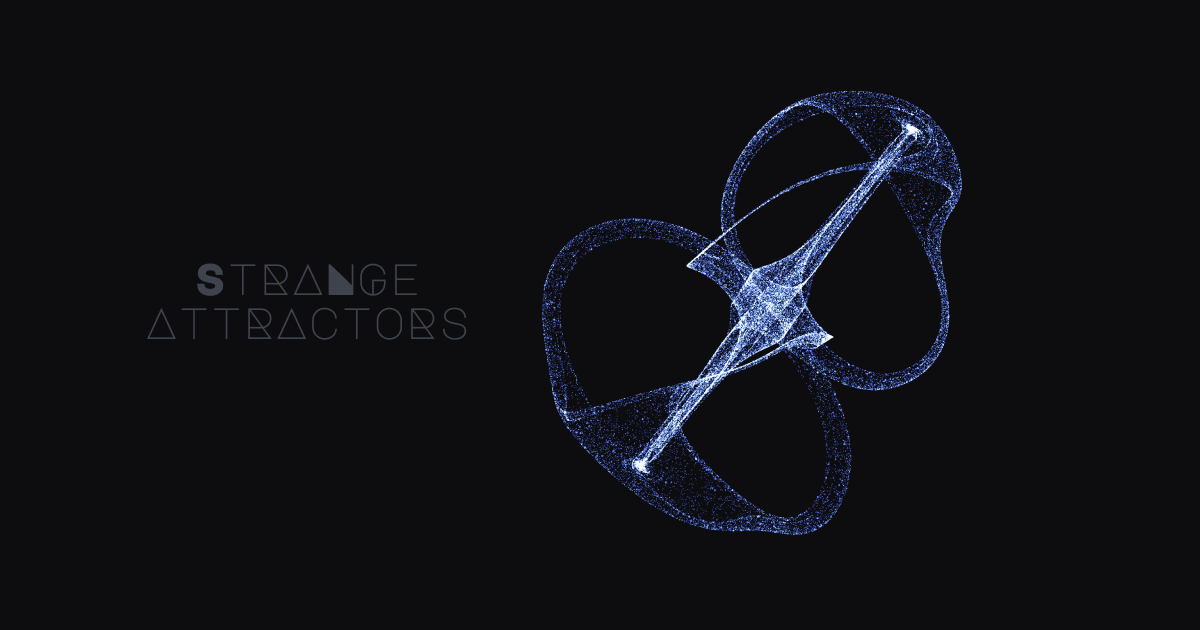
I went down the rabbit hole on a side project and ended up building this: Strange Attractors(https://blog.shashanktomar.com/posts/strange-attractors). It’s built with three.js.

Working on it reminded me of the little "maths for fun" exercises I used to do while learning programming in early days. Just trying things out, getting fascinated and geeky, and being surprised by the results. I spent way too much time on this, but it was extreme fun.
My favorite part: someone pointed me to the Simone Attractor on Threads. It is a 2D attractor and I asked GPT to extrapolate it to 3D, not sure if it’s mathematically correct, but it’s the coolest by far. I have left all the params configurable, so give it a try. I called it Simone (Maybe).
If you like math-art experiments, check it out. Would love feedback, especially from folks who know more about the math side.
Comments (78) 49 threads

Show all comments

Showing thread 1 of 49

cableclasper1 reply#
Visualizations like this truly highlight how much there is to be gained from viewing the 3D phase space, but also how much richness we miss in >3D!

(I wonder if there are slick ways to visualise the >3D case. Like, we can view 3D cross sections surely.
Or maybe could we follow a Lagrangian particle and have it change colour according to the D (or combination of D) it is traversing? And do this for lots of particles? And plot their distributions to get a feeling for how much of phase space is being traversed?)
This visualization also reminds me of the early debates in the history of statistical mechanics: How Boltzmann, Gibbs, Ehrenfest, Loschmidt and that entire conference of Geniuses must have all grappled with phase space and how macroscopic systems reach equilibrium.
Great work Shashank!

flatline4 replies#
The conclusion I’ve come to from works like Flatland, 4D toys, etc., is that we simply don’t have the neural circuitry to grasp anything beyond three dimensions. We can reason about them, we can make inferences about the whole from partial understanding, but we cannot truly grasp more than three, or perhaps only for an instant of forced conceptualization using heuristics like you mentioned. Even three is a stretch, our minds have adapted to build a three dimensional realm from something like a 2.5 dimensional field of combined visual, tactile, and auditory stimuli. I suspect 3D reasoning itself is a huge adaptive trait compared to most other animals.
cantor_S_drug2 replies#
Do you think an AI can learn this intuition by training it in similar environment?
vincnetas2 replies#
Can we train our neurons? Like the experiment where human vision adapted to upside down image, could our brains somehow adapt to understanding 4D data from VR headset?
gf0001 reply#
I'm sure some form of training is possible where you get a better understanding of a 4D universe with some limited inference abilities, but with a bad analogy, this would all be "software emulated" with no hardware acceleration - we only have the latter for 3D and we can't update it without a hardware change.

Continue this thread — 1 reply

lioeters#
Yes, I believe it's possible to train our brains and learn to perceive better in higher dimensions. There's a great description in the science-fiction book Neverness, where pilots meld their minds with the spaceship computer to visualize and navigate hyperspace.
apples_oranges1 reply#
Good point, why not? Communicating it back to us could be a problem. Hmm.. what if future ais hide data from us in dimensions we can’t wrap our heads around?

Continue this thread — 1 reply

sorokod1 reply#
At least for 4D, would you not consider 3D-over-time as a four dimensional model? Doesn't watching the evolution as seen here allows for building up an intuition ?
tliltocatl2 replies#
Well, what's interesting about 4D is that's not just an extra dimension slapped on top, it's extra rotational degrees of freedom. You can't really get that with time (at least not until you get relativistic, and it still would be hyperbolic rotation, not euclidean).

Continue this thread — 2 replies

Gooblebrai#
I've been waiting for Miegakure for ages
Laremere3 replies#
I've managed to visualize a Klein bottle in 4d. I easily visualize 3d objects. However I can't really do color - I startled myself recently when I briefly saw red. On that aphantasia test with an apple, I can hold it's 3d shape, but no surface texture or color.

People seem to have surprisingly different internal experiences. I don't know how common 4d visualization is, and I suspect even those capable require exposure to the concepts and practice. However I do think it possible.

d_tr#
For me, being able to visualize 4D would imply that I can picture four mutually perpendicular axes, something which I find completely impossible for me to do. And I thought it is impossible for any human brain. It would be fascinating if I am wrong.
cantor_S_drug#
The blind French mathematician Bernard Morin is well-known for creating the first visualization of a sphere eversion, a method for turning a sphere inside out without creasing it. His work was based on Stephen Smale's 1958 proof of sphere eversion's existence and on ideas shared by Arnold Shapiro. Morin's method involved constructing a sequence of models, including his "Morin surface," to demonstrate the process.

https://en.wikipedia.org/wiki/Bernard_Morin

soulofmischief#
Your hippocampus has several special clusters of neurons whose members activate and deactivate based on your body's understanding of your position and momentum in a 3D world.

The arrangement of these neurons physically corresponds to reality, and so things are pretty hardwired.
Repurposing these neurons might be possible with advanced training and nootropics, but I'm not sure. You might have better luck engaging other parts of your brain, for example using metaphor or abstraction such as mathematics.