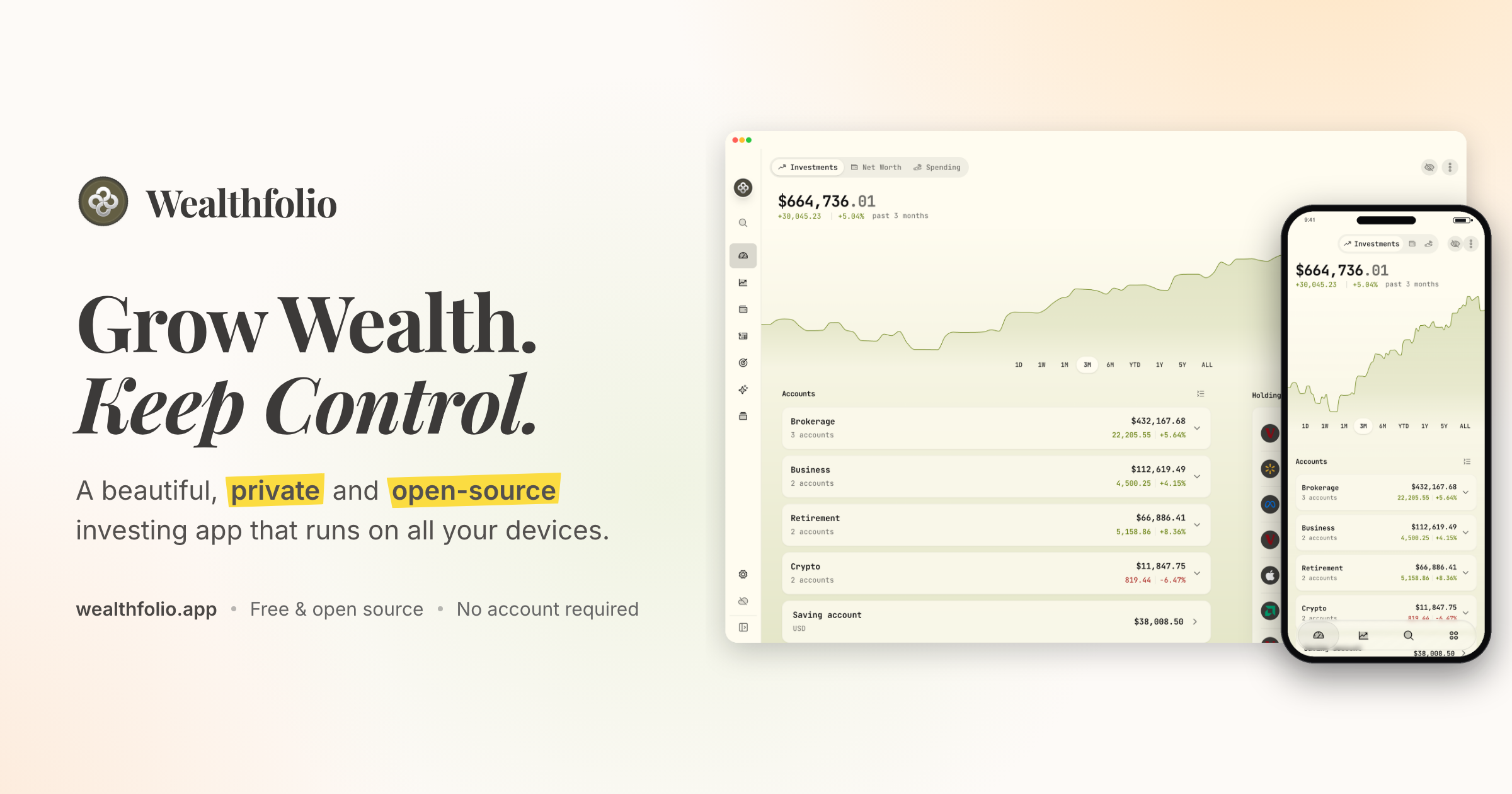
Show HN: Wealthfolio 2.0- Open source investment tracker. Now Mobile and Docker (opens in a new tab)wealthfolio.app
676 pointsHi HN, creator of Wealthfolio here.
A year ago, I posted the first version. Since then, the app has matured significantly with two major updates:
1. Multi-platform Support:
Now available on Mobile (iOS), Desktop (macOS, Windows, Linux), and as a Self-hosted Docker image.
(Android coming soon).
2. Addons System:
We added explicit support for extensions so you can hack around, vibe code your own integrations, and customize the app to fit your needs.
The core philosophy remains the same: Always private, transparent, and open source.
Comments (215) 59 threads
Earlier commentsWhy is there not an aggregation service that literally lets me go directly to my financial institutions to pull down my data and put it into whatever I want? A Plaid, Finicity, Yodlee, MX for the user, not the mass-traffic developer?
I guess, like price engines and free hosting, the business model isn't there to support a thing that just helps folks.
It's still MX under the hood though so it's maybe not quite as satisfying of a solution? I agree I wish we had better consistent APIs between financial institutions for data access in the US.
[0] https://actualbudget.org/
On a side note; SimpleFIN works well with actual, and the person that runs the bridge is great.
* https://wealthfolio.app/docs/guide/goals/
Neat: RRSPs are Canadian, so not necessarily US-only.
What happened was I slowly built an awareness of how things are going, where my spending and savings are and internalised a few things. For example, as a contractor I responsible for my taxes, so 30% of my invoice goes into a savings account as soon as I get paid. But, that wouldn’t have happened right away for me, if I have never done the monthly cash flow.
I think everyone goes through this journey. Because I often see people super into accounting for a couple of years and then completely abandon it later in life. Looking at it daily in early stages help get a feel and set expectations for the long term. Some people get sidetracked here and the phrase “Beat the market” grates on me for that reason.
No one is saying it's healthy but if you have debt, can't save or don't have investments on track to meet your future needs then what's more unhealthy, monitoring or lower living standards?
On the spending/budgeting side, I could see the use of day-to-day tracking. I import my credit card transactions into gnucash weekly - if I didn’t already have a good workflow set up I could see the use of something like this to help keep on top of things.
All comments shown.
Couldn't load more comments. Check your connection and try again.