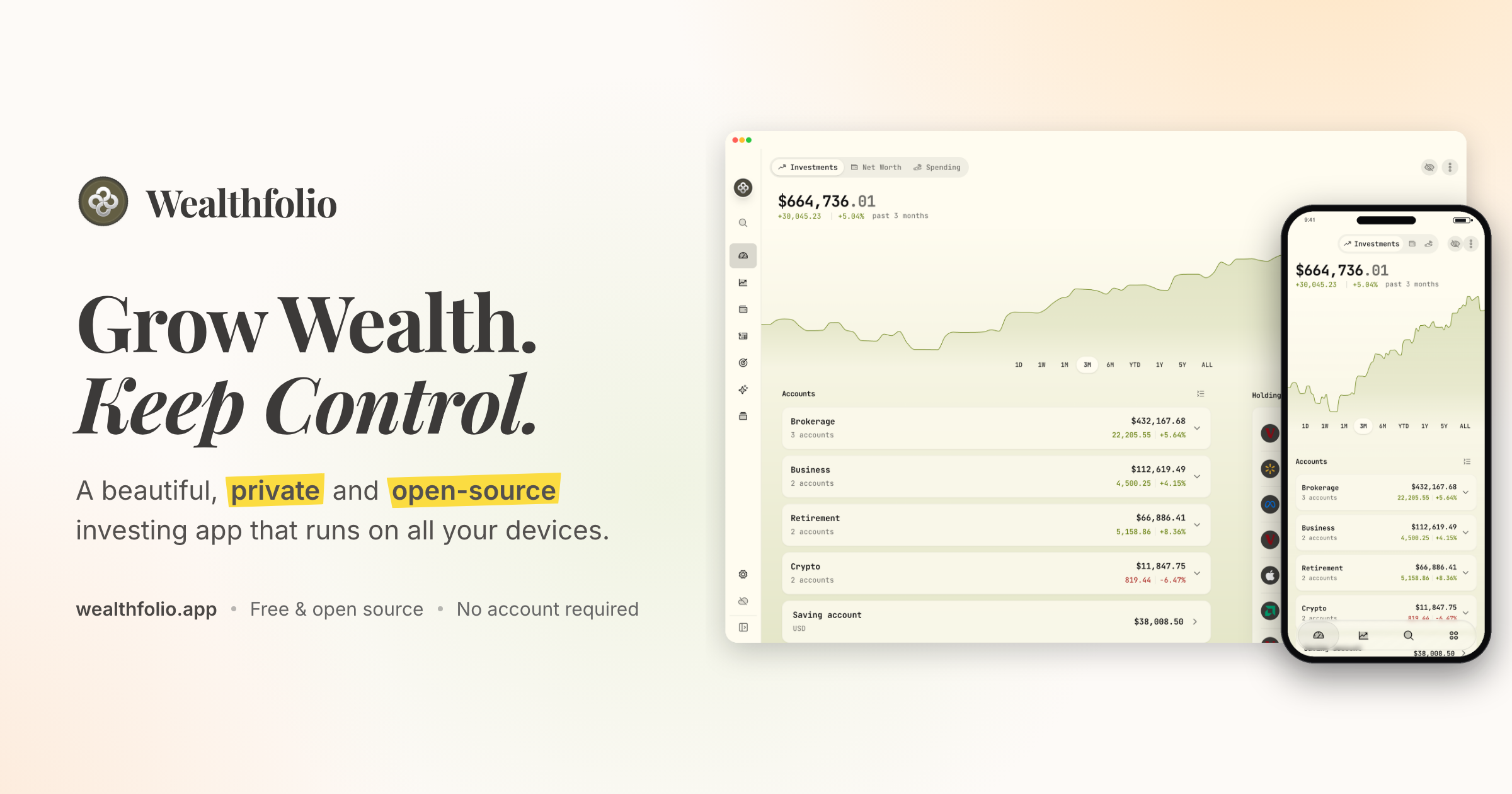
Show HN: Wealthfolio 2.0- Open source investment tracker. Now Mobile and Docker (opens in a new tab)wealthfolio.app
676 pointsHi HN, creator of Wealthfolio here.
A year ago, I posted the first version. Since then, the app has matured significantly with two major updates:
1. Multi-platform Support:
Now available on Mobile (iOS), Desktop (macOS, Windows, Linux), and as a Self-hosted Docker image.
(Android coming soon).
2. Addons System:
We added explicit support for extensions so you can hack around, vibe code your own integrations, and customize the app to fit your needs.
The core philosophy remains the same: Always private, transparent, and open source.
Comments (215) 59 threads
Show all comments
Showing thread 1 of 59
But I don't think I'm willing to give up fully automated data refreshes at this point. I have too many accounts to track.
I'd love that too, but I'm not sure it's even feasible or possible, at least in the EU country where I live. I, like most people (I think?) need to file taxes each year, and those include my new positions, or what positions have disappeared, including how much I have in savings. And, the only way for me to keep savings without losing money, is to keep it in a bank, so it's again not private.
Feels like "private finance" been dead for a long time, unless you start using cryptocurrencies specifically for privacy, like zcash, otherwise you'll be having non-private data at least somewhere.
And I think that's what the parent post is talking about. Today's companies make you agree to 3 50-page documents which they can update at any time and your continued use after such silent updates constitutes consent.. and at some point they will sell your financial status/well-being to people for profit. So the more you feed them the more of your data that is being easily sold.
We ultimately probably can't stop that, but we can make it more difficult. Many apps like this would take your information and sell it.. having an option that lets you track your own finances without becoming a product is nice.
– Install a piece of software and run it locally, no subscription, no cloud – Have to right to use a nicer app instead of a spreadsheet – not hand over your banking creds. Some banks will void your account insurance if you do – Reduce your exposure by not putting all your financial data on some startup’s servers
I prefer to not give to even more people.
In the same way as my doctor knowns some private health info but to keep it private I would prefer to not give it to my employer.
Happy to help build an integration with [Lunch Flow](https://lunchflow.app), which aggregates multiple open banking providers for global coverage behind a single API.
Continue this thread — 1 reply
YNAB4 was a local client, but with YNAB5 they sadly (to me) went online and subscription.
I happily paid for v4 (one-time purchase), but was/am not willing to pay for v5 because (a) I don't like renting software, and (b) I have no need for syncing (which a subscription could justify to pay for ongoing server costs).
IIRC I was pretty impressed with it back then. It looks like there are more non-direct install options now. (Flatpack, appimage, etc.)
https://financier.io/
Continue this thread — 1 reply
It uses a plugin structure so if your bank is missing you can contribute your parser.
https://rubygems.org/gems/ynab_convert/versions/2.0.6
By nature of the economic system, you must interact with 3rd parties, unless you somehow live a life where you can manage to be all crypto or (increasingly harder) cash based. At that point, there is no real benefit to privacy outside of ensuring that whatever institution(s) you work with aren't doing anything odd.
I'm open to missing something here.
1– Install a piece of software and run it locally, no subscription, no cloud 2– Have to right to use a nicer app instead of a spreadsheet 3– not hand over your banking creds. Some banks will void your account insurance if you do 4– Reduce your exposure by not putting all your financial data on some startup’s servers.
Continue this thread — 2 replies
I used Mint for years, and I LOVED it. Hooked it up to all my accounts, it could track purchases and spending and kept everything up to date automatically. It would remember how I categorized things.
Of course, then Intuit decided to get rid of it and force everyone to move to Credit Karma, which doesn't do the same things AT ALL. I don't care about tracking my credit scores, and I pay off all my credit cards every month, I don't need help finding a loan for anything. The only thing it does is try to offer me loans and credit cards. It doesn't have any transaction history, so it doesn't do the one thing I care about.
The decade+ of transaction history I had in Mint was just GONE. It really sucked, and I have not found a replacement yet.
I don't mind if it is hosted, or even if I have to pay for it, but I would like to be able to keep my historical data, and for it to automatically populate from my accounts, and not go away if a company decides it can't make money from it anymore.
Continue this thread — 2 replies
Continue this thread — 1 more reply
My bank has both commercial & cultural reasons not to sell my ID & transaction history. They might still do it anyways, but it's at least plausible that they wouldn't, if only due to the harm to their reputation if it ends up in the papers.
If we want to monetize insights from aggregated data, we'd do it in-house and offer you better products. Example: Why sell your mortgage readiness data to some broker when we could source competitive mortgage offers and present them directly to you? Keep you in our ecosystem, add value to your experience, and build a revenue stream that doesn't destroy the core product.
The wealth space is crowded. Companies that burn user trust get exposed fast and die faster. The only sustainable path is treating your data like it belongs to you and not us. Any company here who doesn't get that is building on quicksand and I'd be very surprised to hear any of the larger players engaging in those practices but maybe I'm naive.
Either way, it's why we're a Fiduciary and that blankets the entire product suite.
https://www.cnbc.com/2025/11/14/jpmorgan-chase-fintech-fees....
That article is about JPMorgan being able to charge Plaid or other providers for the middleman access. They used to be operating almost for free, now Plaid has to pay for access the same way companies like mine pay Plaid.
Plaid does in fact sell your data, but they ask for permission first. So does JPMC, for that matter: https://media.chase.com/news/chase-launches-chase-media-solu...
Continue this thread — 1 more reply
Continue this thread — 1 more reply
Continue this thread — 5 more replies
Continue this thread — 2 more replies
Continue this thread — 4 more replies