Show HN: I used Claude Code to discover connections between 100 books (opens in a new tab)trails.pieterma.es
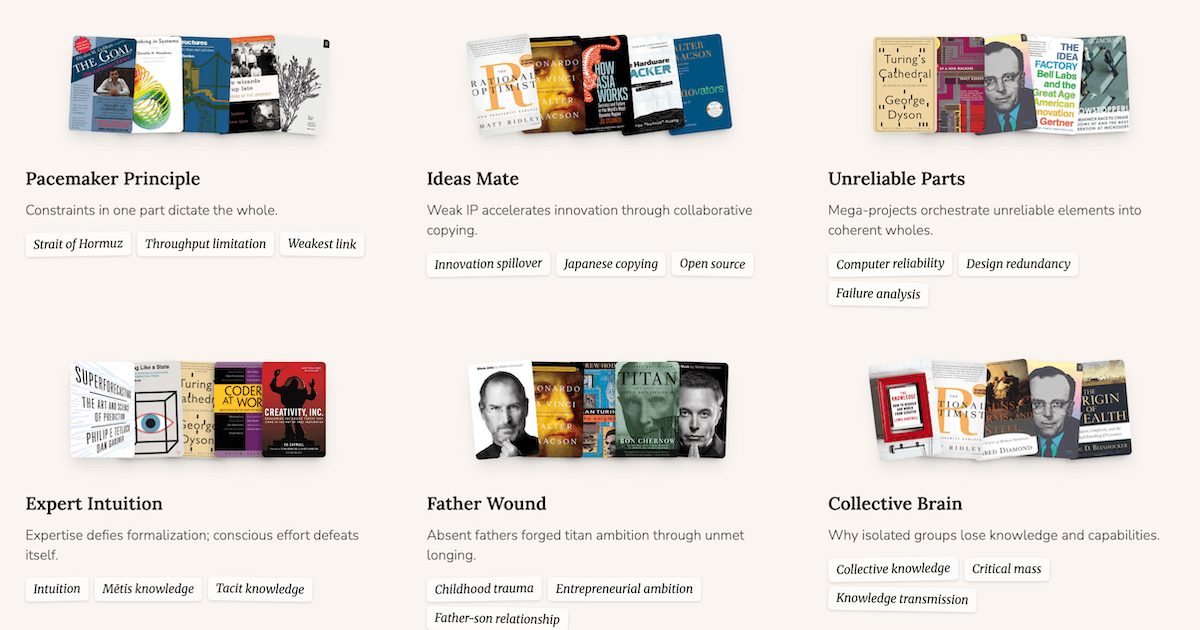
524 pointsI built a system for Claude Code to browse 100 non-fiction books and find interesting connections between them.
I started out with a pipeline in stages, chaining together LLM calls to build up a context of the library.
I was mainly getting back the insight that I was baking into the prompts, and the results weren't particularly surprising.
On a whim, I gave CC access to my debug CLI tools and found that it wiped the floor with that approach.
It gave actually interesting results and required very little orchestration in comparison.
One of my favourite trail of excerpts goes from Jobs’ reality distortion field to Theranos’ fake demos, to Thiel on startup cults, to Hoffer on mass movement charlatans (https://trails.pieterma.es/trail/useful-lies/).
A fun tendency is that Claude kept getting distracted by topics of secrecy, conspiracy, and hidden systems - as if the task itself summoned a Foucault’s Pendulum mindset.
Details:
* The books are picked from HN’s favourites (which I collected before: https://hnbooks.pieterma.es/).
* Chunks are indexed by topic using Gemini Flash Lite. The whole library cost about £10.
* Topics are organised into a tree structure using recursive Leiden partitioning and LLM labels. This gives a high-level sense of the themes.
* There are several ways to browse. The most useful are embedding similarity, topic tree siblings, and topics cooccurring within a chunk window.
* Everything is stored in SQLite and manipulated using a set of CLI tools.
I wrote more about the process here: https://pieterma.es/syntopic-reading-claude/
I’m curious if this way of reading resonates for anyone else - LLM-mediated or not.
Comments (146) 66 threads
Show all comments
Showing thread 9 of 66
I think that this sucks the discreet joy out of reading and learning. Having the ways that the topics within a certain book can cross over in lead into another book of a different topic externalized is hollowing and I don’t find it useful.
On the other hand I feel like seeing this process externalized gives us a glimpse at how “the algorithms” (read: recommender systems) suggest seemingly disjunctive content to users. So as a technical achievement I can’t knock what you’ve done and I’m satisfied to see that you’re the guy behind the HN Book map that I thought was nice too.
At its core this looks like a representation of the advantages that LLMs can afford to the humanities. Most of us know how Rob Pike feels about them. I wonder if his senior former colleague feels the same: https://www.cs.princeton.edu/~bwk/hum307/index.html. That’s a digression, but I’d like to see some people think in public about how to reasonably use these tools in that domain.
Intuitively, I agree. This feels like the different between being a creator (of your own thoughts as inspired by another person's) and a consumer (although in a somewhat educational sense). There would need to be a big advantage to being taught those initial thoughts, analogous to why we teach folks algebra/calculus via formulas rather than having every student figure out proofs for themselves.