Lurker News
Due to bike-induced concussions, I've been worried for a while about losing my memory and not being able to log back in.

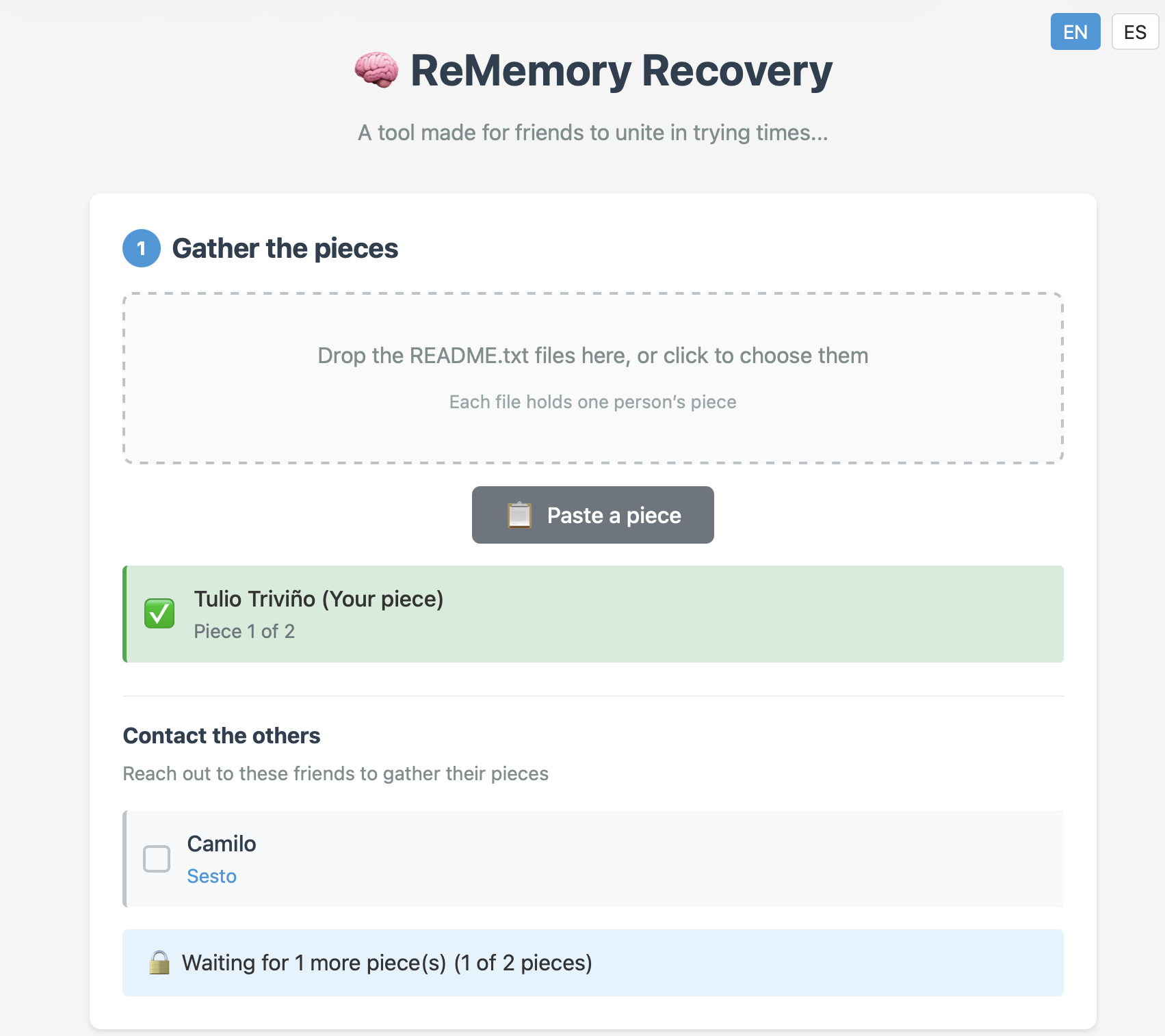
I combined shamir secret sharing (hashicorp vault's implementation) with age-encryption, and packaged it using WASM for a neat in-browser offline UX.
The idea is that if something happens to me, my friends and family would help me get back access to the data that matters most to me. 5 out of 7 friends need to agree for the vault to unlock.
Try out the demo in the website, it runs entirely in your browser!
Comments (233) 69 threads

Earlier comments
modeless2 replies#
For this purpose Google offers "Inactive Account Manager" AKA a dead man's switch.
couchdive#
3 months of non-use is the lowest term available before it will enact. That's too long for most situations except maybe probate court
eljojo2 replies#
I don't use Google :(
bsza#
Set up a Github action to send out the secret if you don't commit to a repo every x days? You could even combine it with secret sharing to make sure your friends can't access it unless you're really in trouble.
sowbug#
You don't need to use Google day-to-day. Create a single-purpose Gmail account and set up Inactive Account Manager to provide Google Drive access to your trusted contacts at the designated time. Put a single document in the drive that contains whatever your recovery instructions are, and encrypt it with the secret that is unlocked with your M-of-N Shamir shares.

Now you don't have to trust your M of N friends as much, because they can conspire to unlock the secret early, but they won't get access to the document that the secret unlocks until after your demise.
There are non-fatal problems with this approach -- your N friends have to recognize the email they receive from a strange Gmail address 3 months after you're gone. You might lose the password to the Gmail account and be unable to get in there yourself, causing it to declare you dead when you're not. All these issues can be mitigated with extra care.

gingerlime4 replies#
Other than passwords though, I also have stuff installed at home on a Synology NAS, a mail server, a VPS running some websites (my own, family, my wife's), Home Assistant, Family photos with backups etc etc.

I wonder who would not only have the passwords, but the know-how to manage the whole thing, at least to transition it to more managed services...

thephyber#
Don’t assume that anyone can.

If you want someone to be able to access it after you’re gone, either put 1000 BTC in it or leave instructions. Paper instructions in a physical fireproof safe is way easier to deal with than any digital encryption with no hints.

eljojo#
you're completely right! the app actually guides you on some of that, it generates a readme that gives you advise on what to document, but I agree you can't be too careful here, the passwords IS NOT ENOUGH.

You need to give people "a map" of where things are: https://github.com/eljojo/rememory/blob/main/internal/projec...

reddalo#
Me too. I'm starting to self-host more and more services for both me and my family, and I wonder what would happen should I meet a bus in a front-facing way.
Terr_#
I think that boils down to having a checklist addendum to go with your will, an outline of accounts and data to rescue.
mjanx1232 replies#
A sticker with your password to the monitor, like everybody else
fragmede1 reply#
That's stupid! I put mine under the keyboard. Way more secure :p
ninalanyon#
I know that you and the person you are responding to are joking (probably) but this does in fact seem like a much simpler way of solving the problem and really not much less secure if we are talking about a home computer.
utopiah#
At least if you go that route use a biometric authentication mechanism, e.g. YubiKey Bio.
utopiah1 reply#
Ah, I actually did something similar years ago. I basically hashed individual pages of my wiki and I think I published the hash of hashes on the Blockchain. Anyway I didn't need it and stop maintaining that system but definitely interesting explorations.

To clarify the hashing was to verify that the pages were indeed modified by me, to prevent tempering.
Damn, found it back, was in 2011!
in English https://fabien.benetou.fr/Slideshows/MemoryLoss
in French https://fabien.benetou.fr/Slideshows/MemoryLossPES

utopiah#
FWIW as I commented just earlier if you have to verify without relying on memory nor a public note (e.g. sticker on screen) that others could use to pollute your data then use a biometric mechanism, e.g. YubiKey Bio.

Load more comments