Lurker News
Due to bike-induced concussions, I've been worried for a while about losing my memory and not being able to log back in.

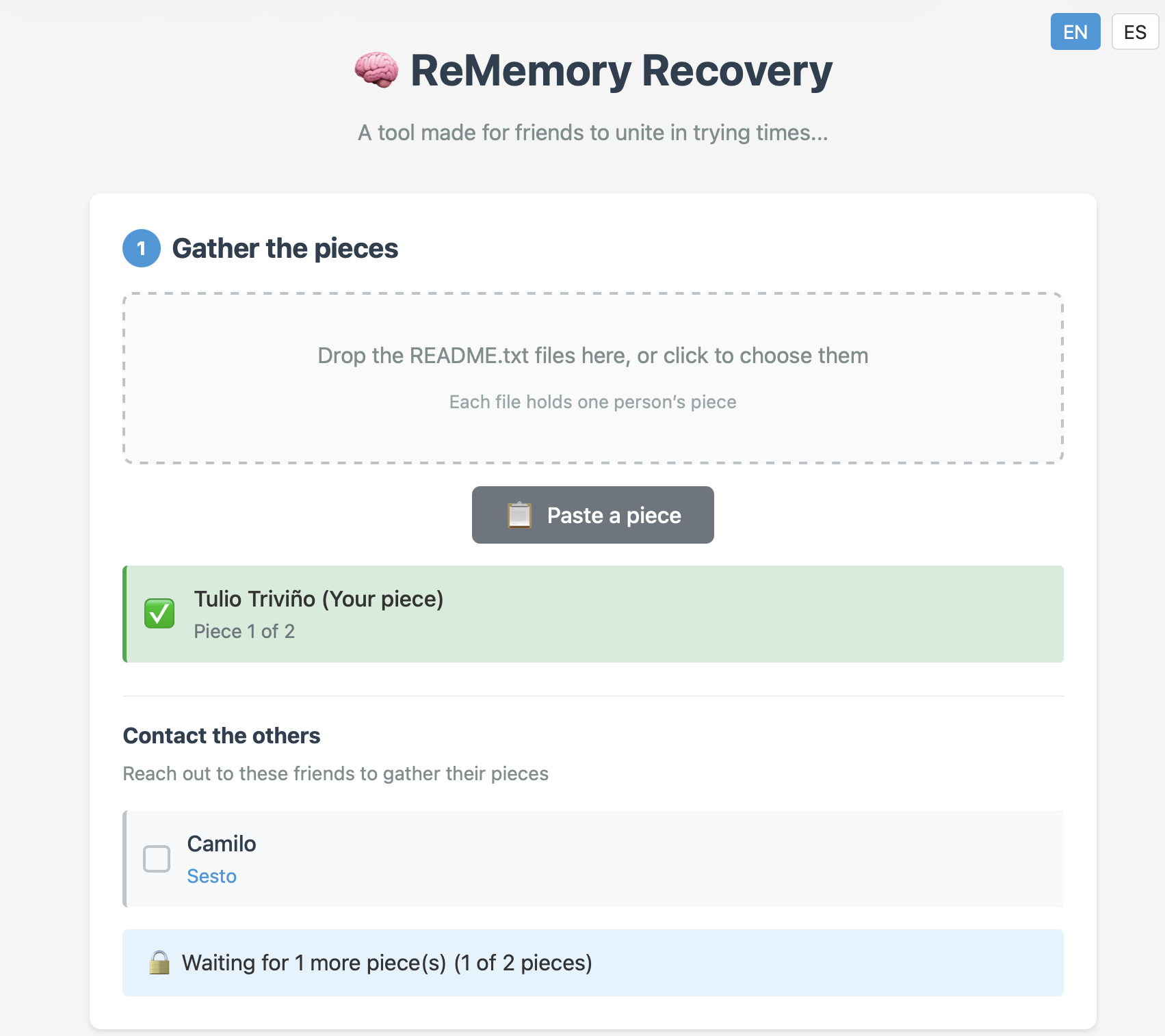
I combined shamir secret sharing (hashicorp vault's implementation) with age-encryption, and packaged it using WASM for a neat in-browser offline UX.
The idea is that if something happens to me, my friends and family would help me get back access to the data that matters most to me. 5 out of 7 friends need to agree for the vault to unlock.
Try out the demo in the website, it runs entirely in your browser!
Comments (233) 69 threads

Earlier comments
econ4 replies#
I like it. Perhaps you can use a weird idea of mine.

You can discard/modify part of a password before sending it to your backend. Then, when you log in the server has to brute force the missing part.
One could extend this with security questions like how many children pets and cars you own. What color was your car in 2024. Use that data to aid brute forcing.
The goal would be to be able to decrypt with fewer than 5 shards but make it as computation heavy as you like. If no one remembers the pink car it will take x hours longer.

eljojo1 reply#
ohhhh that's brutal haha! for context my app runs entirely clientside, but I get it, it's an interesting idea...
econ#
I wonder if they even need a file. They could pick some question and type their secret into the app, something like the name of their first date etc

If you are to hand out files maybe it is wonderful to write them a letter that serves as their shard? They might actually store it some place safe and it wouldn't scream I'M A SECRET!

digiown1 reply#
This makes little sense, IMO. Information is information. There is no difference between this and just having a short/simple passphrase with the PKBDF iterations turned very high. You might as well shard secrets using Shamir and encode it via a modified version of BIP32 words.
econ#
I'm no crypto expert, just fooling around.

The security questions are like extra shares of lower value.
My mental model is something like burying the password in your 100x100 yard. You give one friend the X and a different friend the Y coordinates both rounded down to a multiple of 10 meters. The security questions can be added to the X and Y coordinates.
X = 30 + 2 + 3 + 1
Y = ?? + 3 + 5 + 1
You only have to dig 9 holes now.

Yodel09141 reply#
We use Vaultwarden and Bitwarden to share passwords with the family. My wife has my master password and I have hers.

The bigger issue if I drop dead is all the nontrivial tech crap I have set up (self hosted Vaultwarden included…).

karussell2 replies#
Honest question: what is the benefit of such a specialized service compared to just an encrypted file with all your passwords that you share via some common file sharing service (hosted or self-hosted)
mawax#
A few years ago I switched from KeePass, with the database stored in Dropbox, to a SaaS password manager. My primary reasons where:

- No more sync conflicts when using multiple devices
- Backups are taken care off
- It's harder to steal the database
- Slightly better browser and mobile extensions for auto-filling passwords

Yodel0914#
Well, we already use password managers for all their benefits: autofill, syncing, password generation, passkey storage etc.

For a while we’re using `pass` which doesn’t have an easy way to share passwords, so my wife and I had duplicates of a handful of passwords, which was annoying when they changed, or when we needed to share a new one.
Moving to Bitwarden meant that we can have a set of passwords that are shared, and we can update or add to it. As the kids have gotten older, I’ve get them using it too, so we can share a small set of passwords with them (wifi, streaming services etc).

ddtaylor3 replies#
I suffered a traumatic brain injury (TBI) related to an e-bike accident two years ago. I woke up in the ICU after a short coma-like thing and the nurses/doctors asking me questions and it was clear I was answering for the 10th time or more, like we had all done this before, but I couldn't remember anything.

Thankfully my very long password I use for an encrypted Borgbackup I have was somewhere deep or untouched, but, otherwise I would have been fucked. Also, the backup codes Google told me they would always accept failed and it wasn't until I found a random unused Android device in a drawer that had been unused for a year was I able to get access back to my Google account of ~25 years.

ericbarrett2 replies#
I also had old Google backup codes fail a few years ago. Anybody who hasn't regenerated them in a year or two, I recommend you do so.
lucenet3 replies#
Well, this is disturbing news.
Zambyte#
Google services are best treated as a liability.
tencentshill#
Make Google Takeouts a part of your backup routine.
bornfreddy#
I have (had?) a Google account tied to my email (which is on a domain I own). Not sure if I ever gave them my phone number, initially. Tried to login a few years back, correct password, but they insisted on me entering my phone. Finally I did - and they can't let me in because my "provider is not supported" and they can't send an SMS with the code, so I'm locked out. Tried every few months since then, no go. Fortunately I didn't lose much (except some family photos), but it is annoying as hell. I wouldn't trust Google with anything important. And yes, I tried with an brand new number on a new phone, unrelated provider. No dice. According to reddit I'm far from alone in this. So if you rely on a Google account for anything... Well, good luck!
rektlessness1 reply#
Long-term access recovery typically requires rituals like annual check-ins, media rotation, and human drills. We already do this with annual fire-drills.
lucb1e#
My password manager has, *checks*, precisely 900 entries. Say that I care about maybe ten percent, that's still doing a "drill" on every single weekend day of the year

Security aspects of software should just work properly. Google should test this and, imo, people should make backups of data they care about. Google might ban you for any reason, no matter if the recovery drill worked 2 hours ago it might not work anymore now. Seems like a fool's errand to keep chasing it instead of making routine (or automated) backups of data when you update it

eljojo#
my stomach turned into a knot just reading your story. I know that feel of waking up surrounded by nurses not knowing what happened. I'm so glad you had proper backups!!!!!!!!!!

this exact story is why i built my app, thank you so much for sharing.
my hope is to basically make a next version of your plan that's distributed among friends.

lucb1e1 reply#
Wow, it both surprises me but also makes me feel justified in that I keep telling people to make backups of things they care about including something like a Spotify account (if your song lists are dear to them, at least the titles and other metadata that they could rebuild from) and other "cloud" or SaaS services. Anything one cares about, back it up! (Not to you but as a PSA)

Still, it's weird that Google doesn't accept a recovery code. Then again, I had a similar issue where I had nothing set up but a recovery email address and password (back when 2FA was rare), and after confirming both, Google said "well, we still think it's suspicious, why don't you use a device where you're already logged in" (my account had no active sessions that I knew of, besides that I was traveling). Luckily I didn't need it for anything as I had my email moved away already at that time. I still can't access that account today and I switched to throwaway accounts for things like youtube comments or app downloads from the play store (need to download that government authentication software somehow...)
Did Google specifically reject the recovery code as invalid, or did it accept all entries and then their algorithm rejected the login outright?

ddtaylor1 reply#
It accepted the backup code and my correct password and then wanted to verify more stuff, which there was nothing, and just said "Sorry, we can't give you access to your account right now".
lucb1e2 replies#
Ah, yes okay that sounds precisely like my situation as well. Not so much the backup codes not working as Google's auth gatekeeper being moody, the last thing you want from a login system

Continue this thread — 2 replies

KevinChasse1 reply#
Interesting approach. I like that this is explicit about human recovery rather than pretending crypto alone solves catastrophe. That said, this design and fully stateless systems like mine (deterministic derivation, no escrow) are solving opposite failure modes. Shamir-based social recovery assumes: trusted third parties remain reachable, they are willing and able to cooperate, and that recovery is an exceptional event. Stateless systems assume the inverse: no one can be relied on, recovery is impossible by design, and the primary threat is silent compromise rather than lockout. Neither is “better” universally; they’re value judgments. What I appreciate here is that the tradeoffs are made explicit instead of buried behind UX. One open question I’d be curious about: how you reason about coercion risk over time (friends change, incentives change), and whether you see this as something users should periodically re-shard as relationships evolve.
eljojo#
thanks for your thorough review and congrats on your launch! for my personal use case, I'm not worried about coercion, but many have highlighted it as a real risk. my answer to that is to do what you suggest: update my contact list yearly, send new ZIP files with bundles, and ask them to delete the previous ones.

Load more comments