Show HN: If you lose your memory, how to regain access to your computer? (opens in a new tab)eljojo.github.io
402 pointsDue to bike-induced concussions, I've been worried for a while about losing my memory and not being able to log back in.
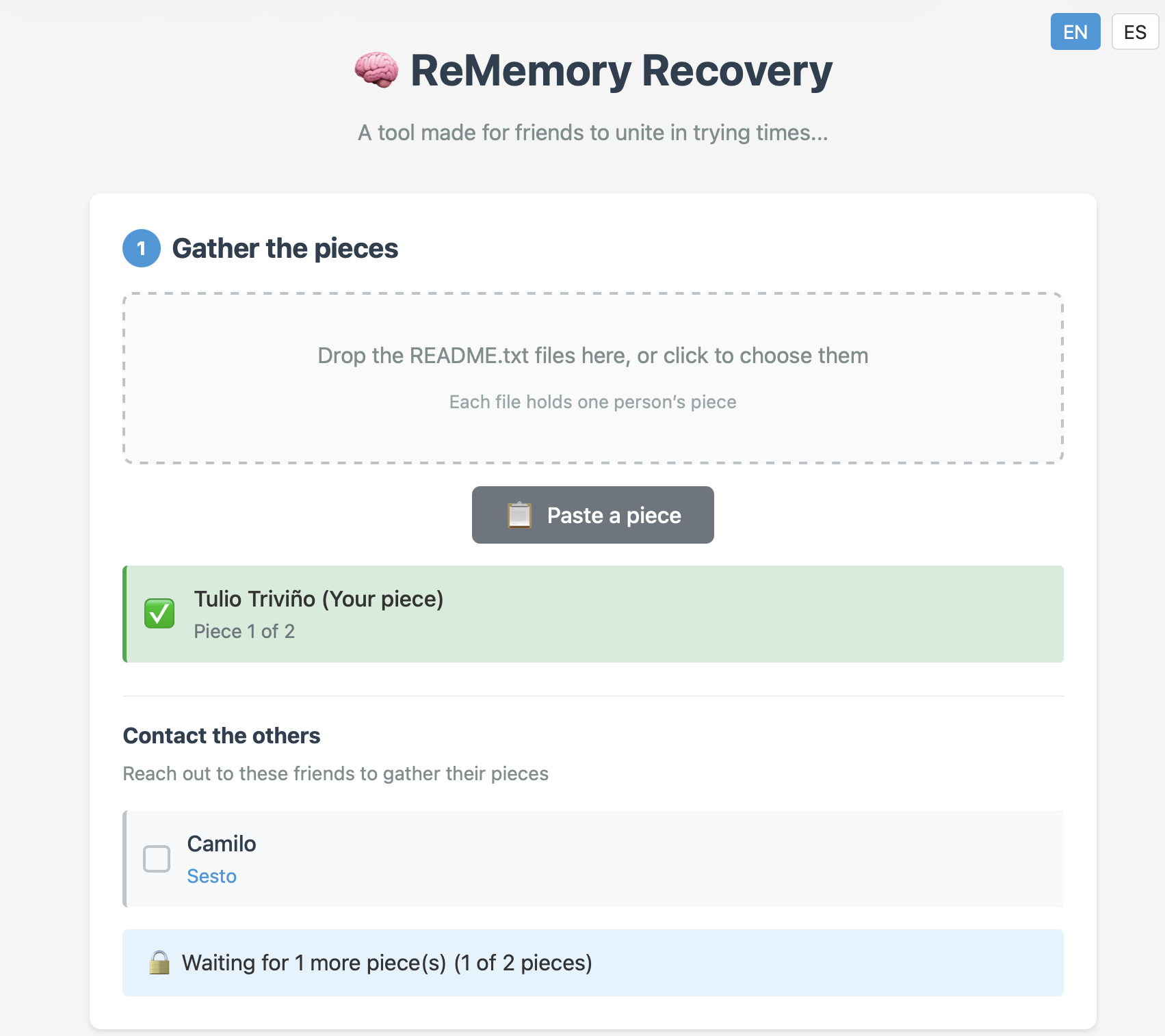
I combined shamir secret sharing (hashicorp vault's implementation) with age-encryption, and packaged it using WASM for a neat in-browser offline UX.
The idea is that if something happens to me, my friends and family would help me get back access to the data that matters most to me. 5 out of 7 friends need to agree for the vault to unlock.
Try out the demo in the website, it runs entirely in your browser!
Comments (233) 69 threads
Show all comments
Showing thread 3 of 69
In a lower trust scenario you could probably use a lawyer as a broker of the secret (potentially even as part of a will).
It would be nice if your Apple account could be unlocked with some other keys as well apart from the primary one, but I guess that is what Apple calls the “Legacy Contact Key”.
Edit: okay so the keychain is excluded from this. So back to storing each others passwords in eachothers keychain…
I like the idea of the lawyer, unlike normal people, they like sticking to their promises.
There are two rules: 1. You need to be a paying customer when setting up. 2. The other person needs to have a Bitwarden account.
On the internet, it's either: Public for anyone in the whole world, or impossible to recover if anything goes wrong.
In hindsight, looking harder for the key would probably have been fruitful.
Maybe the NSA would be willing to brute force the infinite variations from that starting seed, but it is still effectively locked for mortals.
Continue this thread — 3 replies
A bank safe deposit box offers a different security profile that’s probably more robust against fire because banks burn less often than houses.
It’s probably not practical to really be robust against fire without being buried several feet deep.
It's great if you want to store some documents. But don't expect _real_ security. It's guarded by a minimum-wage employee, and the keys are usually laughably insecure. Banks know this, so they cap their liability for the loss of the deposit box at around $1000.
So don't even think about storing gold bars there, like they do in movies.
There _are_ companies that provide safe storage for high-value items, but they are pretty exotic.
Continue this thread — 1 reply
ex: https://www.cbc.ca/news/safety-deposit-box-protection-1.7338...
https://archive.is/www.nytimes.com/2019/07/19/business/safe-...
Continue this thread — 5 replies
Continue this thread — 7 replies
In December 2025, items worth an estimated €30 million were stolen from a Sparkasse bank in the Gelsenkirchen suburb of Buer, Germany. The thieves used a large drill to break into the bank's underground vault and proceeded to crack over 3,000 safe deposit boxes.
The vast majority of these don’t make the news because there’s no proof there was even anything inside the box in the first place so anyone could be lying.
> Mr. Pluard, who tracks legal filings and news reports, estimates that around 33,000 boxes a year are harmed by accidents, natural disasters and thefts.
> Oddly, the bank returned to him five watches that weren’t his. “They were the wrong color, the wrong size — totally different than what I had,” Mr. Poniz said. “I had no idea where they came from.”
https://archive.is/j8e6x
Continue this thread — 2 replies
While the fire resulted in the total loss of the house it was actually the water from the fire department not the heat that did proportionally more damage.
As a mental model you shouldn’t think of it as “what if my house burns down?” so much as “what if nice strangers roll up to my windows and chainsaw through my roof and spray 50,000 gallons of water in here?”
Yes everything in the mechanical room melted but everything in the rest of the house got hot, smoky, soaked and then moldy.
For root of trust materiel like social security cards, cash, passports put in a ziplock bag in a fireproof, waterproof safe. But for other storage I use clear “Ezy Storage” brand stackable 50L tubs labeled with Homebox QR codes. In the US, Target and Home Depot frequently stock them. I am very anti black and yellow tubs.
The majority of work post-fire goes to itemizing your house inventory for insurance. Even cataloging all your bathroom’s soaps by brand name rather than generic can make $100 difference. Multiply that by 500x different things.
From a threat model perspective I look at rooms from a “what would be salvageable in here if I emptied a swimming pool’s worth of water from some fire sprinklers”. Furniture and TVs are easy to replace. Other stuff less so.
1500/piece for 20 junk windows I was building a greenhouse with that I dug out of the trash the year before. $250 for a bird feeder because they couldn't find one outside of specialty stores. $40k instead of 10k for a new roof on the shed because it was heavier gauge metal than standard.
Exact replacements can be expensive, but you need to make sure your insurance has 100% replacement instead of adjusted for age or like-kind replacements.
After that experience, we itemized EVERYTHING in the house with make, model, serial number, and color. It was a bitch to get set up, but took the value of our home contents from around 75k to over 250k for exact replacements.
Copies of these records along with our master password for our keepass database are in two bank deposit boxes about 45 minutes apart. For $50/year we can sleep easy.
Continue this thread — 5 replies
Would you mind sharing more about these tubs and why you are against them?
Continue this thread — 3 replies
Continue this thread — 2 more replies
Continue this thread — 7 more replies
Continue this thread — 2 more replies