Show HN: I built a sub-500ms latency voice agent from scratch (opens in a new tab)ntik.me
570 pointsI built a voice agent from scratch that averages ~400ms end-to-end latency (phone stop → first syllable). That’s with full STT → LLM → TTS in the loop, clean barge-ins, and no precomputed responses.
What moved the needle:
Voice is a turn-taking problem, not a transcription problem. VAD alone fails; you need semantic end-of-turn detection.
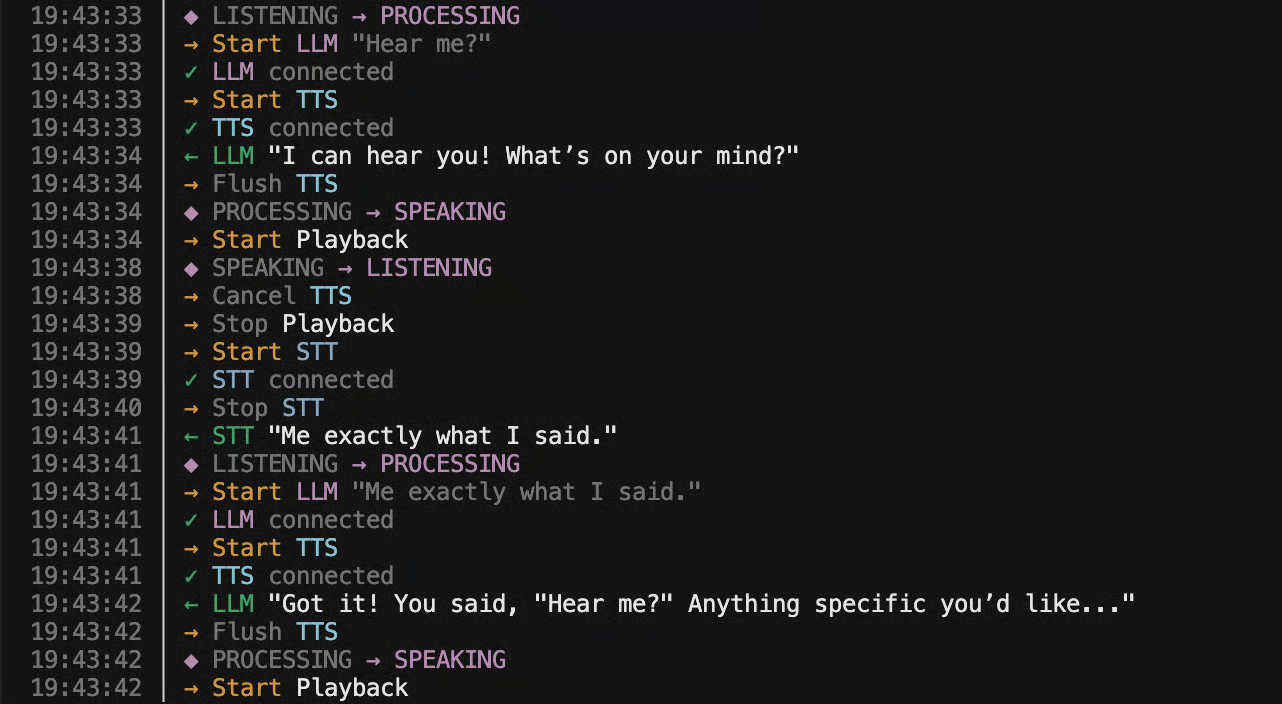
The system reduces to one loop: speaking vs listening. The two transitions - cancel instantly on barge-in, respond instantly on end-of-turn - define the experience.
STT → LLM → TTS must stream. Sequential pipelines are dead on arrival for natural conversation.
TTFT dominates everything. In voice, the first token is the critical path. Groq’s ~80ms TTFT was the single biggest win.
Geography matters more than prompts. Colocate everything or you lose before you start.
GitHub Repo:
https://github.com/NickTikhonov/shuo
Follow whatever I next tinker with: https://x.com/nick_tikhonov
Comments (153) 62 threads
Earlier commentshttps://ttslab.dev/voice-agent
I also have a setting in mr_sip to use gpt-realtime via plugin ah_openai, which is very low latency speech-to-speech but quite expensive.
But my client saw the Sesame demo page, and so now I am trying to fine tune PersonaPlex.
The "turn-taking problem, not transcription problem" framing is exactly right. We burned weeks early on optimizing STT accuracy when the actual UX killer was the agent jumping in mid-sentence or waiting too long. Switching from fixed silence thresholds to semantic end-of-turn detection was night and day.
One dimension I'd add: geography matters even more when your callers are in a different region than your infrastructure. We serve callers in India connecting to US-East, and the Twilio edge hop alone adds 150-250ms depending on the carrier. Region-specific deployments with caller-based routing helped a lot.
The barge-in teardown is the part most people underestimate. It's not just canceling LLM + TTS — if you have downstream automation (updating booking state, triggering webhook workflows, writing to DB), you need to handle the race condition where the system already committed to a response path that's now invalid. We had a bug where a barged-in appointment confirmation was still triggering the downstream booking pipeline.
All comments shown.
Couldn't load more comments. Check your connection and try again.