Show HN: I built a sub-500ms latency voice agent from scratch (opens in a new tab)ntik.me
570 pointsI built a voice agent from scratch that averages ~400ms end-to-end latency (phone stop → first syllable). That’s with full STT → LLM → TTS in the loop, clean barge-ins, and no precomputed responses.
What moved the needle:
Voice is a turn-taking problem, not a transcription problem. VAD alone fails; you need semantic end-of-turn detection.
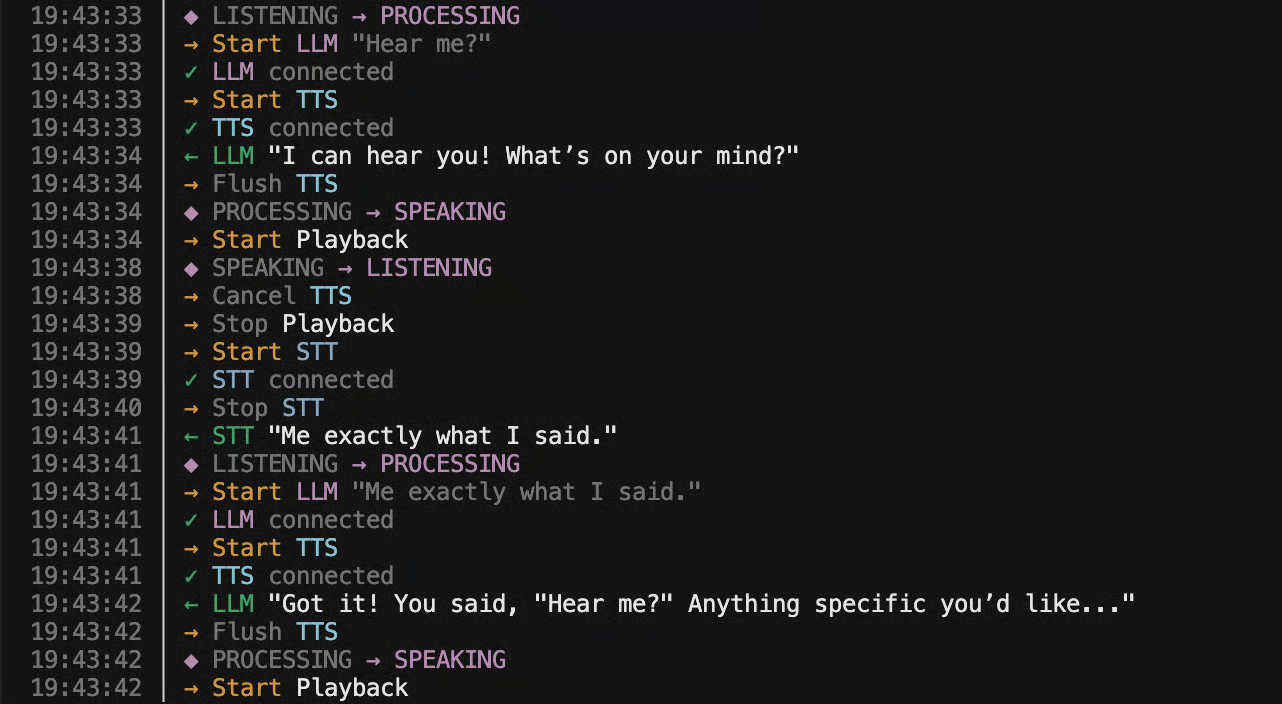
The system reduces to one loop: speaking vs listening. The two transitions - cancel instantly on barge-in, respond instantly on end-of-turn - define the experience.
STT → LLM → TTS must stream. Sequential pipelines are dead on arrival for natural conversation.
TTFT dominates everything. In voice, the first token is the critical path. Groq’s ~80ms TTFT was the single biggest win.
Geography matters more than prompts. Colocate everything or you lose before you start.
GitHub Repo:
https://github.com/NickTikhonov/shuo
Follow whatever I next tinker with: https://x.com/nick_tikhonov
Comments (153) 62 threads
Earlier commentshttps://research.nvidia.com/labs/adlr/personaplex/
Is it super sexy? No. But each individual type of model is developing at a different rate (TTS moves really fast, low latency STT/ASR moved slower, LLMs move at a pretty good pace).
Just use the same tricks humans are using for that.
The cascading model (STT -> LLM -> TTS), is unlikely to go away anytime soon for a whole lot of reasons. A big one is observability. The people paying for voice agents are enterprises. Enterprises care about reliability and liability. The cascading model approach is much more amenable to specialization (rather than raw flexibility / generality) and auditability.
Organizations in regulated industries (e.g. healthcare, finance, education) need to be able to see what a voice agent "heard" before it tries to "act" on transcribed text, and same goes for seeing what LLM output text is going to be "said" before it's actually synthesized and played back.
Speech-to-Speech (end-to-end) models definitely have a place for more "narrative" use cases (think interviewing, conducting surveys / polls, etc.).
But from my experience from working with clients, they are clamoring for systems and orchestration that actually use some good ol' fashioned engineering and that don't solely rely on the latest-and-greatest SoTA ML models.
Carmack's 2013 "Latency Mitigation Strategies" paper[0] made the same point for VR too: every millisecond hides in a different stage of the pipeline, and you only find them by tracing the full path yourself. Great find with the warm TTS websocket pool saving ~300ms, perfect example of this.
[0]: https://danluu.com/latency-mitigation/
The one spot where it feels a bit off is the "2x faster than Vapi" claim. Your system is a clean straight pipe: transcript -> LLM -> TTS -> audio. No tool calls, no function execution, no webhooks, no mid-turn branching.
Production platforms like Vapi are doing way more work on every single turn. The LLM might decide to call a tool—search a knowledge base, hit an API, check a calendar—which means pausing token streaming, executing the tool, injecting the result back into context, re-prompting the LLM, and only then resuming the stream to TTS. That loop can happen multiple times in a single turn. Then layer on call recording, webhook delivery, transcript logging, multi-tenant routing, and all the reliability machinery you need for thousands of concurrent calls… and you’re comparing two pretty different workloads.
The core value of the post is that deep dive into the orchestration loop you built yourself. If it had just been "here’s what I learned rolling my own from scratch," it would’ve been an unqualified win. The 2x comparison just needs a quick footnote acknowledging that the two systems aren’t actually doing the same amount of work per turn.
I am using it daily to drive Claude and it works really-well for me (much better than macOS dictation mode).
All comments shown.
Couldn't load more comments. Check your connection and try again.